


Reverse ETL has quietly become one of those tech topics that sounds backwards until you realize it fixes the things you actually care about — like sales teams having up-to-date customer scores, marketers personalizing campaigns without spreadsheets, and support reps seeing the full customer context in their apps. In this article I’ll explain what reverse ETL is, how it differs from traditional ETL (and CDPs), practical use cases, and how to avoid common pitfalls when rolling it out. If you want your data to stop living in a warehouse tomb and start doing useful work, you’re in the right place.
What is reverse ETL?
Reverse ETL is the process of taking transformed, modeled data from your centralized data warehouse or lake and sending it out to operational systems — CRMs, marketing platforms, customer success tools, ad platforms, and more. Instead of extracting raw source data, transforming it, and loading it into a warehouse (traditional ETL), reverse ETL moves curated, business-ready datasets back to the frontline tools where people make daily decisions.
Think of the data warehouse as the company’s brain and the operational apps as muscles. Reverse ETL is the nervous system that delivers insights from brain to muscles so the whole body can move in sync. For a practical breakdown of how the process works and examples, see Domo’s process guide on reverse ETL.
Why it matters for your business
Organizations invest in data warehouses and analytics to answer strategic questions. But analytics becomes truly valuable when it changes behavior and actions in operational workflows. Reverse ETL operationalizes analytics by syncing the right, trusted data into the tools your teams use every day. That could mean:
- Auto-updating lead scores in your CRM so sales prioritizes the right prospects.
- Feeding product usage signals into support tools so reps troubleshoot faster.
- Syncing segments and attributes to ad platforms for better-targeted campaigns.
Multiple vendors and thought leaders highlight these benefits: Matillion outlines how automated flows reduce manual reporting, while Dinmo emphasizes use cases for personalization and streamlined business processes. When analytics lives only in dashboards, its impact is limited. Reverse ETL closes that loop.
How reverse ETL fits into the modern data stack
Reverse ETL sits downstream of your warehouse. The pipeline looks like: data ingestion → transformation/modeling in the warehouse → reverse ETL syncs curated datasets to operational systems. This pattern keeps trusted business logic centralized while letting frontline teams act on the same source of truth.
ETL vs. reverse ETL
Traditional ETL (extract, transform, load) pulls source data into a centralized store for analysis. Reverse ETL does the opposite: it takes curated, analytics-ready data and loads it into source-of-action systems. They’re complementary — ETL centralizes and models, reverse ETL operationalizes.
For a clear comparison and practical use-case breakdown, RudderStack provides a useful primer on customer data activation and syncing to CRMs and marketing tools.
Common use cases and a concrete example
Reverse ETL fits wherever operational teams need enriched data. Common use cases include:
- CRM enrichment: Add behavioral signals, propensity scores, and churn risk to contact and account records so sales and CS act on current insights.
- Marketing personalization: Sync segments and user attributes to marketing automation and ad platforms for tailored experiences and better ROI.
- Support and success workflows: Provide product telemetry and SLA status directly in ticketing systems for faster, more informed service.
- Finance and ops automation: Feed upstream billing or fulfillment systems with analytics-driven adjustments (e.g., credit limits, discount eligibility).
Example: A SaaS company uses reverse ETL to push a real-time churn-risk score from the warehouse into Salesforce. Sales reps receive alerts when a high-value account’s health drops, enabling proactive outreach and tailored retention offers. Many vendor guides show similar scenarios — see Dinmo’s use cases for operational sync patterns and Matillion’s guide to automating flows.
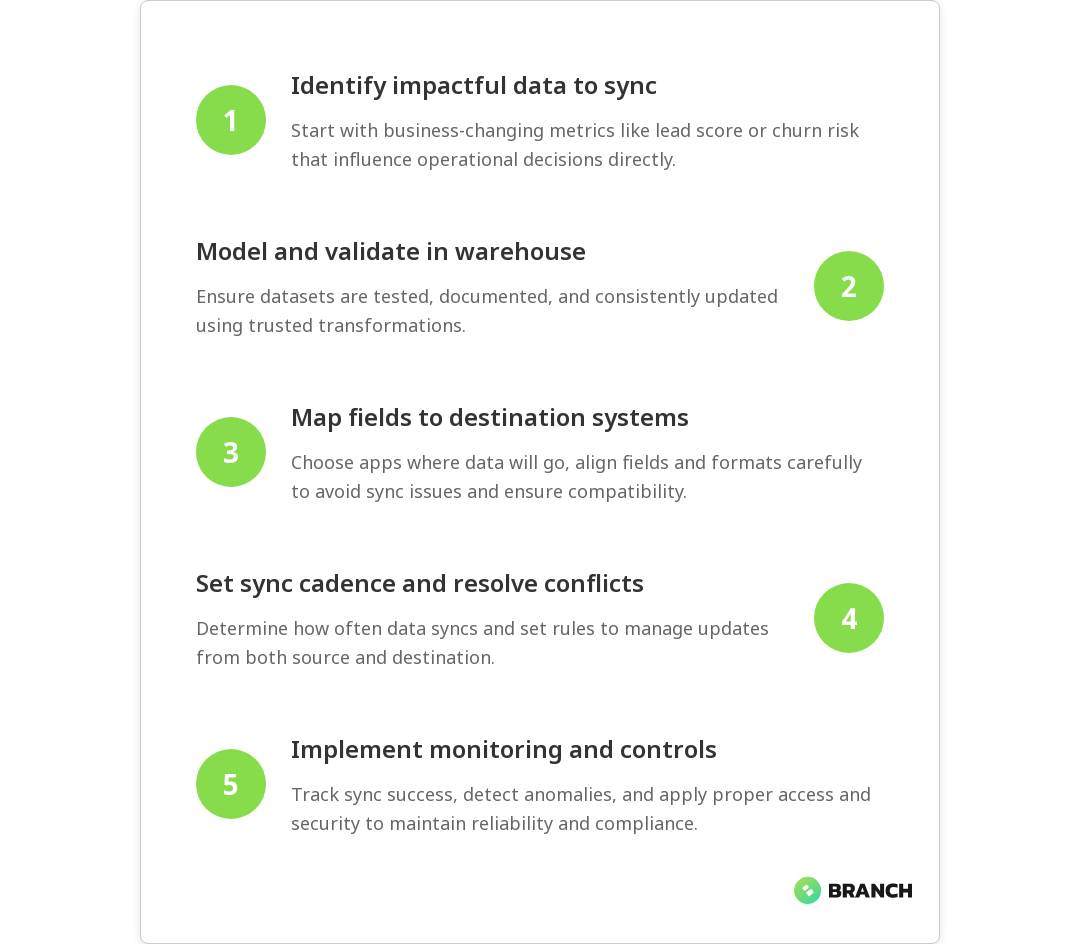
How to implement reverse ETL (practical steps)
Implementing reverse ETL is more of a people-and-process project than a pure technology install. Here’s a practical roadmap:
- Identify high-value datasets to sync: Start with metrics that will change a clear business action (e.g., lead score, churn risk, LTV).
- Model and validate in the warehouse: Ensure your dataset is tested, documented, and updated by a reliable process (ideally using the same transformations your analytics team trusts).
- Choose destinations and map fields: Match warehouse columns to destination object fields, respecting data types and rate/size limits.
- Decide sync cadence and conflict rules: Near real-time vs. batch depends on use case and destination API limits; define how to resolve updates from either side.
- Automate monitoring and observability: Track sync success rates, latency, and schema changes so incidents are caught early.
- Govern and secure: Apply access controls, encryption, and error-handling to protect PII and comply with regulations.
Tools and vendor features vary — Integrate.io highlights the importance of automated pipelines and governance, and Matillion discusses operational analytics to reduce manual work. Whatever tool you pick, ensure it supports the destinations and scale you need.
Common challenges (and how to avoid them)
Reverse ETL brings useful data to the front lines, but there are pitfalls:
- Data freshness vs. cost: Near real-time syncs are great, but API costs and rate limits can bite. Balance cadence with business impact.
- Schema drift and mapping errors: Changes to the warehouse model or destination schema break syncs. Version and test changes with a staging environment.
- Duplicate or conflicting records: Ensure deduplication logic and consistent identifiers (e.g., universal customer ID) across systems.
- Security and compliance: Pushing PII increases compliance surface area. Use encryption, scoped credentials, and strict audit logs.
- Operational ownership: Who owns the synced data — analytics, ops, or the consuming team? Define clear responsibilities and SLAs.
Address these issues with governance, observability, and clear operational processes. Vendors like Integrate.io and Matillion emphasize governance and automated observability as key to scaling safely.
Trends and what’s next
Reverse ETL continues to evolve as part of the larger trend to operationalize data. A few directions to watch:
- Streaming and lower-latency syncs for operational AI and real-time personalization.
- Stronger governance and data contracts to handle multi-team ownership and compliance.
- AI-driven orchestration that recommends which datasets to sync and optimizes cadence based on business impact.
Vendors and guides suggest that as analytics and AI move from insight generation to action automation, reverse ETL will be central to delivering trusted signals into action systems. Domo and Matillion both highlight the role of operational analytics, and Integrate.io underscores governance as adoption scales.
FAQ
What is reverse ETL?
Reverse ETL exports curated, modeled data from your warehouse or lake into operational systems like CRMs, marketing platforms, or support tools. This enables teams to act on insights directly within their daily workflows.
How is reverse ETL different from ETL?
ETL (extract, transform, load) centralizes raw source data into a warehouse for analysis. Reverse ETL pushes analytics-ready data back out to frontline systems so it can power real-time actions and decisions.
What are common use cases for reverse ETL?
Typical use cases include CRM enrichment (adding churn risk or scores), marketing personalization (sending segments to ad platforms), support workflows (embedding product signals in tickets), and finance automation (feeding billing systems).
Can you give an example?
A SaaS company calculates a churn-risk score in its warehouse. Reverse ETL syncs that score into Salesforce so sales reps can proactively reach out to at-risk accounts with tailored offers.
How does reverse ETL compare to a CDP?
CDPs focus on collecting and unifying customer data, with some activation features. Reverse ETL instead treats the warehouse as the source of truth and distributes curated datasets into tools. Both overlap in activation, but their architectures differ.