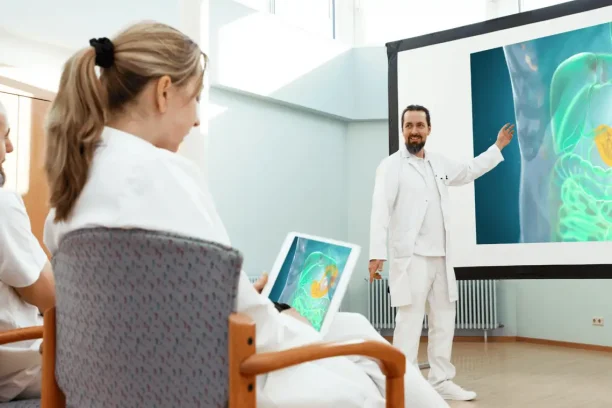

Picture this: you’re trying to explain how a new cardiac stent works to a patient who’s undergoing their first procedure. Or maybe you’re training medical residents on the intricate mechanisms of cellular mitosis. Static diagrams and lengthy text explanations can only go so far. This is where medical animation steps in as a game-changer, transforming abstract biological processes into clear, engaging visual stories that both patients and healthcare providers can actually understand.
For B2B organizations in healthcare—whether you’re developing training programs, patient education platforms, or professional development tools—medical animation is rapidly gaining prominence as vital communication infrastructure. Market reports show strong growth in the medical animation sector, driven by increasing recognition of its value in patient education, clinician training, and simplifying complex medical information.
Why Traditional Medical Communication Falls Short
Healthcare communication faces a unique challenge: bridging the gap between highly technical scientific concepts and the varied technical backgrounds of audiences. Consider the typical scenario where a pharmaceutical company needs to train sales teams on a new drug’s mechanism of action, or a medical device manufacturer must educate surgeons on a complex procedure.
Research shows that poor communication in healthcare is associated with serious consequences. Studies document communication failures leading to medical errors, patient dissatisfaction, and preventable deaths. Traditional approaches often contribute to these problems because they rely heavily on:
- Static 2D diagrams that can’t show process flows or temporal changes
- Text-heavy explanations that assume prior technical knowledge
- Live demonstrations that can be risky for patient safety, face scalability challenges due to staffing constraints, and are difficult to repeat consistently
- Generic stock imagery that doesn’t reflect specific products or procedures
The result? Communication breakdowns that impact patient outcomes and training effectiveness. Medical animation addresses these pain points by making the invisible visible and the complex intuitive.
The Science Behind Visual Learning in Healthcare
Medical animation works because it aligns with how our brains naturally process complex information. Systematic reviews demonstrate that visual-based interventions significantly improve comprehension of health-related material over text or traditional methods, with particularly strong results for spatial relationships, sequential processes, and cause-and-effect mechanisms that define most medical concepts.
But not all medical animations are created equal. The most effective ones share several key characteristics, with scientific accuracy being paramount. Professional medical animation requires strict adherence to current medical literature and clinical guidelines, involving expert physician review and maintaining precise anatomical proportions and molecular structures.
- Accurate scientific representation: Every detail must be medically precise, from molecular structures to anatomical proportions
- Progressive disclosure: Complex processes are broken down into digestible steps that build understanding incrementally
- Interactive elements: Viewers can control pacing, explore different scenarios, or focus on specific aspects
- Context-appropriate detail: The level of technical detail matches the audience’s needs and expertise
What the research says
The evidence base for medical animation effectiveness continues to grow, offering insights into when and how these tools work best:
- Knowledge retention shows clear benefits: Multiple systematic reviews confirm that animation videos significantly improve short-term health information recall compared to traditional text-based methods, with particularly strong results in patient education settings.
- Visual learning advantages are well-documented: Research consistently shows people retain visual information significantly better than text alone, especially for spatial relationships and sequential processes that are common in medical education.
- Effectiveness varies by context: While knowledge outcomes are consistently positive, behavioral outcomes and long-term retention show more mixed results across different healthcare settings and audiences.
- Success metrics need careful consideration: Evidence supports measuring knowledge retention and user satisfaction, but comprehensive evaluation frameworks that include engagement metrics and cost-effectiveness remain limited in the research literature.
Technical Architecture: Building Effective Medical Animations
Creating medical animations that actually work requires careful consideration of both technical infrastructure and user experience. Based on real-world implementation feedback, successful projects typically follow a layered approach that balances visual fidelity with practical usability.
The technical foundation usually involves several key components working together:
| Component | Purpose | Key Considerations |
|---|---|---|
| 3D Modeling & Simulation | Create accurate anatomical or molecular representations | Medical accuracy, detail level, file size optimization |
| Interactive Engine | Handle user interactions, variable changes, scenario branching | Cross-platform compatibility, loading times, intuitive controls |
| Content Management | Update medical information, track usage, manage versions | Regulatory compliance, audit trails, scalability |
| Delivery Platform | Distribute to end users across different devices and contexts | Bandwidth requirements, offline capabilities, integration with existing systems |
For interactive medical animations specifically, the choice of development environment becomes crucial. Game engines like Unity or Unreal Engine are widely used in healthcare applications because they’re designed to handle real-time rendering, complex simulations, and user interactions—exactly what medical animations need to be engaging and educational. Unity is particularly favored for its cross-platform compatibility and integration with medical imaging tools, while Unreal excels in photorealistic rendering for surgical simulations.
Read more: Explore our approach to creating effective educational videos and animations.
Implementation Strategies: From Concept to Deployment
Successfully implementing medical animation projects requires navigating both technical and organizational challenges. The most successful projects we’ve observed follow a structured approach that addresses stakeholder alignment, content accuracy, and scalability from the outset.
Phase 1: Requirements Gathering and Stakeholder Alignment
This phase involves multiple stakeholders with different priorities and success metrics—clinical experts who verify accuracy, learners who need to understand concepts, and often regulatory bodies who must approve content. Professional sources emphasize that establishing clear goals and ensuring everyone is aligned from the start is crucial to avoiding project misalignment and failure.
Phase 2: Content Strategy and Information Architecture
Before any animation work begins, successful projects map out the learning journey. This involves breaking complex medical concepts into logical progressions, identifying decision points where users might need different levels of detail, and planning for how the content will be updated as medical knowledge evolves.
Phase 3: Technical Development and Testing
This is where tool selection becomes critical. Teams often find that combining specialized medical visualization tools (like Houdini for complex simulations) with more accessible game engines (like Unity for user interfaces) provides the best balance of capability and maintainability.
Key technical decisions typically include:
- Real-time rendering vs. pre-rendered sequences (affects interactivity but impacts performance)
- Platform targeting (web-based for accessibility vs. native apps for performance)
- Content delivery strategy (streaming for updated content vs. offline for reliability)
- Integration requirements (LMS compatibility, data tracking, single sign-on)
When to Build, Buy, or Partner
The decision of how to approach medical animation development depends heavily on your organization’s specific context, resources, and long-term strategy. There’s no universal “best” approach, but there are clear indicators that point toward different paths.
Build In-House When:
- Your organization has ongoing, high-volume animation needs
- You have existing 3D design or game development capabilities
- Content requires frequent updates due to evolving medical research
- Regulatory requirements demand tight control over the development process
Partner with Specialists When:
- You need high-quality results quickly without building internal capabilities
- The project requires specialized medical visualization expertise
- You’re dealing with complex integrations across multiple systems
- Your team lacks experience in interactive media development
Many successful organizations find that a hybrid approach works best—partnering with experienced teams for initial development while building internal capabilities for ongoing content updates and maintenance.
Measuring Success and ROI
Medical animation projects need clear success metrics from the beginning. Unlike traditional marketing content, educational animations in healthcare settings can be measured against specific learning outcomes and behavioral changes.
Research supports several key metrics, though the evidence varies in strength:
- Knowledge retention rates compared to traditional training methods: Well-documented in systematic reviews as a reliable measure of animation effectiveness
- Time-to-competency for new concepts or procedures: Some studies show positive results, though evidence is more limited
- User satisfaction and engagement metrics: Measured in several studies with mixed findings, including completion rates, replay frequency, and interaction depth
- Patient satisfaction scores when animations are used in clinical settings: Evidence shows promise but remains inconsistent across different contexts
While early evidence suggests that effective medical animation projects can demonstrate improvements in learning outcomes, comprehensive data on cost reduction compared to traditional training approaches is still emerging.
Working with the Right Development Partner
When partnering with a development team for medical animation projects, look for organizations that understand both the technical challenges and the unique requirements of healthcare communication. The best partners bring together medical accuracy, technical capability, and user experience design in a way that serves your specific organizational goals.
A thoughtful development partner will help you navigate the complex decisions around tool selection, content strategy, and technical architecture while ensuring that the final product actually improves learning outcomes for your intended audience. They should also understand the importance of regulatory compliance, audit trails, and the iterative nature of medical content development.
Whether you’re developing patient education materials, professional training programs, or complex medical simulations, the right combination of strategy, design, and technical execution can transform how your organization communicates complex scientific concepts.
FAQ
What's the difference between medical animation and regular 3D animation?
Medical animation requires strict adherence to scientific accuracy, often involves complex biological processes that don't exist in the physical world, and must serve educational rather than just aesthetic purposes. The development process typically involves medical experts for content validation and regulatory review processes that regular animation projects don't face.
How do we ensure medical animations stay current with evolving research?
Build animations with modular content architecture that allows for updates without complete rebuilds. Plan for version control and establish review cycles with medical experts. Consider using content management systems that can handle dynamic updates to text and supporting materials while maintaining the core visual elements.
What technical skills does our team need to maintain interactive medical animations?
For basic content updates, teams typically need familiarity with content management systems and basic 3D software. For more complex modifications, you'll want someone comfortable with game engines like Unity or Unreal Engine. Consider training existing team members or establishing partnerships for more technical maintenance needs.
How long does it typically take to develop medical animations?
Timeline varies significantly based on complexity and accuracy requirements. Simple educational animations might take 4-8 weeks, while complex interactive simulations can require 3-6 months or more. Factor in time for medical expert review cycles, regulatory approval if needed, and testing with actual users before finalizing timelines.
What's the best way to measure if medical animations are actually improving learning outcomes?
Use pre- and post-training assessments to measure knowledge retention, track completion rates and user engagement metrics, and compare training time requirements to previous methods. For patient-facing content, measure comprehension through follow-up questions and satisfaction surveys. Establish baseline metrics before implementing animations to demonstrate clear improvement.