


If you’ve ever found yourself in a meeting where someone says “we need to fix our brand” and half the room starts talking about logos while the other half debates market positioning, you’ve witnessed one of the most common mix-ups in business: confusing brand identity with brand strategy.
This isn’t just semantic nitpicking. The distinction between brand identity and brand strategy affects how you allocate resources, structure projects, and measure success. For B2B leaders evaluating branding initiatives—whether you’re a CMO planning a rebrand, a product owner launching a new offering, or an ops leader standardizing company communications—understanding this difference is crucial for making smart decisions about what to build, buy, or partner on.
Let’s clear up the confusion and give you a framework for approaching brand work that actually moves the needle.
The Core Distinction: Strategy First, Identity Second
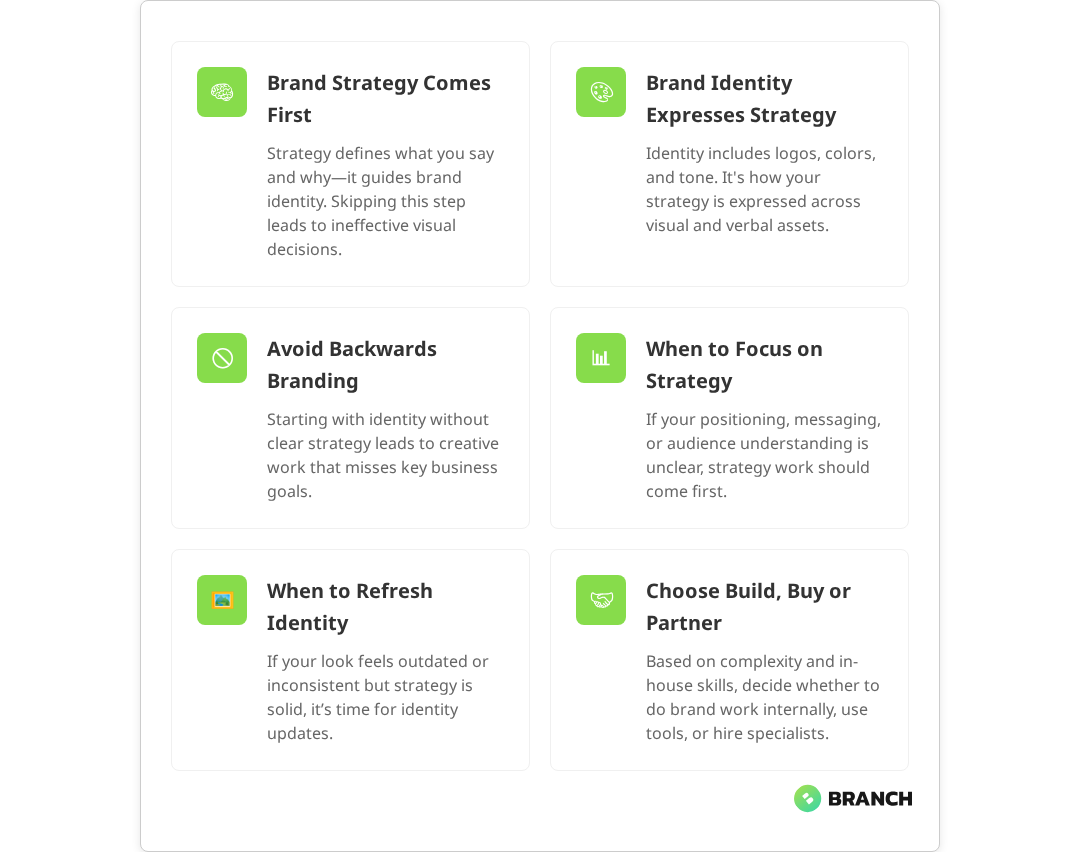
Brand strategy is what you say and why you say it. Brand identity is how you say it. Multiple branding experts agree that strategy serves as the blueprint while identity handles the construction—you need solid architectural plans before you start picking paint colors.
Brand strategy encompasses your positioning in the market, your value proposition, your audience definition, and the key messages that differentiate you from alternatives. Professional branding guides consistently highlight these as core components of effective brand strategy. It’s the invisible foundation that informs every communication decision.
Brand identity, on the other hand, is the tangible expression of that strategy. It includes your visual elements (logo, colors, typography), your voice and tone, imagery style, and all the creative assets that make your brand recognizable and memorable. Research shows these elements work together to create consistent brand recognition across all touchpoints.
| Brand Strategy | Brand Identity |
|---|---|
| Market positioning | Logo and visual marks |
| Value proposition | Color palette and typography |
| Audience definition | Photography and illustration style |
| Key messaging framework | Voice, tone, and writing style |
| Competitive differentiation | Website design and user interface |
| Brand promise and values | Marketing materials and templates |
Why the Confusion Happens (And Why It Matters)
The brand identity versus brand strategy mix-up is so common because many organizations approach branding backwards. Industry research shows that businesses often start with the visible stuff—”we need a new logo”—without first establishing the strategic foundation. It’s like building a house starting with the shutters.
This approach creates several problems:
- Creative without direction: Design teams end up guessing at what the brand should communicate, leading to beautiful work that doesn’t serve business goals.
- Inconsistent messaging: Without a clear strategic framework, different teams develop different ways of talking about the company, confusing prospects and customers.
- Wasted resources: Organizations invest in identity refresh projects that don’t move key metrics because they haven’t addressed underlying positioning problems.
- Difficulty measuring success: When strategy and identity blur together, it becomes impossible to determine which elements are working and which need adjustment.
The most successful brand initiatives start with strategy work to establish clear positioning and messaging, then translate that foundation into cohesive identity systems. This sequence ensures that every creative decision serves a strategic purpose.
What the research says
- Professional branding research consistently shows that brand strategy must precede identity development to ensure alignment with business objectives.
- Multiple studies indicate that organizations starting with visual elements before establishing strategic foundations risk creating work that doesn’t serve long-term business goals.
- Evidence suggests that clear strategic frameworks prevent the common problem of different teams developing inconsistent messaging that confuses prospects.
- Early research indicates that companies focusing solely on identity refreshes without addressing strategic positioning often fail to move key business metrics, though more comprehensive studies are needed to quantify this impact.
When You Need Strategy vs When You Need Identity
Understanding which type of brand work you need starts with honest assessment of your current state. Here are the key indicators:
You Likely Need Brand Strategy Work When:
- Sales teams struggle to explain what makes you different from alternatives
- Marketing messages feel generic or could apply to any company in your space
- You’re entering new markets or launching significantly different products
- Leadership can’t agree on who your ideal customer is
- Your value proposition hasn’t been updated in years despite market changes
- Prospects understand what you do but don’t understand why they should choose you
You Likely Need Brand Identity Work When:
- Your visual brand feels outdated or doesn’t match your strategic positioning
- Different teams are creating materials that don’t look cohesive
- Your current identity doesn’t work well across digital channels
- You have clear messaging but lack consistent ways to express it visually
- Your brand feels too generic or doesn’t stand out in your category
- You’re struggling to maintain consistency as you scale
The Strategic Foundation: Getting Your Positioning Right
Strong brand strategy starts with understanding your competitive landscape and defining where you fit within it. This isn’t about being different for the sake of being different—it’s about identifying the specific value you provide that others don’t, and to whom that value matters most.
The most effective brand strategies address four core questions:
- Who exactly are we serving? Not just demographics, but psychographics—what drives their decisions, what problems keep them up at night, and how they prefer to evaluate solutions.
- What unique value do we provide? This goes deeper than features and benefits to the fundamental outcomes customers achieve by choosing you.
- How do we prove that value? What evidence, credentials, or proof points support your claims?
- Why should people believe us? What gives you the right to make these claims, and what builds trust with your audience?
Good strategy work also involves understanding the broader context your brand operates in—industry trends, regulatory changes, technological shifts, and evolving customer expectations. Brands that ignore this context risk positioning themselves against yesterday’s competition instead of tomorrow’s.
Building Identity That Serves Strategy
Once you have clear strategic direction, identity development becomes much more focused. Instead of subjective aesthetic debates, you can evaluate creative options based on how well they communicate your strategic positioning.
Effective brand identity systems work across multiple dimensions:
Visual Consistency
Your logo, colors, typography, and imagery should create a cohesive look that’s immediately recognizable across all touchpoints—from your website to your sales presentations to your conference booth.
Verbal Identity
How you write, the words you choose, and the tone you take should be as distinctive as your visual elements. This includes everything from taglines to error messages to social media posts.
Experiential Consistency
Your brand identity should extend to how people interact with your company—the sales process, customer support, onboarding, and ongoing relationship management.
The strongest identity systems provide clear guidelines while remaining flexible enough to evolve with your business. They give teams the tools to create on-brand work without requiring designer approval for every decision.
Making the Build vs Buy vs Partner Decision
Once you understand what type of brand work you need, the next question is how to get it done. Your options typically break down into three categories:
| Approach | Best For | Considerations |
|---|---|---|
| Build In-House | Organizations with strong internal creative teams and clear strategic direction | Requires dedicated resources and expertise in both strategy and design |
| Use Templates/Tools | Simple identity refreshes with limited customization needs | Risk of generic results; limited strategic input |
| Partner with Specialists | Complex positioning challenges or comprehensive identity systems | Higher upfront investment but typically faster time-to-market |
The decision often comes down to three factors: the complexity of your brand challenges, the skills available internally, and the timeline for implementation. Organizations that try to shortcut strategy work or attempt complex identity projects without adequate expertise often end up spending more time and money than if they’d partnered with specialists from the start.
Read more about comprehensive brand strategy and identity services.How the Right Partner Approaches Brand Work
Whether you’re looking at brand strategy, identity development, or both, the best partners approach the work systematically. They start by understanding your business context—not just your current brand challenges, but your market position, growth goals, and organizational constraints.
Strong brand partners bring both strategic thinking and creative execution capabilities. They can facilitate the strategic conversations that uncover your unique positioning, then translate that positioning into identity systems that work across your entire organization. They understand that brand work isn’t just about making things look good—it’s about making your entire go-to-market effort more effective.
The most valuable partnerships extend beyond project delivery to include implementation support, team training, and evolving the brand as your business grows. They help you build internal capabilities so you’re not dependent on external resources for every brand decision.
At Branch Boston, we’ve seen how the right approach to brand strategy and identity can transform how B2B organizations connect with their markets. Our creative services team works with clients to establish clear strategic foundations, then build identity systems that bring those strategies to life across all touchpoints.
FAQ
Should brand strategy always come before brand identity work?
In most cases, yes. Strategy provides the foundation that makes identity decisions purposeful rather than arbitrary. However, if you have a clear, well-documented strategy that just needs visual expression, you can move directly to identity work. The key is being honest about whether your strategic foundation is actually solid.
How long does brand strategy work typically take?
Strategic brand work usually takes 6-12 weeks, depending on the complexity of your market position and how much stakeholder alignment is needed. Identity development can take another 8-16 weeks. Rushing either phase typically leads to weaker outcomes that require revision later.
Can we update our brand identity without changing our strategy?
Absolutely. If your positioning and messaging are working well but your visual identity feels outdated or inconsistent, an identity refresh can be very effective. Just make sure your current strategy actually is serving your business goals before investing in new creative expression.
How do we know if our brand work is successful?
Success metrics depend on your goals, but common indicators include improved sales conversation quality, more qualified leads, better employee alignment on company messaging, and stronger differentiation in competitive situations. Brand work should ultimately make your entire go-to-market effort more effective.
What's the biggest mistake organizations make with brand projects?
Starting with creative execution before establishing strategic clarity. This leads to beautiful work that doesn't serve business objectives. The second biggest mistake is treating brand as a one-time project rather than an ongoing asset that needs maintenance and evolution as your business grows.