

Picture this: two employees are taking the same compliance training. One is a seasoned manager who just needs a quick refresher on updated policies, while the other is a new hire who needs comprehensive coverage of every detail. Traditional eLearning serves them identical content at identical pacing. Adaptive learning, on the other hand, recognizes their different needs and adjusts accordingly delivering targeted refreshers to the manager while providing detailed explanations and additional practice opportunities to the newcomer.
For B2B organizations evaluating learning technologies, adaptive learning represents a shift from one-size-fits-all training to truly personalized education experiences. Research confirms that these systems can effectively adjust content difficulty, pacing, and delivery methods based on individual learner performance. But beneath the marketing promises lies a complex ecosystem of algorithms, content architectures, and integration challenges that decision-makers need to understand before committing resources.
The Mechanics Behind Adaptive Learning
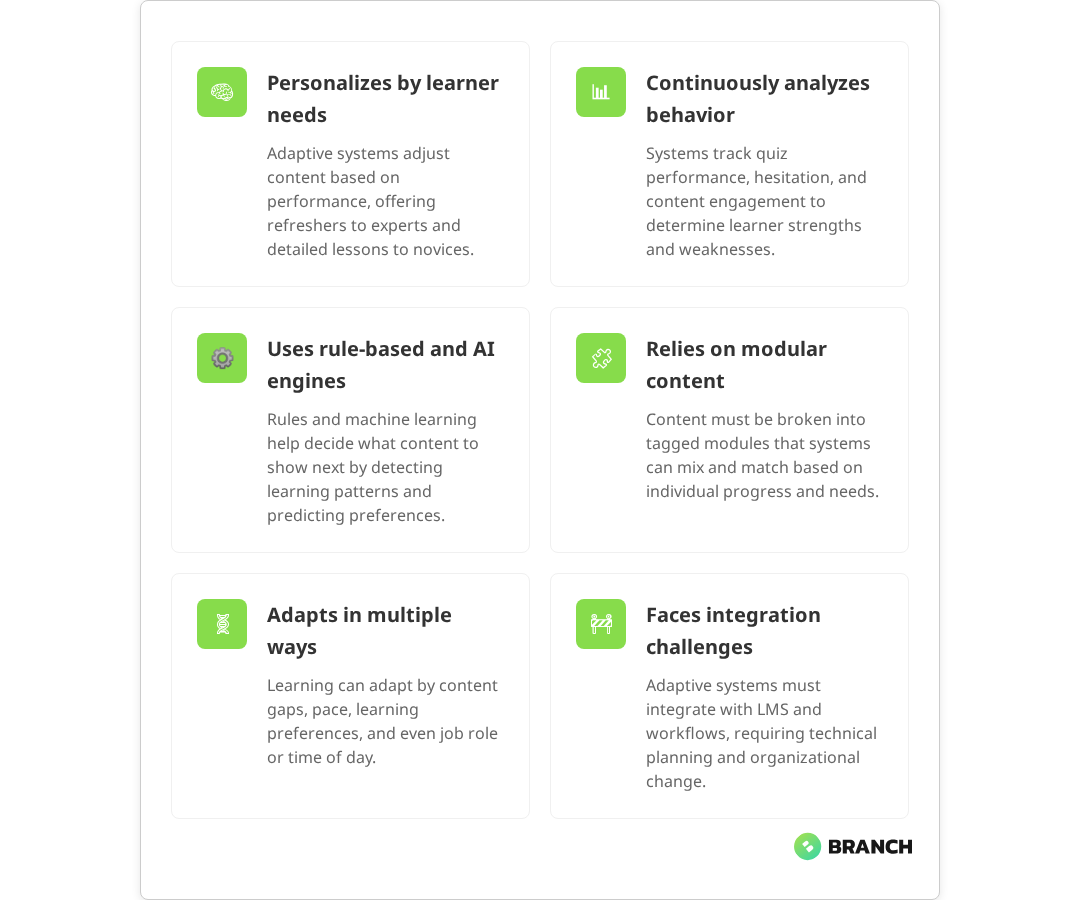
Adaptive learning systems operate on a deceptively simple principle: they continuously assess learner performance and adjust content delivery based on that assessment. Multiple studies demonstrate that this continuous assessment approach, often through real-time diagnostics and interactions, enables systems to dynamically personalize learning paths and improve both engagement and learning effectiveness.
Assessment and data collection forms the foundation. The system tracks not just whether answers are correct or incorrect, but also response time, hesitation patterns, and the types of mistakes being made. Some platforms monitor how long learners spend on different content types, which resources they access repeatedly, and where they tend to drop off.
The algorithmic engine then processes this data to make real-time decisions about what to present next. Simple rule-based systems might follow predetermined branching logic: if a learner scores below 70% on a quiz, they’re routed to remedial content. Research shows that these rule-based systems use “if this, then that” logic to systematically apply predetermined rules for routing learners to appropriate content based on performance thresholds.
More sophisticated machine learning approaches can identify subtle patterns in learning behavior and adjust content difficulty, pacing, or modality accordingly. Current evidence shows that machine learning algorithms can achieve high accuracy in predicting learning preferences and can automatically adjust material based on response times, quiz scores, and individual learning styles.
Content architecture must be designed with granular modularity in mind. Rather than linear courses, adaptive systems require libraries of discrete learning objects that can be dynamically recombined. Research on learning object technology demonstrates that this granular modularity is foundational for enabling true adaptability and individualization in learning systems. This means breaking down traditional training materials into smaller, tagged components that the algorithm can mix and match based on individual learner needs.
What the research says
- Controlled studies show that adaptive learning systems can effectively personalize content delivery by analyzing learner performance data and adjusting difficulty, pacing, and modality in real-time.
- Machine learning-based adaptive systems demonstrate high accuracy (up to 96%) in predicting learning preferences and enabling personalized content delivery across different learning styles.
- Content must be structured as modular, tagged components rather than linear courses research confirms this granular architecture is essential for enabling dynamic content recombination.
- While learners often report preferences for certain content modalities (visual, auditory, etc.), extensive research shows no reliable evidence that matching instruction to supposed “learning styles” actually improves outcomes.
- Integration challenges with existing learning management systems and organizational workflows remain a significant barrier, requiring careful technical planning and change management.
Types of Personalization in Adaptive Learning
Not all adaptive learning systems personalize education in the same way. Understanding the different approaches helps organizations choose solutions that align with their specific training objectives and learner populations.
Content-Based Adaptation
This approach adjusts what learners see based on their demonstrated knowledge gaps. If someone struggles with financial regulations but excels at customer service protocols, the system might skip basic customer service modules while providing additional regulatory compliance resources and practice scenarios. Evidence shows that these systems effectively use performance data to identify areas of weakness and provide targeted resources while allowing learners to bypass content they’ve already mastered.
Pace-Based Adaptation
Some learners need time to absorb complex concepts, while others prefer to move quickly through familiar territory. Pace-based systems monitor completion times and comprehension levels to adjust the speed of content delivery. Research confirms that these systems use engagement metrics and comprehension indicators to allow fast learners to accelerate while providing additional context for those who need more time. Fast learners might skip foundational explanations, while those who need more time get additional context and examples.
Learning Style Adaptation
While extensive research shows that the concept of distinct learning styles has limited scientific support, learners do show preferences for different content modalities. Current evidence indicates that matching instruction to presumed learning styles doesn’t improve outcomes, though individuals may have preferences for processing information in different formats. Adaptive systems might present visual learners with more diagrams and infographics, while offering audio summaries to auditory processors. The key is avoiding rigid categorization while still providing variety in content presentation.
Contextual Adaptation
Advanced systems consider factors beyond just learning performance. They might adjust content based on job role, industry context, or even the time of day when learning typically occurs. A sales training platform might emphasize different techniques for enterprise software reps versus retail associates.
Read more: How custom AI applications create more nuanced personalization than off-the-shelf solutions.Implementation Options and Trade-offs
Organizations have several paths for implementing adaptive learning, each with distinct advantages and constraints that affect both cost and effectiveness.
| Implementation Approach | Best For | Key Benefits | Primary Limitations |
|---|---|---|---|
| Off-the-shelf Platform | Standard training needs, quick deployment | Lower upfront cost, established algorithms | Limited customization, generic content approach |
| Platform + Custom Content | Specific industry requirements | Tailored content with proven technology | Higher content development costs |
| Custom-Built Solution | Complex organizational needs, unique workflows | Complete control over features and integration | Significant development time and cost |
| AI-Enhanced Existing LMS | Organizations with established LMS investments | Leverages existing infrastructure | May require significant technical integration |
The Integration Reality
Many adaptive learning initiatives stumble on integration challenges that weren’t apparent during initial vendor demonstrations. Research identifies that a major challenge in implementation is achieving seamless interoperability with existing educational and organizational infrastructure. Organizations typically need their adaptive learning system to work seamlessly with existing learning management systems (LMS), HR information systems, and content authoring tools.
The complexity isn’t just technical it’s also organizational. Adaptive learning often requires changes to how training content is created, how progress is measured, and how learning analytics are interpreted. Teams accustomed to linear course completion metrics may need to adjust to more nuanced progress indicators.
Making the Build vs. Buy Decision
The choice between custom development and platform adoption depends on several factors beyond just budget considerations.
When Off-the-Shelf Makes Sense
- Your training needs align with common industry patterns
- You need to deploy quickly with limited technical resources
- Content can be adapted to work within platform constraints
- Integration requirements are straightforward
Evidence shows that off-the-shelf adaptive platforms are particularly effective for standard training needs, offering rapid deployment and lower initial costs with pre-built algorithms that work well for common use cases like compliance training and onboarding.
When Custom Development Is Worth Considering
- Existing platforms can’t accommodate your specific workflow requirements
- You have unique data sources that should inform learning personalization
- Integration with proprietary systems is critical
- The total cost of ownership for platform licensing exceeds custom development costs
Research confirms that custom solutions provide complete control over features and integration, making them ideal for complex organizational needs, though they require significantly higher development time and cost investment.
Some organizations are finding middle-ground approaches, using AI tools to enhance existing training content with adaptive elements rather than replacing entire learning infrastructure. This can be particularly effective for organizations that have invested heavily in custom training content but want to add personalization features.
Measuring Adaptive Learning Success
Traditional learning metrics like completion rates and quiz scores don’t capture the full value of adaptive learning systems. Organizations need more sophisticated approaches to measuring effectiveness.
Learning efficiency becomes a key indicator are learners achieving the same or better outcomes in less time? Knowledge retention over time often improves with adaptive approaches, but requires longer-term tracking to demonstrate. Learner engagement metrics might show reduced dropout rates or increased voluntary exploration of additional content.
Perhaps most importantly, business impact should ultimately validate the investment. This might mean measuring performance improvements in the specific skills being trained, reduced time-to-competency for new hires, or decreased support requests after product training.
Working with Development Partners
Whether pursuing custom development or significant platform customization, choosing the right development partner significantly impacts project success. Look for teams that understand both the technical aspects of adaptive algorithms and the pedagogical principles behind effective learning design.
Effective partners will ask detailed questions about your learner populations, existing content assets, and success metrics before proposing technical architectures. They should be able to explain trade-offs between different algorithmic approaches in plain language and help you understand how various design decisions will impact both development timeline and ongoing maintenance requirements.
For organizations considering custom eLearning development, the partnership should extend beyond just technical implementation to include instructional design expertise and change management support for teams adapting to new learning approaches.
Organizations exploring AI-enhanced training solutions benefit from working with teams that can navigate both the possibilities and limitations of current AI technology, helping avoid over-promising on personalization capabilities while maximizing the value of available tools.
For teams evaluating custom training platforms, look for partners with experience integrating learning systems into existing organizational workflows and data infrastructure.
The Future of Adaptive Learning
Adaptive learning continues to evolve, with emerging AI capabilities opening new possibilities for personalization. Natural language processing enables more sophisticated analysis of written responses, while computer vision can analyze learner engagement during video content. However, the core challenge remains the same: creating learning experiences that genuinely improve outcomes rather than just appearing more sophisticated.
The most successful implementations focus on solving specific, measurable learning challenges rather than pursuing personalization for its own sake. As the technology matures, expect to see more focus on seamless integration with existing workflows and more transparent algorithmic decision-making that instructors and learners can understand and trust.
FAQ
How much data does an adaptive learning system need to start personalizing effectively?
Most systems begin making basic adaptations after just a few interactions, but meaningful personalization typically requires data from 10-20 learning activities per user. The quality and granularity of the data matters more than volume systems that track detailed interaction patterns can personalize more effectively with less data than those relying solely on quiz scores.
Can adaptive learning work with existing training content, or does everything need to be rebuilt?
Existing content can often be adapted, but it typically needs to be restructured into smaller, modular components that the system can recombine dynamically. Linear courses work poorly in adaptive systems. The extent of restructuring required depends on how your current content is organized and tagged. Well-structured content libraries adapt more easily than monolithic courses.
How do you ensure adaptive learning algorithms don't create unintended bias or limit learning opportunities?
This requires ongoing monitoring of learning pathways across different user groups and regular auditing of algorithmic decisions. Effective systems include mechanisms for learners to access content the algorithm might not have recommended, and they track whether personalization is inadvertently limiting exposure to important topics. Transparency in algorithmic decision-making helps identify potential bias issues early.
What level of technical expertise is needed to maintain an adaptive learning system?
Platform-based solutions typically require minimal technical maintenance beyond standard LMS administration. Custom systems need ongoing attention to algorithm performance, content updates, and integration maintenance. Most organizations benefit from having at least one team member who understands learning analytics, whether internal or through a support partnership with the development team.
How do you handle learners who don't want personalized learning experiences?
Effective adaptive systems include options for learners to follow standard pathways or manually override algorithmic recommendations. Some learners prefer predictable, linear progression through content. The key is making personalization feel helpful rather than controlling, and providing clear ways for learners to understand and influence how the system adapts to their needs.