


If you’ve ever watched employees’ eyes glaze over during mandatory compliance training, you’re not alone. Most organizations struggle to balance regulatory requirements with actual learning outcomes—and let’s be honest, traditional compliance training often feels like digital broccoli: necessary but far from appetizing.
The challenge isn’t just about checking boxes. Effective compliance training needs to change behaviors, not just satisfy auditors. Research shows that sustainable compliance programs must incorporate behavior change science and real-world relevance to achieve measurable cultural transformation. When employees genuinely understand policies and feel equipped to make good decisions, organizations see fewer violations, better workplace culture, and reduced legal risk. The key is transforming compliance from a necessary evil into engaging, practical learning that people actually retain and apply.
This guide walks through proven strategies for making compliance training more engaging, based on real-world implementation insights and practical design approaches that work for busy teams and skeptical learners alike.
Why Traditional Compliance Training Falls Flat
Most compliance training fails because it treats learners like passive recipients of information rather than active decision-makers. The typical approach—lengthy modules crammed with policy text, followed by obvious multiple-choice questions—creates what learning professionals call “click-through compliance.” Studies indicate that a substantial proportion of employees either click through mandatory training without properly engaging or only skim-read content, showing they haven’t internalized the actual decision-making skills they need when facing real workplace dilemmas.
The problem compounds when organizations prioritize completion rates over comprehension. Multiple sources confirm that focusing solely on compliance training completion rates rather than comprehension leads to disengagement and negative perceptions. When training feels like a time-wasting obstacle rather than useful preparation, employees develop negative associations with both the content and the HR teams behind it. This skepticism makes future training efforts even harder to execute effectively.
The good news? Research shows that small but targeted changes in design and delivery—such as using microlearning, realistic scenarios, and more contextual learning—can significantly increase engagement, retention, and application of compliance knowledge.
Scenario-Based Learning: Moving Beyond Policy Recitation
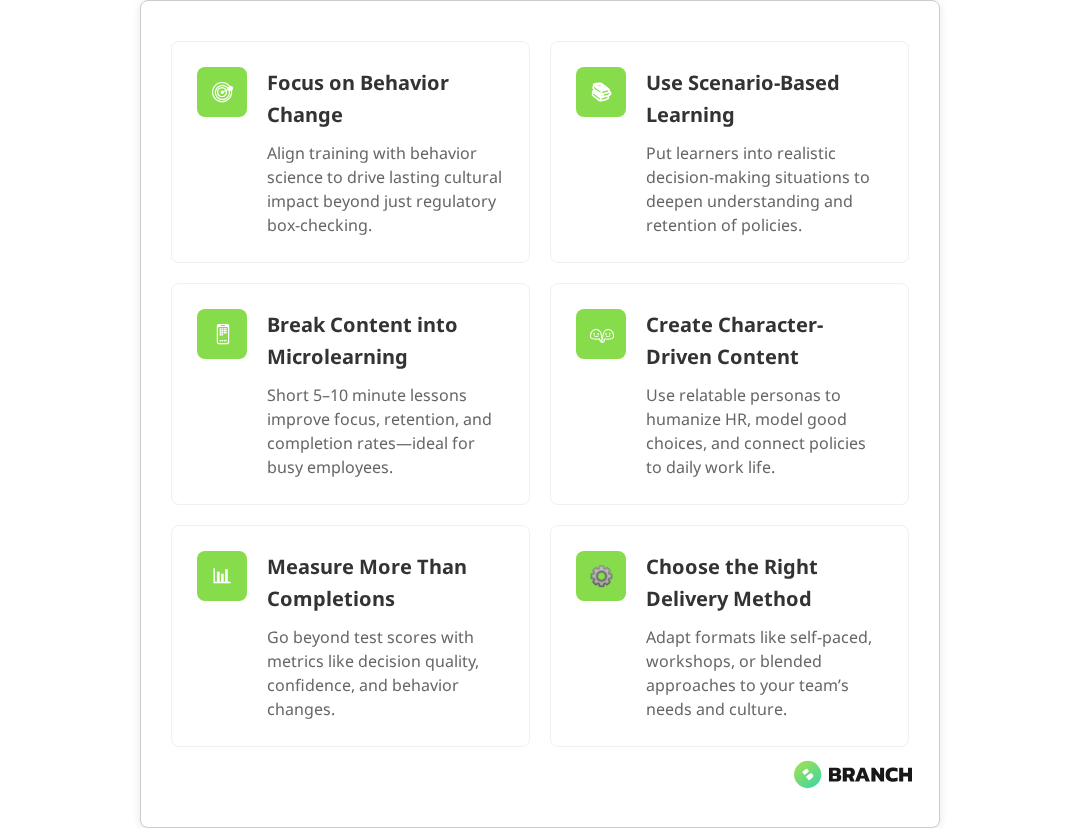
The most effective compliance training puts learners in realistic workplace situations where they must apply policy knowledge to make decisions. Multiple studies show 30-50% improvement in exam scores and 70% improvement in knowledge retention when using scenario-based learning compared to traditional lecture-based training. Instead of asking “What does the harassment policy say about reporting timelines?” scenario-based training presents a situation: “Your colleague mentions feeling uncomfortable about jokes made during team meetings. What’s your next step?”
Effective scenarios share several characteristics:
- Realistic context: Situations that learners might actually encounter, not extreme edge cases
- Non-binary choices: Multiple options that aren’t obviously right or wrong, forcing critical thinking
- Consequences shown: Clear demonstration of how different choices play out over time
- Policy integration: Natural connection between scenario decisions and underlying policies
The key is creating branching scenarios where learners can explore “less correct” paths without being immediately shut down. Evidence shows this approach helps people understand the nuances of policy application rather than just memorizing rules. When learners can see why certain choices lead to better outcomes, they’re more likely to make similar decisions in real workplace situations.
Microlearning and Modular Design
Breaking compliance training into shorter, focused modules serves both learning science and practical constraints. Research demonstrates that microlearning (5–10 minute modules) significantly improves attention span and knowledge retention compared to traditional hour-long sessions, with studies showing up to 80% better retention rates and 83% completion rates versus 20–30% for conventional courses.
Effective microlearning modules focus on specific decision points or skills rather than trying to cover entire policy areas. For example, instead of a comprehensive “Code of Conduct” module, you might create separate focused pieces on:
- Recognizing conflicts of interest
- Appropriate use of company resources
- Social media and confidentiality guidelines
- Reporting concerns and escalation paths
This modular approach allows for more targeted delivery—new employees get the full sequence, while experienced staff might only need refreshers on updated policies. It also makes maintenance easier when policies change, since you can update individual modules rather than rebuilding entire courses.
Read more about using video and animation to create engaging microlearning experiences.What the research says
- Scenario-based learning consistently outperforms traditional training methods, with organizations adopting this approach reporting higher policy adherence and fewer compliance incidents over time.
- Microlearning approaches can improve knowledge retention by up to 80% compared to traditional methods, while reducing cognitive overload and fitting better into busy work schedules.
- Training programs that focus on behavior change science—rather than just regulatory box-ticking—achieve measurable improvements in workplace culture and decision-making quality.
- Early evidence suggests that branching scenarios allowing exploration of multiple decision paths help learners grasp policy nuances more effectively than linear training modules.
- While completion rates remain important for compliance documentation, research shows that measuring decision quality and real-world application provides better indicators of training effectiveness.
Humanizing HR Through Character-Driven Content
One overlooked aspect of compliance training is how it shapes employees’ perceptions of HR and company leadership. When training feels punitive or disconnected from reality, it reinforces negative stereotypes about HR being the “policy police” rather than a supportive business function.
Character-driven training can help address this perception. Instead of faceless policy statements, use consistent characters or personas who guide learners through scenarios and explain the reasoning behind policies. These characters can model good decision-making while acknowledging the real constraints and pressures employees face.
Effective character development includes:
- Relatable backgrounds: Characters from different departments and experience levels
- Realistic motivations: Showing why people might struggle with policy decisions
- Growth over time: Characters learning from mistakes and improving their judgment
- Positive HR interactions: Demonstrating how HR can be a resource rather than an obstacle
This approach works particularly well when combined with light humor or storytelling elements that make the content more memorable without undermining the seriousness of compliance issues.
Implementation Strategies and Delivery Options
Even the most engaging content will fail if the implementation doesn’t match your organization’s culture and constraints. The table below outlines different delivery approaches and their trade-offs:
| Delivery Method | Best For | Time Investment | Engagement Potential | Scalability |
|---|---|---|---|---|
| Self-paced online modules | Geographically distributed teams | Low ongoing | Medium | High |
| Facilitated workshops | Complex policy changes | High | High | Low |
| Microlearning sequences | Busy schedules, mobile workforce | Medium | Medium-High | High |
| Blended approach | Critical compliance areas | High | High | Medium |
Most successful implementations combine multiple approaches rather than relying on a single delivery method. For example, you might use self-paced modules for foundational knowledge, followed by facilitated discussions for complex scenarios, with microlearning reinforcements delivered over time.
Measuring Success Beyond Completion Rates
Traditional compliance training metrics focus on completion rates and test scores, but these don’t tell you whether the training is actually changing behaviors or reducing risk. More meaningful metrics include:
- Time to competency: How quickly employees can apply policy knowledge in realistic scenarios
- Decision quality: Performance on complex, branching scenarios rather than simple recall questions
- Self-reported confidence: Employees’ comfort level with handling policy-related situations
- Behavior indicators: Changes in reporting rates, policy violations, or help-seeking behavior
- Feedback quality: Depth and specificity of learner comments about the training experience
The most valuable metric might be reduction in repeat violations or policy-related incidents over time. This indicates that training is actually preventing problems rather than just documenting that education occurred.
Read more about eLearning standards that enable sophisticated tracking and measurement of learning outcomes.When to Build In-House vs. Partner with Specialists
The decision between developing compliance training internally or working with specialists depends on several factors: your team’s capacity, the complexity of your compliance requirements, and how critical these training programs are to your organization’s risk management.
Consider building in-house when:
- You have dedicated learning and development resources
- Your compliance requirements are straightforward and stable
- You need frequent updates and iterations
- Your organization has unique cultural considerations that outsiders might miss
Consider partnering with specialists when:
- You need sophisticated interactivity or multimedia production
- Compliance requirements are complex or changing rapidly
- You want to leverage proven instructional design methodologies
- Internal teams lack bandwidth for a major training overhaul
Many organizations find success with a hybrid approach: partnering with specialists to design the foundational architecture and most complex modules, while handling simpler updates and customizations internally. This approach provides professional design quality while maintaining ongoing flexibility.
Getting Buy-In and Managing Change
Even excellent compliance training can fail if employees approach it with negative expectations. Successful rollouts require intentional change management that addresses both practical and emotional barriers to engagement.
Pre-training communication from leadership helps set appropriate expectations and context. When managers can explain how compliance training connects to organizational values and business success, rather than just regulatory requirements, employees are more likely to engage meaningfully with the content.
Consider gathering anonymous feedback from employees about their current perceptions of HR and compliance processes. This intelligence can inform both content design and communication strategy, helping you address specific concerns or misconceptions that might otherwise undermine the training’s effectiveness.
Read more about our specialized approach to developing compliance training that balances engagement with regulatory requirements.Working with Digital Learning Partners
Organizations that choose to work with external partners for compliance training development benefit most when they approach the relationship as a collaboration rather than a simple vendor transaction. The most effective partnerships involve:
Clear stakeholder alignment from the start, including legal, HR, and operational teams who understand both the compliance requirements and the practical realities of your workplace culture.
Iterative design processes that allow for testing and refinement based on real user feedback, rather than trying to perfect everything before any employees see the content.
Knowledge transfer that leaves your internal team equipped to make updates and modifications as policies evolve, rather than creating dependency on external resources for every small change.
Teams like Branch Boston specialize in translating complex compliance requirements into engaging, human-centered learning experiences. We work with organizations to design training that satisfies auditors while actually improving workplace decision-making—because the best compliance training is the kind people want to complete and remember how to apply.
FAQ
How long should compliance training modules be to maintain engagement?
Most effective compliance training modules run 5-10 minutes each, focusing on specific decisions or skills rather than trying to cover entire policy areas. This length respects learners' attention spans while allowing sufficient depth for meaningful scenarios. Breaking content into shorter modules also enables better scheduling flexibility and makes updates easier when policies change.
What's the best way to handle employees who rush through compliance training just to get it done?
Design scenarios with branching paths and realistic consequences that require genuine consideration rather than obvious answers. Implement 'test-out' options for experienced employees to demonstrate competency upfront, which respects their knowledge while ensuring compliance. Focus on measuring decision quality in complex scenarios rather than just completion speed or simple recall questions.
How can we make compliance training feel less punitive and more supportive?
Use character-driven content that shows HR as a helpful resource rather than policy enforcers. Include scenarios where characters learn from mistakes and grow over time, demonstrating that compliance is about making good decisions rather than avoiding punishment. Pre-training communication from leadership should frame compliance as part of company values and ethical culture, not just regulatory obligations.
Should we customize compliance training for different departments or keep it standardized?
A hybrid approach works best: standardized core content ensures consistent policy understanding across the organization, while department-specific scenarios help employees see how policies apply to their actual work situations. This maintains compliance consistency while improving relevance and engagement for different roles and responsibilities within your organization.
How do we measure whether compliance training is actually changing behavior, not just completion rates?
Track metrics like decision quality in complex scenarios, self-reported confidence levels, reduction in policy violations over time, and changes in help-seeking behavior when employees face policy questions. Anonymous feedback about training relevance and applicability can also indicate whether employees feel prepared to handle real workplace situations covered by your compliance policies.