


If you’ve been in a training planning meeting lately, chances are someone mentioned microlearning as the solution to everything from low engagement to tight budgets. But here’s the thing: research consistently shows that microlearning isn’t a magic bullet, and it certainly isn’t appropriate for every learning scenario. The question isn’t whether microlearning is “better” than traditional eLearning it’s when each approach actually serves your learners and your business goals.
For B2B leaders evaluating training strategies, understanding the real trade-offs between microlearning and traditional eLearning formats can save you from costly misaligned projects. This article breaks down when microlearning genuinely outperforms longer-form content, when it falls short, and how to make informed decisions about your learning architecture.
The Microlearning Misconception
Let’s start with what microlearning actually is and what it isn’t. Research defines true microlearning as targeted, bite-sized content designed for specific moments of need. Think 2-minute videos that walk through a software feature, interactive job aids accessible via QR codes, or quick reinforcement modules that combat the forgetting curve.
What microlearning isn’t is simply chopping up a traditional course into smaller pieces. Unfortunately, many stakeholders conflate microlearning with basic content chunking, leading to projects that deliver neither the depth of traditional eLearning nor the targeted efficiency of genuine microlearning. Studies show that this misunderstanding can result in fragmented content that fails to achieve microlearning’s intended benefits of engagement and retention.
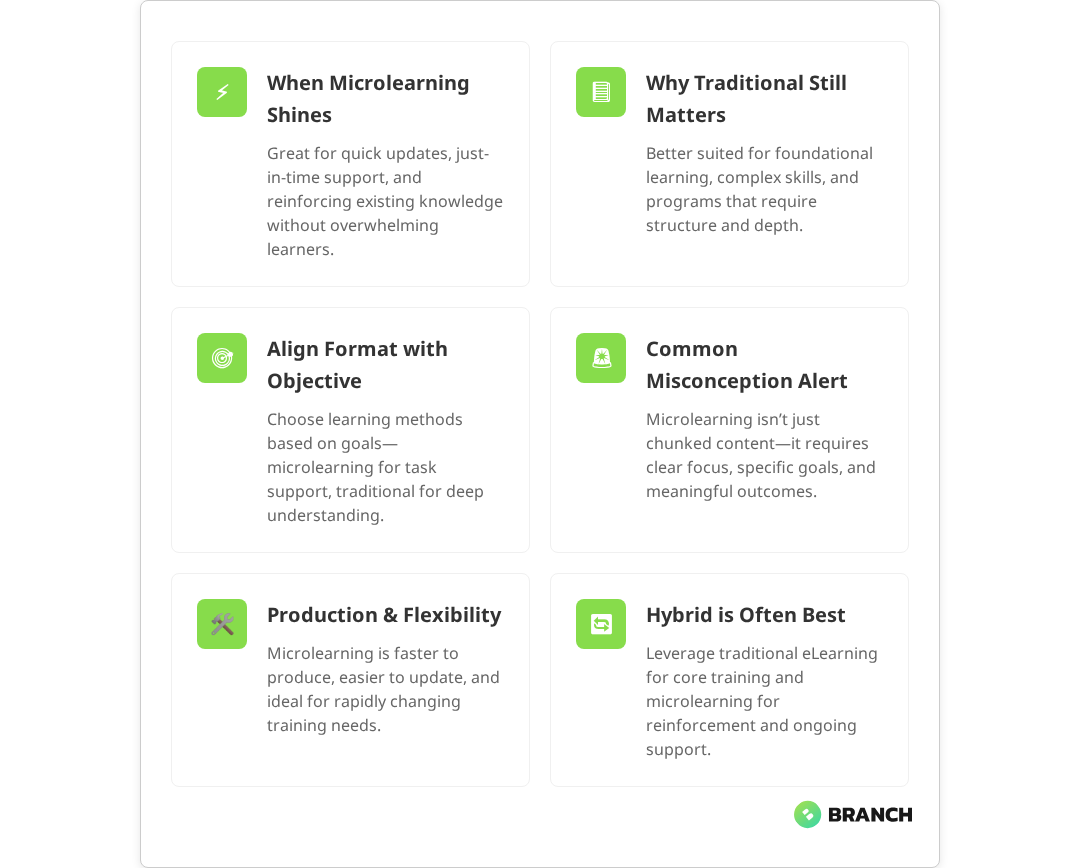
The key distinction lies in purpose and context. Multiple studies confirm that microlearning excels when learners need just-in-time support, behavioral reinforcement, or quick skill updates. Traditional eLearning works better for foundational knowledge, complex procedures, or comprehensive skill development that requires guided practice and feedback.
When Microlearning Actually Works
Microlearning shines in specific scenarios where traditional eLearning would be overkill or impractical. Research shows that microlearning achieves 80% completion rates and offers 25-60% retention improvements when used for these sweet spots:
- Just-in-time performance support: Quick how-to guides accessible during workflow moments
- Reinforcement and spaced repetition: Combating the forgetting curve with targeted follow-up content
- Rapid response training: Addressing emerging knowledge gaps or trending issues quickly
- Infrequent task reminders: Annual processes or rarely-used procedures that need quick refreshers
- Behavior change nudges: Small, consistent interventions that build habits over time
The most successful microlearning implementations often start as reactive solutions. Organizations notice specific performance gaps, create targeted microlearning content to address them, and then incorporate effective modules into broader training curricula once they prove their value. Given that employees spend only 1% of their workweek on formal learning, microlearning’s ability to integrate seamlessly into daily workflows makes it particularly valuable for performance support scenarios.
Read more: Understanding the full eLearning development process helps clarify where microlearning fits in the broader learning strategy.Where Traditional eLearning Still Wins
Despite the microlearning hype, traditional eLearning formats remain superior for several critical learning scenarios. Educational research indicates that traditional methods excel when structured curricula, extended exploration, and instructor interaction are essential:
- Foundational knowledge building: Complex concepts that require scaffolded learning and context
- Certification and compliance training: Comprehensive coverage with formal assessment requirements
- Skill development requiring practice: Scenarios, simulations, and guided exercises that need extended time
- Abstract or theoretical content: Topics that benefit from detailed explanation and reflection
- Behavioral change programs: Comprehensive interventions that require sustained engagement
Traditional eLearning also excels when you need structured progression through material, formal tracking and reporting, or comprehensive assessments that go beyond basic knowledge checks.
| Learning Need | Microlearning Fit | Traditional eLearning Fit | Why |
|---|---|---|---|
| Software feature update | High | Low | Quick, targeted, just-in-time need |
| New employee onboarding | Low | High | Complex, foundational, requires sequencing |
| Safety reminder | High | Medium | Reinforcement of known concepts |
| Leadership development | Medium | High | Abstract concepts need depth and practice |
| Process troubleshooting | High | Low | Performance support during workflow |
| Regulatory compliance | Low | High | Comprehensive coverage and formal assessment required |
What the research says
As organizations evaluate microlearning versus traditional eLearning, several key research findings can guide decision-making:
- Development efficiency: Studies show microlearning reduces development time by 70-85% compared to traditional eLearning, with modules developed up to 300% faster than conventional materials.
- Engagement and completion: Microlearning consistently achieves higher completion rates (around 80%) and can improve knowledge retention by 25-60% through targeted, bite-sized delivery.
- Context matters: Research indicates microlearning excels for reinforcement and just-in-time support, while traditional methods remain superior for foundational knowledge and complex skill development.
- Implementation challenges: Early evidence suggests that without strategic coordination, microlearning’s flexibility can become a weakness, leading to fragmented content that lacks coherence.
The Production and Deployment Reality
One often-overlooked advantage of microlearning is its production agility. Industry analysis shows that microlearning modules typically have lower production expectations, enabling faster iteration and deployment. A 2-minute explanatory video shot with basic equipment can be more effective than a polished 30-minute course if it reaches learners exactly when they need it.
This production flexibility offers significant advantages:
- Rapid response capability: Address emerging training needs without lengthy development cycles
- Lower barrier to content creation: Subject matter experts can contribute directly without extensive instructional design support
- Easier updates: Modify or replace individual modules without rebuilding entire courses
- Cost-effective scaling: Create targeted content for specific teams or roles without full course development overhead
However, this same flexibility can become a weakness if quality standards slip or if microlearning modules proliferate without strategic coordination. Research suggests that thoughtful planning is essential to ensure individual modules connect logically and maintain educational coherence.
Making the Strategic Choice
The decision between microlearning and traditional eLearning shouldn’t be based on trends or assumptions about learner preferences. Instead, focus on these strategic considerations:
Start with Learning Objectives
What specific outcomes do you need? Expert guidance emphasizes that if learners must demonstrate complex problem-solving or integrate multiple concepts, traditional eLearning’s structured approach typically delivers better results. If they need quick answers or behavioral nudges, microlearning fits better.
Consider the Learning Context
Where and when will learning happen? Microlearning excels for workflow-embedded learning, while traditional eLearning works better for dedicated learning sessions where learners can focus deeply.
Evaluate Resource Constraints
Microlearning can be more cost-effective for targeted needs, but don’t assume it’s always cheaper. Creating truly effective microlearning still requires instructional design expertise, and managing numerous small modules can become complex.
Working with Learning Development Partners
Whether you choose microlearning, traditional eLearning, or a hybrid approach, the development process matters. Look for partners who lead with discovery rather than jumping straight to format decisions. The right team will help you:
- Clarify actual learning needs beyond stakeholder assumptions about formats
- Map content to appropriate delivery methods based on learning science, not trends
- Design scalable content systems that can evolve with your organization’s needs
- Integrate learning with existing workflows and technology infrastructure
Experienced learning partners also understand the technical considerations that affect format choice from LMS capabilities to mobile accessibility to tracking requirements. They can help you avoid the trap of choosing formats based on surface appeal rather than strategic fit.
For organizations considering custom eLearning development, the key is working with teams who understand both the pedagogical and technical aspects of different learning formats. The best outcomes come from partnerships that prioritize learning effectiveness over trendy delivery methods.
Implementation Recommendations
If you’re moving forward with either microlearning or traditional eLearning, consider these practical steps:
For Microlearning Projects
- Start with identified performance gaps rather than comprehensive topic coverage
- Establish clear content governance to prevent module proliferation
- Design for discoverability learners need to find relevant modules quickly
- Plan for maintenance and updates from the beginning
For Traditional eLearning Projects
- Invest in thorough needs analysis and learner journey mapping
- Design for engagement over information density
- Build in assessment and feedback mechanisms throughout
- Plan complementary microlearning for post-course reinforcement
Many successful organizations use both approaches strategically. eLearning course development handles foundational training, while microlearning modules provide ongoing support and updates. This hybrid approach maximizes the strengths of each format while minimizing their weaknesses.
The key is matching format to function, not following the latest learning trends. When you get this alignment right, both learners and business outcomes benefit.
FAQ
How do I know if my stakeholders really want microlearning or just think they do?
Ask them to describe the specific learning outcomes they want to achieve, not just the format they prefer. If they're focused on comprehensive skill development or complex procedures, they likely need traditional eLearning despite requesting microlearning. Lead with discovery conversations that unpack actual needs rather than assumed solutions.
Can microlearning really change behavior, or is it just information delivery?
Microlearning can support behavior change, but it works best as reinforcement rather than the primary intervention. Use microlearning for spaced repetition, just-in-time reminders, and small habit-building nudges. For comprehensive behavior change programs, traditional eLearning provides the depth and structured practice necessary for lasting impact.
Is microlearning always cheaper than traditional eLearning?
Not necessarily. While individual microlearning modules cost less to produce, managing numerous small pieces of content can become complex and expensive over time. Additionally, truly effective microlearning still requires instructional design expertise. Cost-effectiveness depends on your specific use case and long-term content management strategy.
How do I prevent microlearning from becoming just chopped-up traditional courses?
Focus on specific, targeted outcomes for each microlearning module rather than trying to cover comprehensive topics. Each piece should stand alone and address a particular moment of need or performance gap. If you find yourself creating sequential modules that build on each other extensively, you likely need traditional eLearning instead.