


The question of whether to rebrand your business isn’t one to take lightly. It’s also not one to avoid indefinitely because you’re worried about rocking the boat. Research consistently shows that a well-timed rebrand can unlock growth, clarify your market position, and energize your team. A poorly timed one can confuse customers, waste resources, and create internal friction that takes years to resolve.
The trick is knowing when the business case is strong enough to justify the investment—and when you’re better off optimizing what you already have. This isn’t about chasing design trends or satisfying personal preferences. It’s about making evidence-based decisions that align with measurable business outcomes.
The Real Cost of Waiting vs. Moving Too Fast
Most organizations fall into one of two camps: those who rebrand at the first sign of visual fatigue, and those who cling to outdated brand assets long after they’ve stopped serving their purpose. Both approaches miss the mark.
Studies have documented that rebranding too quickly—often driven by internal aesthetics or a new marketing hire’s personal preferences—can alienate existing customers and dilute brand equity you’ve spent years building. But waiting too long can be equally costly. When your brand no longer reflects your capabilities, values, or market position, you’re essentially leaving money on the table with every prospect interaction.
The key is recognizing the difference between cosmetic fatigue (you’re tired of looking at the same logo) and strategic misalignment (your brand is actively hindering business goals). One requires patience; the other demands action.
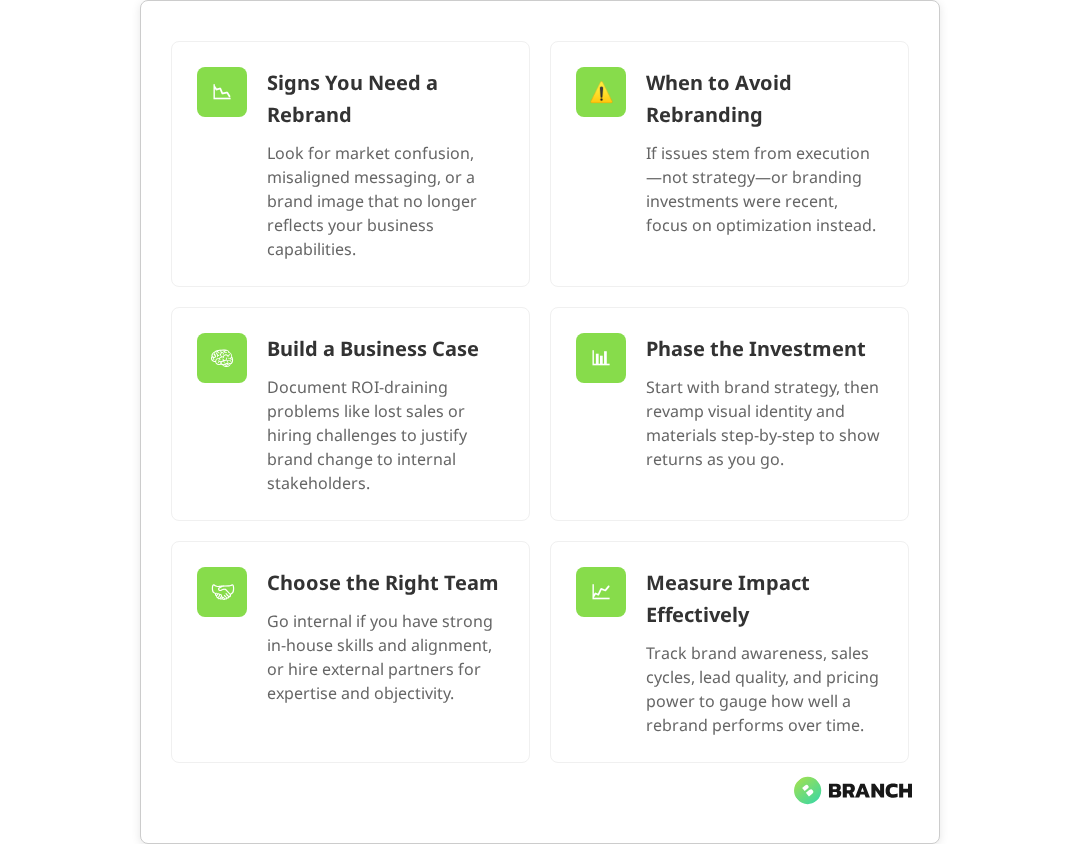
Let’s break down the most common scenarios where rebranding makes strategic sense—and when it doesn’t.
When Rebranding Makes Strategic Sense
A successful rebranding strategy isn’t about fixing what looks old; it’s about aligning your external identity with your business reality. Here are the scenarios where the investment typically pays off:
Market Position Has Fundamentally Shifted
Multiple industry analyses confirm that if your business has evolved significantly—say, from a local service provider to a regional leader, or from a generalist firm to a specialized consultancy—your brand needs to reflect that change. Customers should understand your capabilities at a glance, not struggle to connect your current offerings with an outdated brand promise.
This is particularly common in professional services firms that have grown beyond their original scope. A boutique marketing agency that now handles enterprise-level digital transformation projects needs a brand that communicates that capability.
Competitive Landscape Has Changed
Sometimes the market moves around you. New competitors enter with more polished brands, or industry standards shift in ways that make your current approach feel dated. This isn’t about keeping up with design trends—it’s about ensuring your brand communicates competence and relevance in the current marketplace.
Read more about developing a brand strategy that aligns with your market position.Internal Stakeholders Can’t Articulate Your Value
Business experts recognize that if your sales team struggles to explain what you do, or your employees can’t clearly communicate your company’s purpose at networking events, you have a brand clarity problem. This often manifests as long, complicated elevator pitches or inconsistent messaging across team members.
The solution isn’t necessarily a visual rebrand—it might be brand strategy work that clarifies your positioning—but it’s definitely a brand problem that needs addressing.
Customer Feedback Indicates Confusion
Pay attention to the questions prospects ask during initial meetings. Consumer research shows that if you’re consistently clarifying misconceptions about your services, pricing tier, or industry focus, your brand isn’t doing its primary job: communicating who you serve and how you help them.
When You Should Optimize Instead of Rebrand
Not every brand problem requires a complete overhaul. Sometimes the issue isn’t your core brand elements—it’s how you’re implementing them. Here’s when to pump the brakes on rebranding:
Inconsistent Application, Not Poor Strategy
Branding experts consistently distinguish between strategic issues and execution problems. If your brand strategy is sound but your materials look scattered or unprofessional, the problem might be execution, not positioning. Investing in better templates, style guides, or design support can often solve what feels like a “brand problem” without the risk and expense of starting over.
This is especially true for organizations with strong brand recognition but inconsistent visual implementation across departments or locations.
Recent Investment Without Clear ROI
Industry guidance suggests that if you’ve invested in branding within the last 3-5 years and haven’t given it enough time to show results, consider optimization first. Brand recognition and market perception take time to shift, and premature changes can waste previous investments.
Internal Opinion vs. External Data
Multiple studies emphasize the importance of being wary of rebranding initiatives driven primarily by internal preferences rather than customer feedback or business metrics. Just because your team is tired of your current brand doesn’t mean your market is.
What the research says
- Well-executed rebrands aligned with strategic business changes consistently drive measurable improvements in market share, revenue growth, and employee engagement.
- Customer confusion and brand equity dilution are the most frequently documented risks of poorly timed rebrands, particularly those driven by aesthetic preferences rather than business strategy.
- Phased rebranding approaches show higher success rates than comprehensive overhauls, allowing organizations to demonstrate ROI at each stage while building stakeholder confidence.
- Early evidence suggests that brands struggling with internal articulation of value proposition face measurable impacts on sales cycle length and competitive win rates.
- Recent studies indicate that organizations benefit more from brand optimization when they’ve invested in positioning within the past 3-5 years, rather than pursuing complete rebrands.
Building the Business Case for Rebranding
If you’ve determined that rebranding makes strategic sense, the next challenge is building internal support for the investment. This is where many well-intentioned rebranding initiatives stall out.
Research consistently shows that the most effective approach is framing the rebrand through measurable business impact rather than aesthetic preferences. Decision-makers need to understand how the current brand is costing the organization money and how a rebrand could drive revenue growth.
Read more about the strategic process behind visual identity development.Document Specific Business Impact
Start by cataloging concrete examples where your current brand has hindered business objectives:
- Lost opportunities where prospects chose competitors with more polished brands
- Extended sales cycles due to brand confusion or misperception
- Difficulty attracting top talent who perceive the organization as outdated
- Challenges entering new markets or customer segments
- Inconsistent pricing power compared to similarly positioned competitors
Create Visual Prototypes
Abstract strategy discussions rarely move the needle with skeptical decision-makers. Instead, create tangible mockups that demonstrate the potential impact of strategic brand changes. This approach helps stakeholders visualize the benefit rather than just understand it intellectually.
Focus your prototypes on the materials that matter most to your business: proposals, website headers, trade show displays, or whatever touchpoints most directly impact revenue.
Phase the Investment
Industry best practices suggest structuring the rebrand as a phased investment rather than a single large expense. This allows you to demonstrate ROI at each stage and builds confidence for subsequent phases.
| Phase | Investment Level | Key Deliverables | Success Metrics |
|---|---|---|---|
| Phase 1: Strategy | Low | Brand positioning, messaging framework | Clearer internal communication, improved elevator pitches |
| Phase 2: Visual Identity | Medium | Logo, color palette, typography system | More consistent brand application across materials |
| Phase 3: Application | Medium-High | Website, sales materials, signage | Improved lead quality, shortened sales cycles |
| Phase 4: Experience | High | Comprehensive brand system, training | Measurable impact on customer perception and retention |
Navigating Internal Politics and Stakeholder Buy-In
Even with a solid business case, rebranding initiatives often face internal resistance. Understanding the common dynamics can help you navigate them more effectively.
The Credibility Challenge
Newer team members or those outside traditional marketing roles often face skepticism when proposing strategic brand changes. If you’re in this position, focus on building credibility through smaller improvements first.
Consider starting with tactical improvements within your existing brand guidelines—better templates, tighter messaging, more consistent application—before proposing larger strategic changes. Success with these smaller initiatives builds trust and demonstrates your understanding of the business impact of brand decisions.
Managing Multiple Stakeholders
Rebranding touches every part of an organization, which means every department has opinions. The key is distinguishing between input (valuable perspectives that should inform decisions) and approval (decision-making authority that should be limited to key stakeholders).
Create a clear decision-making framework before you start, and stick to it even when the process gets messy.
Read more about creating design systems that ensure consistent brand application across teams.The “Good Enough” Trap
One of the most common objections to rebranding is that the current brand is “good enough” or “still working.” This perspective often comes from stakeholders who focus on the costs and risks of change while underestimating the opportunity costs of staying the same.
Address this by quantifying the status quo. What business opportunities might you be missing with your current brand? How does your brand perception compare to direct competitors? What would happen to your market position if you maintain the current trajectory for another 3-5 years?
Working with External Partners vs. Internal Teams
The decision of whether to handle rebranding internally or work with external partners often comes down to capability, capacity, and objectivity.
When Internal Makes Sense
Internal teams work well for rebranding when you have:
- Strong design and strategy capabilities in-house
- Sufficient capacity to dedicate to the project without compromising other priorities
- Clear internal alignment on the need for change and the strategic direction
- A relatively straightforward brand challenge (messaging clarification, visual refresh)
When External Partners Add Value
External partners become valuable when you need:
- Objective perspective on internal blind spots or sacred cows
- Specialized expertise in brand strategy, naming, or complex visual systems
- Additional capacity without long-term staffing commitments
- External credibility to support internal change management
- Experience with similar organizations or industry-specific brand challenges
The right external partner brings both strategic thinking and tactical execution, helping you navigate the inevitable challenges that arise during any significant brand initiative.
For organizations considering a rebrand, Branch Boston’s branding and design services combine strategic positioning work with visual identity development, ensuring your rebrand addresses both the underlying business challenges and the market-facing brand expression.
Measuring Rebrand Success
A successful rebrand should deliver measurable business impact, not just prettier marketing materials. Establish clear success metrics before you begin, and track them consistently after implementation.
Leading Indicators
- Brand awareness and recognition: Surveys and market research tracking aided and unaided brand recognition
- Message clarity: Reduction in FAQ volume about your services or positioning
- Internal alignment: Consistency of brand messaging across team members and departments
Business Impact Metrics
- Lead quality: Higher percentage of prospects who fit your ideal customer profile
- Sales cycle length: Reduction in time from initial contact to close
- Win rates: Improved success rate in competitive sales situations
- Pricing power: Ability to command premium pricing or resist price pressure
- Employee satisfaction: Increased pride and clarity in representing the organization
Remember that brand impact often takes 6-18 months to fully materialize. Plan for patience while tracking progress consistently.
Making the Decision
Ultimately, the decision to rebrand should be based on clear evidence that your current brand is hindering business objectives in ways that optimization can’t address. It’s not about perfection—it’s about alignment.
If you’re still unsure whether rebranding makes sense for your organization, consider starting with a comprehensive brand audit. This process can help you distinguish between execution problems (which can be solved with better implementation) and strategic problems (which require more fundamental changes).
For organizations ready to move forward, the key is approaching rebranding as a strategic business initiative, not a creative project. The most successful rebrands solve real business problems while creating a brand platform that can grow with the organization over time.
Whether you’re working with internal teams or external partners, success comes down to clear objectives, stakeholder alignment, and a commitment to measuring impact beyond aesthetics. Done right, rebranding becomes an investment in your organization’s future growth and market position.
If you’re considering a rebrand and want to explore your options, get in touch with our team for a strategic consultation. We can help you determine whether rebranding is the right move for your organization and, if so, how to approach it in a way that delivers measurable business value.
You can also see how strategic brand work translates into compelling brand narratives through examples like our Community Servings brand video project, which demonstrates how visual storytelling supports new brand positioning in action.
FAQ
How often should a business consider rebranding?
Most businesses should evaluate their brand strategy every 3-5 years, but full rebrands are typically needed every 7-10 years or when significant business changes occur. The key is regular assessment rather than automatic timing—market position, competitive landscape, and business evolution matter more than calendar years.
Can we rebrand gradually instead of all at once?
Absolutely. Phased rebranding often works better than comprehensive overhauls, especially for established organizations. You can start with strategy and messaging, then move to visual identity, and finally roll out across all touchpoints. This approach allows you to test and refine while building internal confidence in the process.
How do we know if our current brand is actually hurting our business?
Look for concrete signs: prospects consistently asking clarifying questions about your services, sales cycles that drag due to positioning confusion, difficulty attracting quality talent, or losing competitive situations to better-branded competitors. Document specific instances rather than relying on internal opinions—the data will guide your decision.
What's the biggest risk of rebranding?
The biggest risk is confusing existing customers and diluting brand equity you've built over time. This is why rebranding should solve specific business problems, not just satisfy aesthetic preferences. Strong brands have staying power—make sure you're changing for strategic reasons, not cosmetic ones.
How long does a typical rebrand take?
Timeline depends on scope and complexity, but most strategic rebrands take 3-6 months for strategy and identity development, plus 3-12 months for implementation across all touchpoints. Rushing the process often leads to poor decisions, while dragging it out creates confusion and momentum loss. Plan for thoroughness within reasonable timelines.