


If you’ve been hearing whispers about “learning experience design” in boardrooms and wondering whether it’s just another buzzword or something worth your attention, you’re not alone. Learning experience design (LXD) sits at the intersection of instructional design, user experience, and behavioral psychology and research confirms it’s becoming increasingly critical for B2B organizations that need their people to actually learn from training, not just click through it.
Unlike traditional instructional design, which often focuses on information delivery, LXD takes a human-centered approach to creating learning experiences that stick. Multiple studies indicate that people learn better when experiences are designed around how they actually think, work, and solve problems not around how content is easiest to deliver. It’s about designing the entire journey from the moment someone realizes they need to learn something to the point where they’re confidently applying that knowledge in their work.
For B2B leaders evaluating learning and development investments, understanding LXD isn’t just about keeping up with trends. It’s about recognizing when your organization needs more than off-the-shelf training modules and when a thoughtful, designed learning experience could be the difference between compliance theater and actual capability building.
How Learning Experience Design Actually Works
Learning experience design operates on a simple premise: research consistently shows that people learn better when the experience is designed around how they actually think, work, and solve problems not around how content is easiest to deliver.
Traditional instructional design often follows a linear path: analyze learning objectives, create content, deliver it, and assess retention. Expert analyses reveal that LXD flips this by starting with the learner’s context, constraints, and goals. It asks questions like:
- When and where will learners actually apply this knowledge?
- What barriers (technical, cultural, or cognitive) might prevent them from succeeding?
- How does this learning connect to their existing workflows and mental models?
- What would make them want to engage with this content?
This approach draws heavily from user experience design principles. Just as a well-designed app considers user journeys, pain points, and contexts of use, LXD maps the learning journey from initial motivation through skill application and beyond.
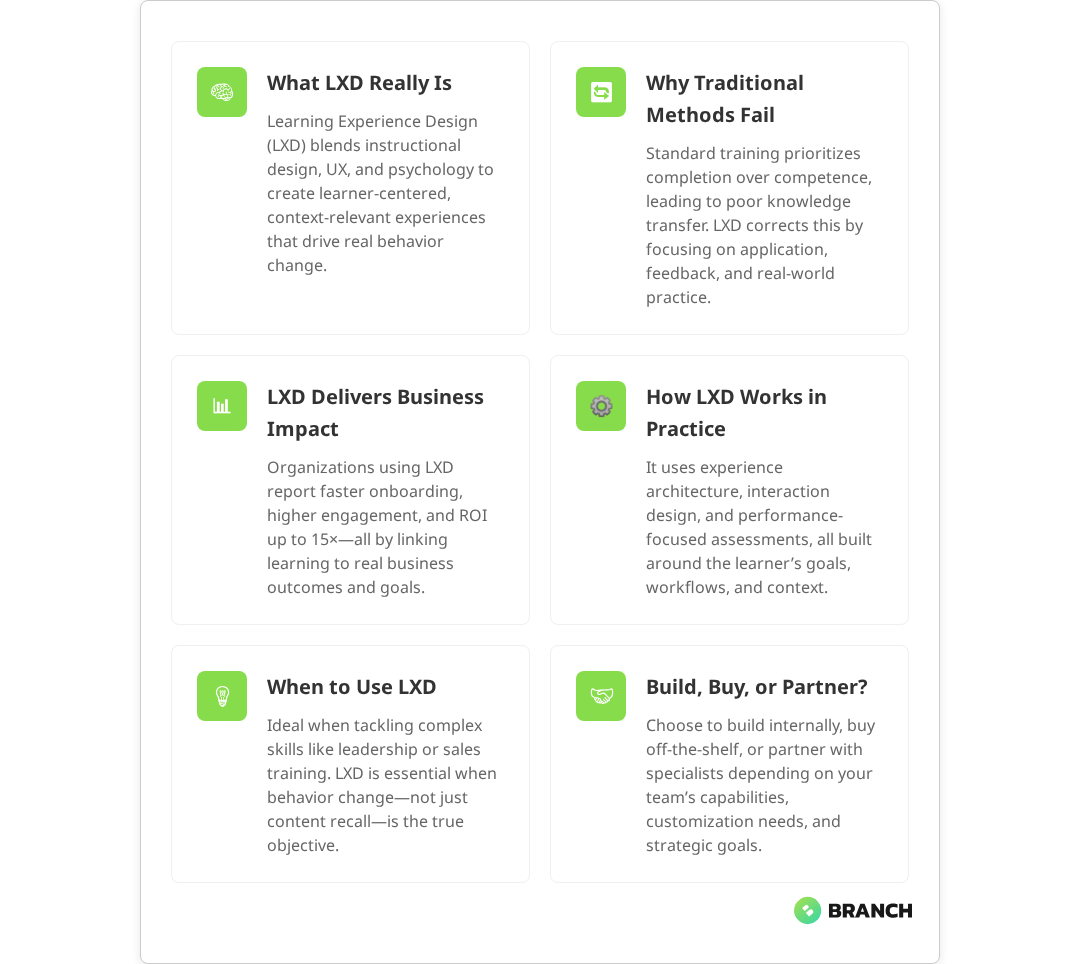
The mechanics involve several layers of design thinking. Experience architecture structures the overall learning journey, considering pacing, sequence, and touchpoints. Interaction design focuses on how learners engage with content and activities. Content strategy ensures information is relevant, contextual, and actionable. And assessment design moves beyond knowledge checks to evaluate real-world application, incorporating scenario-based assignments and practical demonstrations that measure genuine competence.
Why Traditional Approaches Fall Short
Most corporate learning still operates on an industrial model: create standardized content, push it out to employees, track completion rates, and call it success. This approach works fine for compliance training where the goal is documentation, but industry analysis shows it fails spectacularly when organizations need people to actually change how they work.
The problems are structural. Traditional instructional design often treats learners as empty vessels waiting to be filled with information. Studies indicate it prioritizes content coverage over comprehension, completion over competence. The result? Learning that doesn’t transfer. People complete the training, pass the quiz, and return to work doing exactly what they did before.
Learning experience design addresses these limitations by focusing on behavior change rather than information transfer. Research confirms that LXD recognizes learning as fundamentally social, contextual, and iterative. People learn by doing, by connecting new information to existing knowledge, and by getting feedback in realistic situations.
| Traditional Instructional Design | Learning Experience Design |
|---|---|
| Content-centered approach | Learner-centered approach |
| Linear information delivery | Contextual, adaptive experiences |
| Focus on completion metrics | Focus on behavior change outcomes |
| One-size-fits-all solutions | Personalized learning paths |
| Knowledge assessment | Performance-based evaluation |
| Standalone training events | Integrated workflow learning |
This shift matters especially for complex B2B skills leadership development, technical training, sales methodology, or change management where context and application are everything. Multiple sources confirm that you can’t learn to be a better manager by reading about management theory. You learn by practicing management decisions in realistic scenarios with meaningful feedback.
What the research says
- Human-centered design improves outcomes: Systematic reviews demonstrate that learning experiences designed around learner needs, contexts, and goals significantly outperform traditional content-delivery approaches in terms of engagement and knowledge retention.
- Context matters for complex skills: Research consistently shows that leadership development, technical training, and sales methodology are best learned through realistic scenarios and hands-on practice rather than abstract theory.
- ROI is measurable when aligned with business goals: Organizations see documented improvements in employee performance, engagement, and retention when learning design connects explicitly to business outcomes and success metrics.
- Implementation requires expertise: Early studies suggest that simply retrofitting existing content or purchasing platforms without proper design expertise often fails to deliver the promised benefits strategic, context-aware approaches are essential for success.
The Business Case for Better Learning Design
Here’s where learning experience design moves from “nice to have” to “business critical.” Industry data shows that organizations that invest in thoughtful learning design see measurable differences in employee performance, engagement, and retention but only when the design actually connects to business outcomes.
The ROI shows up in several ways. Reduced time-to-competency for new hires or people transitioning roles with some organizations achieving 57% increases in learning efficiency through personalized approaches. Higher completion rates and genuine engagement with learning content. Better knowledge transfer from training to actual job performance. And perhaps most importantly, sustained behavior change that actually improves business metrics, with documented ROI multiples of 10-15× in some implementations.
But here’s the catch: realizing these benefits requires more than just applying LXD principles. It requires understanding your specific organizational context, learner constraints, and performance goals. This is where many organizations stumble they either try to retrofit existing content with interactive elements (which misses the point) or they invest in sophisticated learning platforms without the design expertise to use them effectively.
The most successful learning experience design projects start with clear business problems: “Our sales team isn’t adopting the new methodology,” or “New engineers take too long to become productive,” or “Our managers aren’t having effective performance conversations.” LXD provides a framework for designing learning experiences that address these specific challenges rather than generic skill gaps.
Key Design Principles That Actually Matter
Effective learning experience design isn’t about flashy interactions or gamification gimmicks. It’s built on research-backed principles that address how people actually learn and retain information in work contexts.
Contextual relevance means designing learning experiences that mirror real-world situations as closely as possible. Instead of abstract scenarios, use actual challenges learners face in their roles. Instead of generic examples, incorporate company-specific processes, tools, and constraints.
Progressive complexity structures learning experiences to build confidence and competence gradually. Start with foundational concepts in low-stakes environments, then progressively increase complexity and consequences as learners demonstrate readiness. This prevents cognitive overload while maintaining challenge.
Spaced repetition and reinforcement recognize that learning happens over time, not in single training events. Well-designed learning experiences include multiple touchpoints, refreshers, and opportunities to practice concepts in different contexts.
Social learning integration acknowledges that much workplace learning happens through collaboration, observation, and peer interaction. Effective LXD creates structured opportunities for learners to learn from each other, not just from content.
Performance support bridges the gap between learning and application by providing just-in-time resources, job aids, and reference materials that help people apply what they’ve learned when they need it most.
These principles work together to create learning experiences that feel natural, relevant, and immediately applicable. The best implementations feel less like “training” and more like guided practice with expert coaching.
When to Build vs. Buy vs. Partner
The strategic question for most B2B organizations isn’t whether learning experience design matters it’s how to actually implement it given real constraints around budget, timeline, and internal capability.
You have three basic paths, each with distinct trade-offs:
Build internally when you have specific learning designers on staff, clear requirements, and ongoing needs that justify the investment. This works best for organizations with dedicated L&D teams and consistent training volumes. However, be realistic about the learning curve good LXD requires specialized skills in instructional design, user experience, and behavioral psychology.
Buy off-the-shelf solutions when your learning needs are straightforward, standardized, and don’t require heavy customization. Many excellent platforms and content libraries exist for common skills like project management, software training, or compliance. But be prepared for limited customization and the risk that generic content won’t transfer to your specific context.
Partner with specialists when you need custom solutions but lack internal expertise, have complex requirements that span multiple disciplines, or need to integrate learning experiences with broader digital transformation initiatives. This approach works best when you have clear success metrics and stakeholders committed to seeing the project through.
| Approach | Best For | Key Considerations |
|---|---|---|
| Build Internally | Large L&D teams, ongoing needs | Requires specialized skills, longer timeline |
| Buy Off-the-Shelf | Standardized training, limited customization | Lower cost, faster deployment, generic content |
| Partner with Specialists | Custom solutions, complex requirements | Higher investment, need clear success metrics |
Most successful implementations combine elements of all three approaches. You might partner with specialists for high-impact, custom learning experiences while using off-the-shelf solutions for standard skills training and building internal capability for ongoing maintenance and updates.
What Good Implementation Actually Looks Like
Successful learning experience design projects share certain characteristics that separate them from well-intentioned efforts that fail to deliver results.
They start with clear performance goals tied to business outcomes, not just learning objectives. Instead of “learners will understand project management principles,” the goal becomes “project managers will complete projects on time and within budget using standardized methodology.”
They involve stakeholder alignment from the beginning. Learning experience design affects multiple parts of an organization HR, operations, technology, and the learners themselves. Successful projects ensure all stakeholders understand their roles and commit to supporting behavior change, not just content delivery.
They include iterative design and testing with real learners in realistic situations. Like any good design process, effective LXD involves prototyping, testing, gathering feedback, and refining the experience based on actual usage patterns and outcomes.
They plan for measurement and improvement beyond completion rates. Good learning experience design projects track leading indicators (engagement, progression, confidence) and lagging indicators (job performance, business metrics) to demonstrate ROI and identify improvement opportunities.
Most importantly, they recognize that technology is an enabler, not a solution. The most sophisticated learning management system in the world won’t fix poorly designed learning experiences. Focus on the design first, then select technology that supports your learning goals.
How Branch Boston Approaches Learning Experience Design
When organizations partner with Branch Boston for learning experience design, they’re getting more than instructional design expertise. They’re getting a team that understands how learning experiences integrate with broader digital ecosystems and business processes.
Our approach combines strategic learning design with technical implementation capabilities. We start by understanding your specific business context, learner constraints, and performance goals. Then we design learning experiences that work within your existing technology stack and organizational culture.
We’re particularly effective at bridging the gap between learning theory and technical implementation. Many learning design projects fail because they create beautiful experiences that can’t be deployed effectively or maintained sustainably. Our team ensures that learning experience design decisions are informed by technical realities and business constraints from the beginning.
For organizations evaluating custom eLearning development, we bring a data-informed approach that treats learning experience design as a product development challenge. We use rapid prototyping, user testing, and iterative improvement to create learning experiences that actually change behavior.
We also recognize that most organizations need more than just custom learning content. They need help with LMS implementation and integration, performance support systems, and ongoing optimization. Our approach to learning experience design considers the entire learning ecosystem, not just individual courses or modules.
FAQ
What's the difference between instructional design and learning experience design?
Instructional design focuses primarily on creating effective training content and delivery methods. Learning experience design takes a broader view, considering the entire learner journey, workplace context, and how learning experiences integrate with job performance. LXD borrows heavily from user experience design principles to create more engaging, contextual, and effective learning experiences.
How do I know if my organization needs learning experience design?
Consider LXD if you're seeing high training completion rates but limited behavior change, if your learning needs are complex and context-specific, or if traditional training approaches aren't delivering measurable business results. Organizations with sophisticated workforce development needs, technical training requirements, or change management challenges typically benefit most from LXD approaches.
What should I expect to invest in a learning experience design project?
Investment varies significantly based on scope, complexity, and delivery requirements. Simple experiences might cost $15,000-50,000, while comprehensive learning ecosystems can range from $100,000-500,000 or more. The key is aligning investment with business impact effective LXD should deliver measurable ROI through improved performance, reduced time-to-competency, or other business outcomes.
How long does it take to design and implement a learning experience?
Timeline depends on complexity and stakeholder availability, but most projects range from 3-9 months from initial strategy through full deployment. Simple experiences can be developed in 6-12 weeks, while comprehensive learning ecosystems typically require 6-12 months. Factor in additional time for stakeholder alignment, content review cycles, and technical integration.
Can learning experience design work with our existing LMS and technology stack?
Yes, good LXD considers your existing technology constraints and opportunities. Experienced designers can create effective learning experiences within most LMS platforms, though some technical limitations may require workarounds or supplementary tools. The key is designing experiences that work within your technical reality rather than requiring wholesale platform changes.