


If you’ve spent any time in the eLearning world, you’ve probably encountered the acronym soup: ADDIE, SAM, Agile. These instructional design models promise to bring structure and predictability to learning development projects. But here’s the thing that most practitioners won’t tell you upfront the gap between theory and practice is often wider than the Grand Canyon.
Whether you’re a learning and development leader evaluating your team’s approach or a digital decision-maker considering custom eLearning development, understanding when and how these models actually work (versus when they don’t) can save you from costly missteps and scope creep nightmares.
Let’s cut through the LinkedIn thought leadership fluff and examine what ADDIE, SAM, and Agile instructional design really look like when they hit the messy reality of stakeholder politics, changing requirements, and tight deadlines.
The Reality Check: How Models Actually Get Used
Before diving into the specifics of each model, let’s acknowledge an uncomfortable truth that experienced instructional designers know well: most teams claim to follow formal models but adapt them heavily in practice. This isn’t necessarily a failure it’s often smart pragmatism.
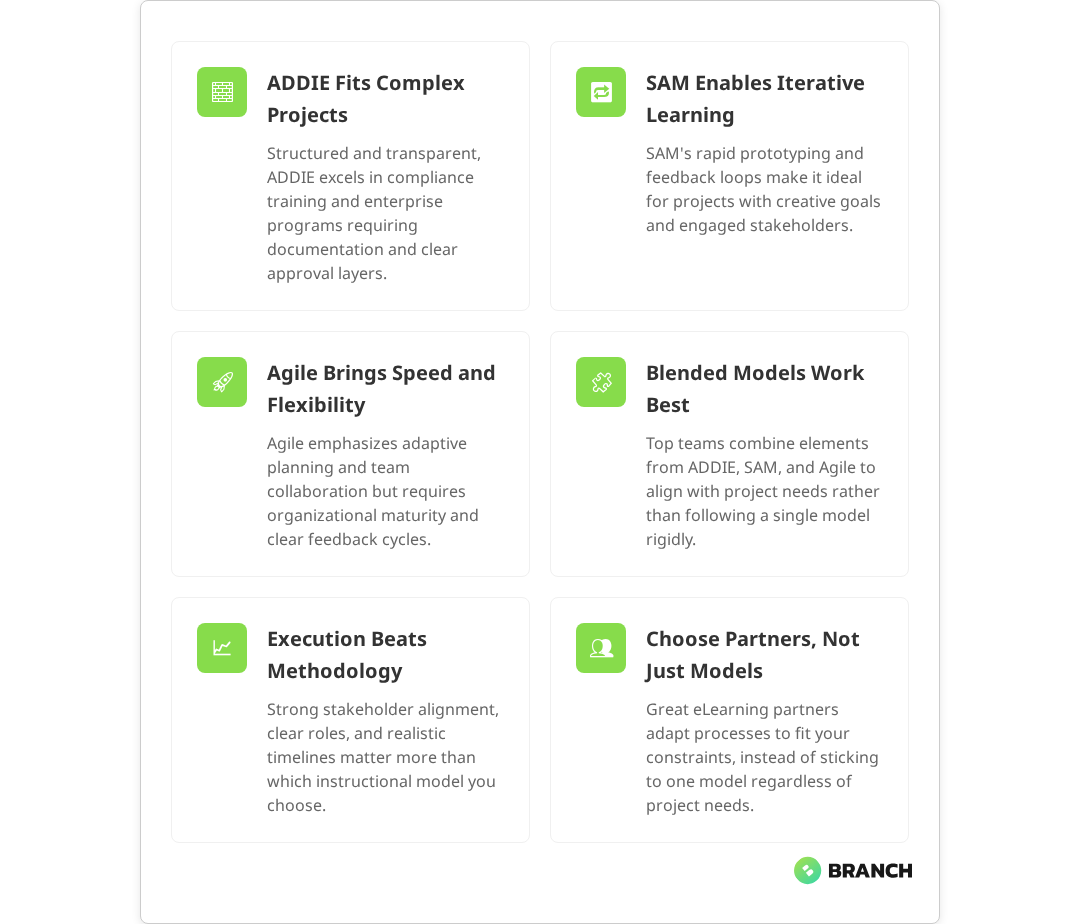
Research shows that the most effective learning development teams blend methodologies based on project constraints, stakeholder needs, and organizational culture. They might use ADDIE’s structure to communicate with unfamiliar clients, SAM’s iterative approach for rapid prototyping, and Agile principles for stakeholder collaboration sometimes all within the same project. This hybrid approach allows teams to match their process to project realities rather than forcing projects to fit rigid methodological frameworks.
ADDIE: The Structured Workhorse
ADDIE (Analysis, Design, Development, Implementation, Evaluation) remains the most widely recognized instructional design model, and for good reason. Multiple sources confirm that it provides a clear, linear framework that’s particularly valuable when working with complex stakeholder groups or clients new to learning development.
When ADDIE Works Best
- Complex compliance training where documentation and approval processes are critical
- Large enterprise projects with multiple subject matter experts and approval layers
- Clients unfamiliar with instructional design who need transparent, step-by-step guidance
- High-stakes learning programs where thorough upfront analysis prevents costly mistakes
ADDIE’s Real-World Challenges
The linear nature of ADDIE can feel rigid when requirements change mid-project (and they always do). Research indicates that once ADDIE development has begun, it does not adapt well to mid-project changes, and shifting project goals can throw the entire process back to the analysis phase. The model works well when you have stable requirements and cooperative subject matter experts, but it can become a bureaucratic burden when stakeholders want to see something tangible quickly.
Additionally, ADDIE’s emphasis on comprehensive upfront analysis can slow initial momentum, leading to pushback from stakeholders who confuse activity with progress. Studies show this front-loaded approach can result in lengthy development cycles, with some courses taking up to two years from approval to delivery.
SAM: ADDIE’s Agile Cousin
The Successive Approximation Model (SAM) emerged as a response to ADDIE’s perceived rigidity. Research confirms that SAM emphasizes iterative development through rapid prototyping and frequent stakeholder feedback cycles, making it more adaptable to changing requirements.
SAM’s Two-Tier Approach
SAM1 works well for smaller, less complex projects with minimal stakeholders. SAM2 adds more formal project management and evaluation phases for larger initiatives.
When SAM Makes Sense
- Innovative learning experiences where the final product isn’t clearly defined upfront
- Projects with engaged stakeholders who can provide timely, meaningful feedback
- Learning programs where user experience and engagement are primary concerns
- Teams comfortable with ambiguity and iterative refinement
SAM’s Hidden Pitfalls
While SAM promises faster delivery through iteration, it requires disciplined scope management. Without clear boundaries, the “successive approximation” can become successive scope creep. Studies highlight that the frequent changes and overlapping phases in SAM can extend timelines and increase costs if scope is not managed carefully. The model also assumes stakeholders understand their role in providing timely, actionable feedback an assumption that often proves optimistic.
Read more: How professional eLearning development processes actually work in practice.
Agile Instructional Design: Promise vs. Practice
Agile principles have migrated from software development into instructional design, bringing concepts like user stories, sprints, and retrospectives to learning development. However, the implementation often falls short of the ideals.
True Agile Characteristics in Learning Design
- Cross-functional collaboration between designers, developers, and stakeholders
- Working prototypes delivered in short iterations
- Adaptive planning based on user feedback and changing requirements
- Continuous improvement through regular retrospectives
Where “Agile” Goes Wrong
Many organizations slap the “Agile” label on chaotic processes that lack clear ownership, defined scope, or meaningful user feedback loops. True Agile requires organizational maturity and stakeholder buy-in that many teams simply don’t possess.
The result? Projects that ping-pong between unclear requirements, with “Agile” becoming an excuse for poor planning rather than a framework for adaptive excellence.
What the research says
- Blended approaches outperform single models: Multiple studies show that teams combining elements from different models achieve better outcomes than those rigidly following one approach
- ADDIE remains valuable for complex projects: Research consistently supports ADDIE’s effectiveness for compliance training and large enterprise initiatives requiring extensive documentation
- SAM requires stakeholder maturity: Evidence indicates SAM’s success depends heavily on engaged stakeholders who can provide meaningful, timely feedback throughout iterative cycles
- Agile principles work across models: Cross-functional collaboration and continuous improvement practices enhance outcomes regardless of the primary methodology chosen
- Context matters more than methodology: Early research suggests that project constraints and organizational readiness are stronger predictors of success than model selection, though more studies are needed to establish definitive best practices
Choosing Your Approach: A Practical Framework
Rather than asking “Which model should we use?” the more useful question is “What constraints and goals shape our project?” Here’s a practical decision framework:
| Project Characteristics | Recommended Primary Approach | Key Adaptations |
|---|---|---|
| Complex compliance with multiple approvers | ADDIE-based | Add SAM-style prototyping for stakeholder alignment |
| Innovative UX with engaged stakeholders | SAM-based | Include Agile retrospectives and user story mapping |
| Ongoing learning platform development | Agile-based | Use ADDIE analysis phase for foundational research |
| Tight timeline with clear requirements | Modified SAM1 | Front-load analysis, compress iteration cycles |
| Uncertain scope with exploratory goals | Design thinking + Agile | Extended discovery phase before development sprints |
Making Models Work in the Real World
Successful instructional design projects share certain characteristics regardless of the underlying model:
Clear Stakeholder Roles and Expectations
Define who provides input, who makes decisions, and who has final approval authority. Ambiguous ownership kills more projects than methodology choices.
Realistic Timeline and Scope Boundaries
Whether you’re using ADDIE’s phases, SAM’s iterations, or Agile sprints, scope creep is the enemy of every model. Build change management processes into your approach from day one.
Meaningful User Feedback Loops
All three models depend on stakeholder input, but they differ in when and how that feedback gets incorporated. Match your feedback approach to your stakeholders’ availability and expertise.
Flexible Documentation
ADDIE traditionally emphasizes comprehensive documentation, while Agile favors working software over documentation. The sweet spot is usually somewhere in between enough documentation to maintain quality and enable handoffs, but not so much that it becomes bureaucratic overhead.
When to Partner with Specialists
Custom eLearning development requires more than choosing the right model it demands expertise in learning science, user experience design, and technical implementation. Consider partnering with specialists when:
- Your internal team lacks experience with iterative development approaches
- The project involves complex technical integrations or custom functionality
- Stakeholder alignment and change management are proving challenging
- You need to balance multiple competing priorities across different organizational levels
A thoughtful digital partner can help you adapt instructional design models to your specific constraints while maintaining focus on learning outcomes rather than process orthodoxy. They bring experience with what actually works across different organizational contexts, not just what sounds good in theory.
Beyond the Model Wars: What Really Matters
Here’s what experienced practitioners know: the model matters less than execution quality and stakeholder alignment. A well-executed ADDIE project will outperform a poorly managed Agile effort every time.
Focus on these fundamentals regardless of your chosen approach:
- Learning objectives that connect to business outcomes
- User research that informs design decisions
- Stakeholder communication that prevents surprises
- Quality assurance that catches problems before launch
- Success metrics that measure actual learning transfer
The teams that succeed understand that instructional design models are tools, not religions. They adapt their approach based on project realities while maintaining unwavering focus on creating learning experiences that actually work for end users.
Whether you’re building custom eLearning development projects, implementing LMS platforms, or developing structured learning courses, success comes from matching your process to your context, not from following any particular model perfectly.
FAQ
Do most instructional design teams actually follow ADDIE, SAM, or Agile strictly?
No, most experienced teams blend elements from different models based on project needs. They might use ADDIE's structure for stakeholder communication, SAM's rapid prototyping for user testing, and Agile principles for team collaboration often within the same project. Pure adherence to any single model is less common than adaptive, hybrid approaches.
How do I know if my team is ready for Agile instructional design?
Successful Agile requires organizational maturity: stakeholders who can provide timely feedback, teams comfortable with ambiguity, and leadership that supports iterative refinement over upfront perfection. If your organization struggles with scope creep or has unclear decision-making authority, address those issues before adopting Agile approaches.
Is SAM just a repackaged version of ADDIE?
While SAM and ADDIE share similar phases, SAM emphasizes iterative development and rapid prototyping where ADDIE follows a more linear progression. SAM's key difference is building working prototypes early and often, while ADDIE typically develops the full solution after comprehensive upfront analysis. However, many practitioners blend both approaches in practice.
What's the biggest mistake teams make when choosing an instructional design model?
The biggest mistake is choosing a model based on what sounds innovative rather than what fits the project constraints. Teams often underestimate the organizational change required for newer approaches like Agile, or they dismiss ADDIE as outdated when its structure would actually help manage complex stakeholder environments.
How should I evaluate an eLearning partner's approach to instructional design models?
Ask for specific examples of how they've adapted their process to different client needs and constraints. Look for partners who can explain the trade-offs between different approaches rather than promoting one model as universally superior. The best partners match their methodology to your project reality, not the other way around.