


When you’re tasked with choosing a corporate learning platform, the alphabet soup of acronyms can feel overwhelming. LMS, LXP, LCMS – and that’s before vendors start throwing around terms like “AI-powered” and “next-generation.” But here’s the thing: behind the marketing jargon are two fundamentally different approaches to how people learn at work.
If you’re a learning and development leader, HR director, or operations manager evaluating digital learning solutions, this guide cuts through the noise. We’ll explore what Learning Management Systems (LMS) and Learning Experience Platforms (LXP) actually do, when each makes sense, and how to navigate the increasingly blurry line between them.
The Core Philosophy: Structure vs. Discovery
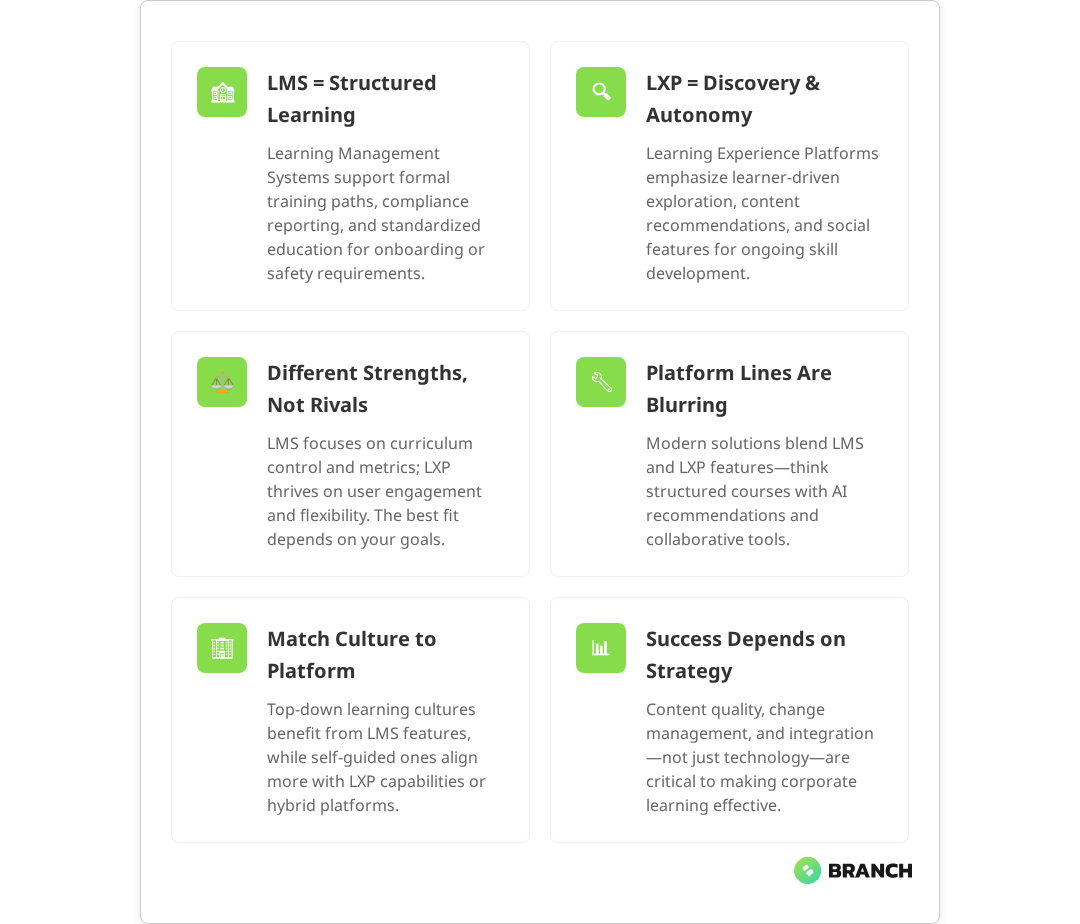
Think of an LMS as the digital equivalent of a traditional classroom. Research consistently shows that Learning Management Systems are designed around managed learning – with clear curriculums, assigned courses, tracked progress, and measurable outcomes. An LXP, on the other hand, works more like YouTube for professional development: Learning Experience Platforms prioritize discovery, social learning, and learner autonomy in driving their own educational journey.
This philosophical difference shapes everything else about how these platforms work:
- LMS approach: “Here’s what you need to learn, when you need to learn it, and how we’ll measure your success.”
- LXP approach: “Here are learning resources tailored to your interests – explore, share, and learn at your own pace.”
Neither approach is inherently better. The question is which one aligns with your organization’s learning culture, compliance requirements, and business objectives.
LMS: The Structured Learning Workhorse
Learning Management Systems excel at what their name suggests: managing the learning process. Multiple industry analyses confirm that LMSs are the go-to choice for organizations that need to deliver consistent training, track completion rates, and demonstrate compliance.
Core LMS Capabilities
- Course administration: Create structured learning paths with prerequisites, deadlines, and automatic enrollment
- Assessment and testing: Built-in quiz tools with detailed scoring and reporting
- Compliance tracking: Generate reports for audits, certifications, and regulatory requirements
- User management: Organize learners by department, role, or location with different access levels
- SCORM compatibility: Support for industry-standard eLearning content formats
LMS platforms shine in scenarios where consistency and measurability matter most. Industry research demonstrates that LMS platforms are particularly well-suited for onboarding new hires, safety training, regulatory compliance, or any situation where you need to prove that specific learning objectives were met.
Read more about eLearning standards like SCORM and xAPI that impact platform compatibility.
LXP: The Social Learning Discovery Engine
Learning Experience Platforms flip the script by putting the learner in the driver’s seat. Current research shows that LXPs use recommendation algorithms, social features, and user-generated content to create a more engaging, personalized learning environment.
Core LXP Capabilities
- Content aggregation: Pull learning resources from multiple sources, including external providers and user submissions
- AI-powered recommendations: Suggest relevant content based on role, interests, and learning history
- Social learning features: Peer-to-peer content sharing, discussion forums, and collaborative projects
- Microlearning support: Bite-sized content designed for just-in-time learning
- Mobile-first design: Optimized for learning on-the-go across devices
Expert analyses indicate that LXPs work best for organizations focused on upskilling, professional development, and creating a culture of continuous learning. They’re particularly effective for knowledge workers who need to stay current with rapidly changing industry trends.
What the research says
- Platform convergence is real: Industry studies from 2025 confirm that modern hybrid platforms now offer comprehensive support for both structured courses and social learning features, making the traditional LMS vs LXP distinction less relevant.
- AI personalization delivers results: Research shows that AI-powered recommendation systems in LXPs can effectively tailor learning paths based on user behavior, role requirements, and learning history, leading to higher engagement rates.
- Compliance tracking remains essential: Multiple sources confirm that robust reporting capabilities for audits and regulatory compliance continue to be a critical differentiator for organizations in regulated industries.
- Implementation success varies widely: Early studies suggest that platform choice matters less than implementation quality, change management, and content strategy, though more research is needed to establish definitive best practices.
The Reality: Platforms Are Blending Features
Here’s where things get interesting – and slightly frustrating for buyers. Current market analysis reveals that the strict distinction between LMS and LXP is increasingly a marketing construct rather than a technical reality. Modern platforms are adopting features from both camps, creating hybrid solutions that challenge the traditional categories.
Today’s LMS platforms often include social learning features, content recommendation engines, and mobile-responsive designs. Meanwhile, LXP vendors are adding formal course structures, assessment tools, and compliance reporting to appeal to enterprise buyers.
| Feature | Traditional LMS | Traditional LXP | Modern Hybrid |
|---|---|---|---|
| Structured courses | Core strength | Limited | Comprehensive |
| Social learning | Limited | Core strength | Comprehensive |
| Compliance reporting | Core strength | Limited | Comprehensive |
| Content discovery | Limited | Core strength | Comprehensive |
| Mobile optimization | Variable | Core strength | Expected standard |
This convergence means you should focus less on whether a platform calls itself an LMS or LXP and more on whether its specific capabilities match your organizational needs.
Making the Right Choice: Key Decision Factors
Rather than getting caught up in platform labels, consider these practical factors when evaluating corporate learning solutions:
Organizational Learning Culture
- Top-down training culture: LMS-heavy approach works well for standardized training programs
- Self-directed learning culture: LXP features become more valuable for employee engagement
- Mixed culture: Look for hybrid platforms that support both structured and exploratory learning
Primary Use Cases
- Compliance and onboarding: LMS capabilities are essential for tracking and reporting
- Skill development and upskilling: LXP features help with discovery and engagement
- Leadership development: Often benefits from hybrid approach combining structure with exploration
Technical Requirements
- Integration needs: How well does the platform connect with your existing HR, payroll, and business systems?
- Content standards: Do you need SCORM, xAPI, or other specific eLearning format support?
- Scalability: Can the platform grow with your organization and handle peak usage periods?
Read more about professional eLearning development processes and platform considerations.
Beyond the Platform: Implementation and Success Factors
Choosing between LMS and LXP capabilities is just the first step. The success of your corporate learning initiative depends heavily on how well you implement and integrate the chosen platform with your broader learning strategy.
Content Strategy Matters More Than Platform
The most sophisticated platform won’t drive engagement without quality content that’s relevant to your learners’ daily challenges. Consider how you’ll source, create, and maintain learning materials – whether that’s through internal subject matter experts, external vendors, or user-generated content approaches.
Change Management Is Critical
Any new learning platform represents a change in how employees access professional development. Success requires clear communication about benefits, adequate training on the new system, and ongoing support to build adoption habits.
Measurement and Iteration
Whether you choose an LMS, LXP, or hybrid approach, establish clear metrics for success beyond simple completion rates. Look at engagement patterns, knowledge retention, performance improvements, and employee feedback to continuously refine your learning strategy.
Working with Learning Technology Specialists
Implementing a corporate learning platform involves more than selecting software. It requires understanding your organization’s unique learning needs, integrating with existing systems, and creating a sustainable content strategy.
Experienced eLearning development teams can help you navigate the technical complexities while keeping focus on the human side of learning. They can assess your current training processes, recommend appropriate platform capabilities, and design custom content that works within your chosen system.
Whether you need help with custom eLearning development, LMS implementation services, or want to see how other organizations have successfully deployed learning platforms like our H-E-B corporate LMS case study, the key is finding partners who understand both the technical requirements and the learning objectives.
The Bottom Line: Focus on Learning Outcomes
The LMS vs LXP debate often misses the most important point: successful corporate learning happens when you align platform capabilities with how your people actually work and learn. Some organizations thrive with structured, compliance-focused approaches. Others need discovery-driven, social learning environments. Many need elements of both.
Instead of choosing based on platform labels, evaluate specific capabilities against your organizational needs. Look for vendors who ask about your learning objectives before pitching features. And remember that the best learning platform is the one your employees will actually use to develop skills that matter to your business.
The future of corporate learning isn’t about picking the right acronym – it’s about creating learning experiences that fit naturally into how your team works and grows together.
FAQ
Can an LMS do everything an LXP does, or vice versa?
Modern platforms increasingly blur these lines, with many LMS solutions adding social features and recommendation engines while LXPs incorporate formal course structures. However, platforms still tend to excel in their core strength – LMS for structure and compliance, LXP for discovery and engagement. The key is finding a solution that covers your primary use cases well rather than trying to do everything.
How do I know if my organization needs LMS or LXP capabilities?
Start by identifying your primary learning objectives. If you need to deliver consistent training, track completion for compliance, or manage formal certification programs, LMS capabilities are essential. If your focus is on skill development, employee engagement, and self-directed learning, LXP features become more valuable. Many organizations benefit from hybrid approaches that support both structured and exploratory learning.
What's the typical implementation timeline for a corporate learning platform?
Implementation timelines vary significantly based on platform complexity, integration requirements, and content migration needs. Simple LMS deployments might take 2-3 months, while comprehensive enterprise implementations with custom integrations can take 6-12 months. The content development and user training phases often take longer than the technical setup, so plan accordingly for change management and adoption activities.
How do learning platforms integrate with existing HR and business systems?
Most modern learning platforms offer API integrations with common HR information systems (HRIS), payroll systems, and business applications. This enables automatic user provisioning, single sign-on, and data synchronization. However, integration complexity varies significantly based on your existing tech stack. It's important to map out integration requirements early in the evaluation process and factor in potential custom development work.
Should we build a custom learning platform or buy an existing solution?
Unless you have very unique requirements or significant technical resources, buying an existing platform is typically more cost-effective and faster to implement. However, custom development makes sense if you need highly specific integrations, have complex workflow requirements that don't fit standard platforms, or want to create a learning experience that's tightly integrated with your existing business applications. Consider hybrid approaches that customize or extend existing platforms rather than building from scratch.