


Most L&D teams know their training programs feel valuable, but proving it with hard numbers? That’s where things get messy. You’ve got completion rates in one spreadsheet, engagement data in another, and business impact scattered across three different systems. Meanwhile, your CFO is asking pointed questions about training spend, and you’re left cobbling together reports that barely scratch the surface of what’s actually happening.
Here’s the thing: measuring training ROI doesn’t have to be a quarterly nightmare of manual data wrangling. With the right LMS analytics approach, you can move beyond basic completion tracking to understand real learning outcomes and business impact. This guide walks through practical strategies for B2B organizations looking to build evidence-based training programs that demonstrate clear value to stakeholders.
Why Most Training ROI Measurement Falls Short
The problem isn’t that organizations don’t want to measure training effectiveness—it’s that they’re often working with incomplete data and outdated approaches. Traditional LMS platforms offer basic activity reporting, but that leaves teams manually tracking everything else in spreadsheets.
Here’s what we typically see in training ROI measurement:
- Activity-focused metrics: Completion rates, login frequency, and time spent become proxies for learning effectiveness, though these don’t directly measure knowledge gain or behavioral change
- Siloed data sources: Training data lives separately from performance management, sales results, or customer satisfaction metrics
- Lag time problems: By the time you see business impact, the training cohort has moved on and variables have changed
- Attribution challenges: Isolating training impact from external variables like market conditions or seasonal trends remains a complex analytical challenge
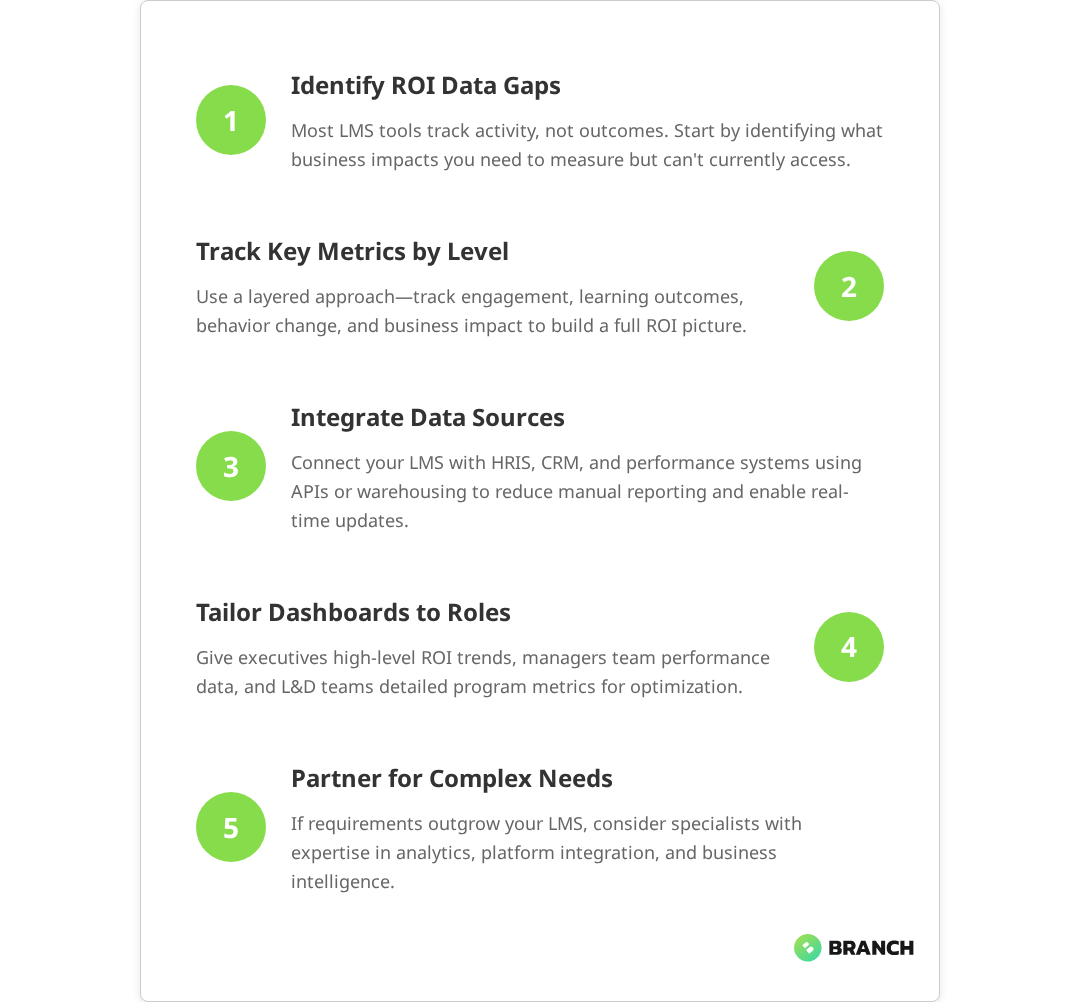
The key insight here is that meaningful ROI measurement requires connecting learning analytics to business outcomes in ways that most standard LMS reporting simply can’t handle. You need data integration, not just data collection.
Essential LMS Analytics for ROI Measurement
Effective training ROI measurement starts with capturing the right data points at the right level of detail. Based on what actually matters to business stakeholders, here are the core metrics that drive meaningful insights:
| Metric Category | Key Data Points | Business Value | Collection Method |
|---|---|---|---|
| Engagement & Completion | Course completion rates, module-level progress, quiz performance, time-on-task | Indicates learning investment and content effectiveness | Standard LMS tracking |
| Learning Outcomes | Skill assessments, knowledge retention, competency progression | Measures actual learning transfer | Integrated assessments, manager evaluations |
| Application & Behavior | On-the-job application, process adherence, tool usage | Shows workplace behavior change | Performance tracking systems, observational data |
| Business Impact | Performance metrics, customer satisfaction, revenue attribution | Direct business outcome connection | CRM, HRIS, customer feedback systems |
The magic happens when these data streams connect. Research shows that tracking learners through course completion to skill demonstration to improved customer satisfaction scores creates a comprehensive ROI narrative that stakeholders can act on.
Read more about building structured eLearning programs that support effective measurement from day one.Data Integration Challenges and Solutions
Most organizations struggle with connecting LMS data to broader business systems. The typical scenario involves manual exports, spreadsheet gymnastics, and reports that are outdated before they’re distributed. Here’s how to move beyond that:
- API-driven connections: Modern LMS platforms integrate directly with your HRIS, CRM, and performance management systems
- Automated reporting workflows: Set up triggers that update stakeholder dashboards when key metrics change
- Role-based access: Different stakeholders need different views—managers want team performance, executives want organizational trends
- Real-time updates: Monthly reports are fine for compliance, but ongoing program optimization needs current data
What the research says
- Studies show that organizations tracking comprehensive learning-to-business-outcome pathways report 24% better performance improvements compared to those using activity metrics alone
- Research indicates that API-driven LMS integrations with business systems reduce manual reporting time by up to 60%, enabling more frequent optimization cycles
- Multiple analyses confirm that Level 3 behavioral metrics (tool adoption, process adherence) are stronger predictors of business outcomes than completion rates
- Early evidence suggests that predictive analytics using engagement patterns can forecast performance improvements 4-8 weeks before they appear in business metrics, though more research is needed on optimal prediction models
- Industry data shows 55% of businesses now integrate their LMS with HRIS systems, indicating this has become standard practice rather than an advanced capability
Building a Practical ROI Measurement Framework
Effective ROI measurement isn’t about tracking everything—it’s about tracking the right things in ways that connect to business decisions. Here’s a framework that works for most B2B training programs:
Level 1: Reaction and Engagement
This covers immediate learner response and participation patterns. While not directly tied to business outcomes, engagement metrics predict downstream success and help identify content or delivery issues early.
- Course completion rates by department, role, or training type
- Engagement depth (time spent, interactions, resource downloads)
- Learner satisfaction and feedback sentiment
- Drop-off points and completion patterns
Level 2: Learning and Knowledge Transfer
Research confirms that pre/post assessment score improvements, skill demonstrations, and knowledge retention checks effectively connect engagement to competency development.
- Pre/post assessment score improvements
- Skill demonstration in controlled settings
- Knowledge retention over time
- Competency progression tracking
Level 3: Behavior Change and Application
The critical bridge between learning and business impact. Multiple studies show that tracking process adherence, tool adoption, manager observations, and peer feedback reliably measures whether training translates into workplace behavior change.
- Process adherence and compliance rates
- Tool adoption and usage patterns
- Manager observations of changed behaviors
- Peer feedback and collaboration indicators
Level 4: Business Results and ROI
This connects learning programs to measurable business outcomes. The key is establishing clear attribution models and tracking cohorts over time. Evidence shows that effective Level 4 measurement includes performance metric improvements in sales, quality, and efficiency, along with customer satisfaction changes and cost savings.
- Performance metric improvements (sales, quality, efficiency)
- Customer satisfaction and retention changes
- Compliance and risk reduction
- Revenue impact and cost savings
Technology Considerations for LMS Analytics
The right technology stack can make ROI measurement seamless, while the wrong one turns it into a monthly data archaeology project. Here’s what to look for:
LMS Platform Capabilities
Your LMS should handle more than just course delivery. Look for platforms that offer:
- Flexible reporting engines: One-click reports filtered by time period, department, training type, or custom segments
- API integration: Seamless data flow to and from other business systems
- Real-time dashboards: Current data for ongoing program management
- Custom field tracking: Ability to capture organization-specific data points
Data Integration and Warehousing
For organizations with complex training ecosystems, consider dedicated data integration approaches:
- Data warehouse solutions that aggregate training, performance, and business data
- ETL processes that clean and standardize data from multiple sources
- Business intelligence tools that create executive-ready visualizations
- Automated alert systems for significant changes or trends
When to Build vs. Buy vs. Extend
| Approach | Best For | Pros | Cons |
|---|---|---|---|
| Off-the-shelf LMS | Standard training programs, limited integration needs | Quick setup, proven functionality, vendor support | Limited customization, may not fit complex workflows |
| Extended/integrated platforms | Existing LMS with specific analytics gaps | Builds on current investment, targeted improvements | Integration complexity, potential vendor lock-in |
| Custom development | Unique business requirements, complex data needs | Perfect fit, complete control, competitive advantage | Higher upfront cost, ongoing maintenance responsibility |
Making ROI Data Actionable for Stakeholders
The best analytics in the world won’t drive business value if stakeholders can’t understand or act on them. Here’s how to translate training ROI measurement into business intelligence:
Executive Dashboards
C-level stakeholders need high-level trends and business impact summaries. Focus on:
- Training investment vs. performance outcome trends
- Department-level ROI comparisons
- Predictive indicators for business risk or opportunity
- Cost per outcome metrics (e.g., cost per competency developed, cost per performance improvement)
Manager Reports
Front-line managers need actionable data about their teams. Provide:
- Individual learner progress and engagement patterns
- Team competency gaps and development priorities
- Correlation between training completion and team performance
- Recommended actions for underperforming learners
L&D Analytics
Training professionals need detailed program optimization data:
- Content effectiveness analysis (which modules drive the best outcomes)
- Learner pathway optimization (ideal sequencing and timing)
- Resource allocation insights (where training investment has highest impact)
- Continuous improvement recommendations
Working with Specialists for Advanced ROI Measurement
Many organizations reach a point where their ROI measurement needs outgrow standard LMS capabilities. When should you consider working with specialists who understand both learning technology and business intelligence?
Signs You Need Specialized Help
- Your training programs impact multiple departments with different success metrics
- You need to connect learning data to complex business outcomes (customer lifetime value, operational efficiency, compliance risk)
- Manual reporting is consuming too much L&D team time
- Stakeholders are asking for predictive analytics or trend forecasting
- You’re evaluating major LMS platform changes or integrations
Teams like Branch Boston specialize in connecting learning technology to broader business intelligence systems. This might involve LMS implementation services that prioritize analytics from day one, or custom eLearning development that builds measurement into the learning experience itself.
The key is working with teams who understand that training ROI measurement isn’t just a reporting problem—it’s a business intelligence challenge that requires connecting learning outcomes to organizational performance in ways that drive real decisions.
For organizations with particularly complex evaluation needs, specialized evaluation and talent performance solutions can provide the advanced analytics infrastructure that turns learning data into competitive advantage.
FAQ
What's a realistic timeframe to see ROI from training programs?
Most organizations see engagement and knowledge transfer results within 30-60 days, but business impact typically takes 3-6 months to become measurable. The key is tracking leading indicators (engagement, skill assessments) while you wait for lagging indicators (performance improvements, business outcomes). Don't expect instant ROI, but you should see positive learning trends quickly if your program is working.
How do you handle attribution when multiple factors affect performance?
Use control groups when possible—compare trained vs. untrained employees in similar roles. Also track multiple variables and use statistical analysis to isolate training impact. Consider cohort-based analysis where you follow specific groups over time. The goal isn't perfect attribution but reasonable confidence that training is contributing to positive outcomes alongside other factors.
What if our current LMS doesn't provide the analytics we need?
You have three main options: extend your current platform with third-party analytics tools, integrate LMS data into a broader business intelligence system, or evaluate platforms with stronger native analytics. Start by clearly defining what ROI data you actually need, then assess whether your current system can be enhanced or if you need to make a platform change.
How detailed should ROI tracking be for different types of training?
Compliance training needs basic completion and knowledge retention tracking. Skills development requires deeper engagement analytics and behavior change measurement. Leadership development demands long-term performance tracking and 360-degree feedback integration. Match your measurement complexity to the business importance and expected impact of each training type.
What's the most common mistake organizations make with training ROI measurement?
Focusing only on activity metrics (completions, logins, time spent) instead of connecting training to actual business outcomes. These engagement metrics matter, but they're not ROI. Real ROI measurement requires tracking learners through to performance improvement, behavior change, or business impact. Start with the business outcome you want and work backward to identify the learning metrics that predict success.