
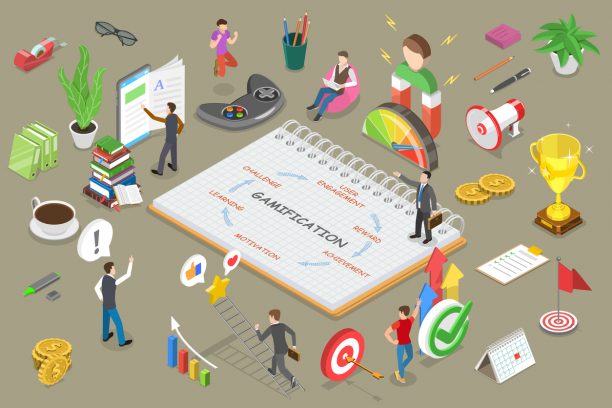

Let’s be honest: most corporate training feels like watching paint dry while filling out tax forms. Employees click through slides, check completion boxes, and promptly forget everything they just “learned.” But here’s where gamification in eLearning gets interesting research shows that when done right, it transforms passive content consumption into active skill-building that actually sticks.
For B2B leaders evaluating eLearning solutions, gamification isn’t just about adding points and badges to make training “fun.” Multiple studies confirm it’s about creating learning experiences that drive measurable behavior change and business outcomes. The key is understanding which game mechanics work, why they work, and how to avoid the common pitfalls that turn engagement tactics into expensive distractions.
The Engagement Problem in Traditional eLearning
Traditional eLearning has a retention problem. Employees complete modules with completion rates that look good on paper, but knowledge retention and real-world application remain frustratingly low. This happens because most eLearning treats learners as passive recipients of information rather than active participants in skill development.
The human brain is wired to learn through practice, feedback, and progression exactly the elements that effective gamification provides. Research demonstrates that gamification incorporates these three core learning mechanisms: interactive practice through challenges and quizzes, instant feedback via progress indicators, and clear progression through levels and achievements. When learners can see their progress, retry challenging scenarios, and receive immediate feedback on their decisions, they engage with content on a deeper level than simple read-and-quiz formats allow.
The difference matters for business outcomes. Organizations that implement thoughtfully designed gamified learning see improvements in:
- Knowledge retention rates (often 75-90% higher than traditional methods)
- Course completion rates and voluntary re-engagement
- Time-to-competency for new skills
- Employee confidence in applying learned concepts
- Measurable performance improvements in real-world scenarios
How Gamification Mechanics Drive Learning
Effective gamification in eLearning works by tapping into psychological drivers that make learning feel natural rather than forced. Understanding these mechanisms helps you evaluate whether a gamified solution will deliver real value or just superficial engagement.
Simulation and Safe Practice
The most powerful gamified learning experiences create realistic simulations where learners can practice skills without real-world consequences. Instead of reading about how to handle difficult customer interactions, employees can work through branching scenarios that respond to their choices. When they make mistakes, they can retry immediately with new knowledge rather than carrying uncertainty into actual customer conversations.
This approach works because it moves beyond recognition and recall (remembering facts) to application and analysis (using knowledge to solve problems). Real mastery happens when learners can confidently navigate complex, realistic situations something traditional content delivery rarely achieves.
Read more: How professional eLearning development creates effective skill-building experiences.
Progress Visualization and Mastery Paths
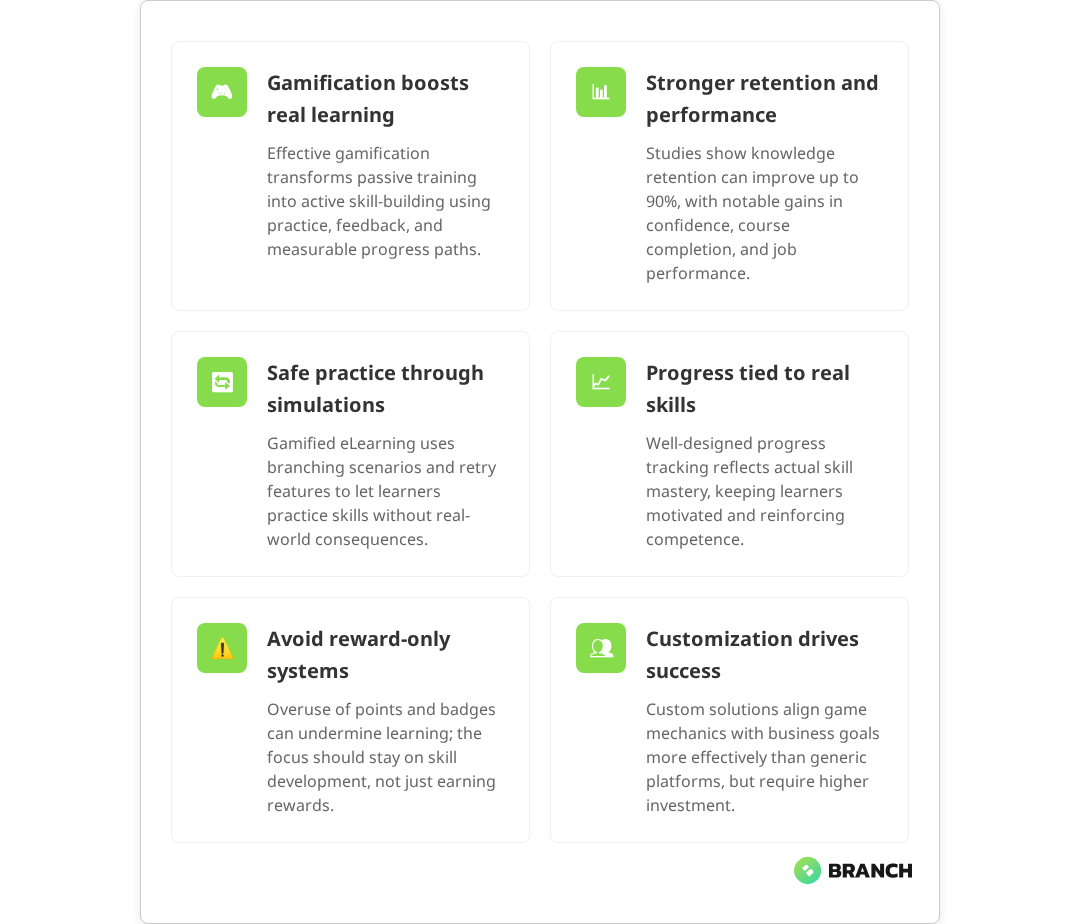
Well-designed gamification makes learning progress visible and meaningful. Rather than a simple progress bar, effective systems show learners how their growing competencies connect to larger goals. This might include skill trees that unlock new capabilities, proficiency levels that reflect real expertise, or achievement systems tied to measurable performance outcomes.
The key is ensuring that progress indicators reflect actual learning rather than just time spent clicking through content. Studies show that learners are more motivated and engaged when progress systems are tied to genuine learning achievements, as this fosters a sense of accomplishment and intrinsic motivation. When progress visualization aligns with genuine skill development, it motivates continued engagement and helps learners understand their own growth trajectory.
What the research says
- Large-scale studies demonstrate that gamification can boost engagement by 60-150%, with one challenge-based program showing 89.45% performance improvement compared to lecture-based education.
- Randomised trials consistently find that gamified learning experiences with immediate feedback and retry mechanisms lead to significantly higher knowledge retention up to 90% higher than traditional methods.
- Evidence from corporate implementations shows gamification drives measurable business outcomes: course completion rates increase by up to 47%, and employees demonstrate improved real-world performance in job-relevant tasks.
- However, research also reveals that effectiveness varies significantly based on design quality not all gamification creates effective learning, and success depends heavily on alignment between game mechanics and learning objectives.
- Studies consistently show that while external rewards boost initial participation, over-reliance on points and badges can shift learner focus away from skill development toward reward optimization, making intrinsic motivation more sustainable long-term.
Strategic Implementation: What Works vs. What Backfires
Not all gamification creates effective learning. The difference between successful and counterproductive implementation often comes down to alignment between game mechanics and learning objectives.
| Effective Approach | Problematic Approach | Why It Matters |
|---|---|---|
| Skill-based challenges with real scenarios | Generic point systems for content consumption | Builds applicable competence vs. gaming the system |
| Immediate feedback on decision outcomes | Delayed or irrelevant rewards | Reinforces learning in context vs. disconnected motivation |
| Retry mechanisms that encourage experimentation | One-shot assessments with pass/fail outcomes | Supports mastery learning vs. anxiety-inducing evaluation |
| Progress tied to demonstrable skills | Completion badges without competency validation | Reflects real capability vs. checkbox completion |
The Extrinsic Motivation Trap
Many organizations fall into the trap of focusing on external rewards discounts, prizes, or public recognition without considering how these incentives interact with learning goals. While external motivators can boost initial participation, research from cognitive psychology demonstrates they can also shift focus away from skill development toward reward optimization.
The most sustainable gamified learning systems emphasize intrinsic motivators: the satisfaction of mastering new skills, the confidence that comes from successful problem-solving, and the recognition that follows demonstrated competence. External rewards work best when they celebrate meaningful achievements rather than driving the learning process itself.
Accessibility and Inclusive Design
Gamified eLearning must work for learners with diverse needs and abilities. This goes beyond basic accessibility compliance to consider how interactive elements, multimedia feedback, and navigation patterns affect different users. Current accessibility standards confirm that visual progress indicators need audio alternatives, timed challenges need accommodation options, and complex interfaces need simplified navigation paths.
Designing for accessibility from the start creates better experiences for all learners, not just those with specific needs. It also ensures that gamification enhances rather than creates barriers to learning.
Implementation Considerations for B2B Organizations
Successfully implementing gamification in eLearning requires careful planning around your organization’s specific context, constraints, and goals.
Technology and Integration Requirements
Gamified eLearning often requires more sophisticated tracking and interaction capabilities than traditional content delivery. Industry analysis shows that effective gamification requires expertise in instructional design, game mechanics, and sophisticated development capabilities. You’ll need to consider:
- Learning analytics: Systems that can track detailed interaction patterns, not just completion status
- Standards compliance: Integration with existing LMS infrastructure through SCORM, xAPI, or cmi5 standards
- Performance optimization: Interactive content that loads reliably across different devices and network conditions
- Data privacy: Secure handling of detailed learning behavior data
Content Development and Maintenance
Gamified content typically requires more upfront development investment than traditional eLearning, but this investment pays dividends in engagement and effectiveness. Key considerations include:
- Scenario development based on real workplace situations
- Iterative testing and refinement based on learner feedback
- Regular content updates to maintain relevance and challenge
- Cross-functional collaboration between instructional designers, UX professionals, and subject matter experts
Read more: Understanding eLearning standards for gamified content integration.
Making the Build vs. Buy Decision
Organizations considering gamified eLearning face several implementation options, each with distinct trade-offs in cost, customization, and time-to-deployment.
Off-the-Shelf Gamification Platforms
Best for: Organizations with standard training needs and limited customization requirements.
These platforms offer pre-built game mechanics that can be applied to existing content. They’re typically faster to deploy and less expensive upfront, but may not align perfectly with your specific learning objectives or organizational context. The gamification elements may feel generic rather than integrated into your content and culture.
Custom Gamified Learning Solutions
Best for: Organizations with unique training requirements, complex skill development needs, or specific brand/culture considerations.
Custom development allows for deeper integration between game mechanics and learning objectives. This approach can create more engaging, effective experiences but requires significant upfront investment and longer development timelines. The payoff comes in better alignment with business goals and more sustainable learner engagement.
Hybrid Approaches
Best for: Organizations that want some customization without full custom development costs.
Many successful implementations combine customizable platforms with targeted custom development for specific high-impact areas. This might mean using a flexible framework for general training needs while investing in custom simulation development for critical skills training.
Measuring Success Beyond Engagement Metrics
The true value of gamification in eLearning shows up in business outcomes, not just engagement statistics. Effective measurement requires tracking both learning indicators and performance results.
Leading Indicators (Learning Metrics)
- Scenario completion rates and retry patterns
- Time spent on challenging content vs. simple content
- Help-seeking behavior and resource utilization
- Peer collaboration and knowledge sharing activities
Lagging Indicators (Business Outcomes)
- Performance improvements in actual job tasks
- Reduced error rates or faster problem resolution
- Employee confidence and competence assessments
- Customer satisfaction scores for trained employees
- Time-to-productivity for new hires or role transitions
The most convincing ROI data comes from connecting learning engagement patterns to measurable business improvements. When you can show that employees who engaged deeply with gamified simulations perform better in real scenarios, you have a compelling case for continued investment.
Working with eLearning Development Partners
Many organizations find that effective gamified eLearning requires expertise they don’t have in-house combining instructional design, user experience design, technical development, and performance measurement in ways that few internal teams can manage alone.
The right development partner brings together specialists who understand how game mechanics support learning objectives rather than just engagement metrics. They can help you avoid common pitfalls like superficial point systems or accessibility barriers while creating experiences that align with your specific organizational context and constraints.
Look for partners who start with learning outcomes and business goals rather than technology features. The best collaborations focus on understanding your learners’ real challenges and designing solutions that address those challenges through thoughtfully applied game design principles.
A team like Branch Boston can help organizations navigate the strategic decisions around gamification from initial feasibility assessment through custom development and performance measurement. The goal is creating eLearning experiences that employees actually want to engage with because they’re genuinely helpful for doing their jobs better.
For organizations ready to move beyond checkbox compliance training toward skill-building experiences that drive business results, custom eLearning development offers the flexibility to implement gamification strategies that align with your specific needs and constraints.
FAQ
What's the difference between gamification and game-based learning?
Gamification applies game design elements (points, levels, challenges) to traditional learning content, while game-based learning uses actual games as the primary learning vehicle. Gamification enhances existing content; game-based learning replaces it with interactive simulations or serious games. Both can be effective, but gamification is often easier to implement gradually.
How do you prevent gamification from becoming a distraction from actual learning?
The key is aligning game mechanics directly with learning objectives rather than adding them as superficial elements. Focus on mechanics that reinforce skill practice like scenario-based challenges or mastery progression rather than generic point systems. Always test whether gamified elements help learners demonstrate competence, not just engagement.
What types of training content work best with gamification?
Gamification works exceptionally well for procedural training, decision-making skills, customer interaction scenarios, and complex problem-solving tasks. It's less effective for purely informational content or compliance training that doesn't require skill application. The best candidates are training areas where practice and feedback improve real-world performance.
How much more expensive is gamified eLearning compared to traditional approaches?
Custom gamified eLearning typically costs 2-4x more than traditional content initially, but often delivers better ROI through improved retention and performance outcomes. Off-the-shelf gamification tools can reduce upfront costs but may sacrifice effectiveness. Consider starting with high-impact pilot programs to demonstrate value before scaling investment.
Can gamification work for compliance training or mandatory courses?
Yes, but it requires careful design to avoid trivializing serious content. Focus on scenario-based practice rather than entertainment elements. Use gamification to help employees practice applying compliance knowledge in realistic situations rather than just memorizing rules. The goal is building confident, competent behavior, not making compliance 'fun.'