


Your team needs better communication. Collaboration feels stilted. Managers struggle to give feedback effectively. Sound familiar? You’re not alone—soft skills gaps consistently rank among the top workforce challenges, yet recent research shows that only one-fifth of employees feel they receive effective soft skills training from their organizations.
The problem isn’t a lack of content. There’s no shortage of leadership modules, communication courses, or teamwork workshops out there. The real challenge is choosing methods that drive genuine behavioral change rather than just ticking compliance boxes. Whether you’re a learning and development leader, HR director, or operations manager tasked with upskilling your team, you need approaches that work in the real world—not just in theory.
Let’s explore the most effective methods for soft skills training, the trade-offs you’ll face, and how to design programs that actually change how people work together.
Why Most Soft Skills Training Falls Flat
Before diving into what works, let’s acknowledge what doesn’t. Generic soft skills content—the kind that gets rolled out enterprise-wide with minimal customization—typically sees adoption rates of just 5-10%. That’s not because employees don’t value communication or leadership skills. It’s because the training doesn’t connect to their daily reality.
Research has identified three common failure modes that plague soft skills training:
- Solution without a problem: Content that isn’t tied to specific business challenges your organization faces
- Digital-only delivery: Relying purely on eLearning modules without human reinforcement or coaching
- One-size-fits-all approach: Generic content that doesn’t reflect your team’s roles, industry, or organizational culture
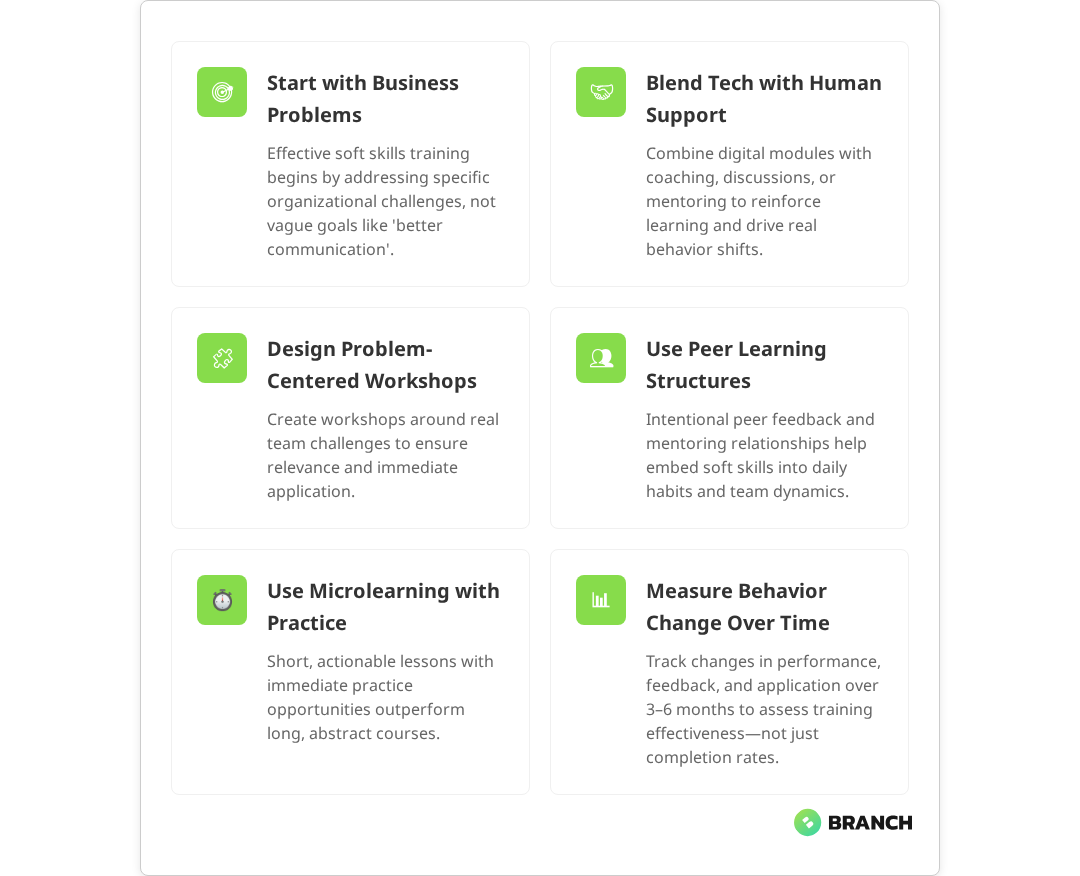
The most effective soft skills training flips these problems on their head. Instead of starting with content, start with the specific performance gaps you need to address.
The Four Most Effective Training Methods
Based on what actually works in practice, here are the four methods that consistently deliver behavioral change:
1. Blended Learning with Human Support
Pure digital content rarely drives culture change on its own. Research consistently shows that the most successful soft skills programs combine digital resources with human-led elements like facilitated discussions, peer learning sessions, or one-on-one coaching.
This hybrid approach works because soft skills are inherently interpersonal. You can’t truly practice active listening or conflict resolution through a screen—you need real interactions with feedback and guidance.
2. Problem-Centered Workshops
Instead of abstract training on “leadership principles,” focus workshops on specific challenges your team faces. For example, if project handoffs consistently create confusion, design a session around stakeholder communication and documentation practices.
These workshops work best when they:
- Address real scenarios from your organization
- Include role-playing with actual team dynamics
- Produce actionable tools or templates participants can use immediately
Read more about designing effective learning experiences that stick.
3. Peer Learning and Mentoring Programs
Some of the most powerful soft skills development happens through structured peer interactions. This might include cross-functional project teams, mentoring relationships, or regular feedback partnerships.
The key is making these interactions intentional rather than hoping they happen organically. Provide frameworks for giving and receiving feedback, templates for difficult conversations, and regular check-ins to ensure the relationships are productive.
4. Microlearning with Practical Application
Rather than lengthy courses, break soft skills training into bite-sized lessons tied to immediate application. Recent studies show that a 10-minute module on giving constructive feedback, followed by a template and an assignment to practice with a real team member, often proves more effective than a two-hour workshop.
This approach works because it reduces cognitive load and creates multiple opportunities for practice and reinforcement.
What the research says
- Blended approaches outperform single methods: Multiple studies confirm that combining digital content with human-led elements like coaching and facilitated discussions leads to better skill retention and application than purely digital training.
- Microlearning boosts engagement and outcomes: Research shows that bite-sized training modules can reduce training time by up to 80% while improving engagement by 50% and enhancing real-world skill application.
- Business alignment is crucial: Training programs that address specific organizational challenges rather than generic skills see significantly higher adoption rates and measurable business impact.
- Manager involvement is critical: Studies indicate that manager buy-in and active participation can influence up to 70% of training effectiveness, making leadership support essential for success.
- Measurement needs time: Early research suggests that while initial enthusiasm may appear within weeks, genuine behavior change typically requires 3-6 months to become visible and measurable.
Choosing the Right Approach for Your Organization
The best training method depends on your specific context. Here’s a framework for making that decision:
| Your Situation | Recommended Approach | Key Success Factors |
|---|---|---|
| Small team (under 50), specific skill gaps | Problem-centered workshops | Address real scenarios; include all stakeholders |
| Large organization, broad skill development | Blended learning program | Strong managerial support; clear success metrics |
| Remote or distributed teams | Microlearning + peer partnerships | Structured interaction frameworks; regular check-ins |
| Leadership development focus | Mentoring + targeted workshops | Executive sponsorship; real project assignments |
| Limited budget or pilot program | Curated content + facilitated discussions | Strong curation; consistent facilitation quality |
Building vs. Buying: Your Content Options
Once you’ve selected your delivery method, you need to decide on content. You have three main options, each with distinct trade-offs:
Off-the-Shelf Solutions
Best for: Common skill areas with broad applicability (basic communication, time management)
Pros: Quick deployment, lower upfront cost, professionally produced
Cons: Generic scenarios, limited customization, may not reflect your culture
Curated and Customized Content
Best for: Organizations with specific industry context or unique challenges
Pros: Relevant scenarios, aligned with company values, can incorporate real examples
Cons: Higher upfront investment, longer development timeline
Fully Custom Development
Best for: Complex skill development tied to specific business processes or unique organizational dynamics
Pros: Perfectly aligned with business needs, can integrate with existing workflows
Cons: Significant time and budget investment, requires ongoing maintenance
Measuring Success Beyond Completion Rates
The metrics that matter for soft skills training go beyond traditional learning analytics. While completion rates and quiz scores provide basic data, they don’t tell you if behavior actually changed.
Expert frameworks recommend more meaningful metrics including:
- Performance indicators: Project success rates, stakeholder satisfaction scores, conflict resolution times
- 360-degree feedback: Pre- and post-training assessments from peers, direct reports, and managers
- Application tracking: Evidence that participants are using tools or frameworks from training in real work situations
- Business impact: Improvements in collaboration, communication effectiveness, or team performance tied to training initiatives
The key is establishing baseline measurements before training begins and tracking changes over 3-6 month periods, not just immediate post-training surveys. Multiple training specialists emphasize that this extended timeframe allows you to measure sustained behavioral change rather than just initial enthusiasm.
Read more about how Branch Boston designs measurable soft skills training programs.
When to Partner with Specialists
While some organizations successfully develop soft skills training internally, others benefit from working with experienced learning design partners. Consider external help when:
- You need custom content that reflects complex business processes or unique organizational challenges
- Your internal team lacks instructional design expertise or bandwidth
- You want to integrate multiple delivery methods (digital + facilitated + coaching) into a cohesive program
- You need to scale training across multiple locations or business units while maintaining consistency
The right partner will start by understanding your specific business problems, not pushing a predetermined solution. They should be able to demonstrate experience with both content development and program implementation, including change management support.
At Branch Boston, we’ve found that the most successful soft skills training programs combine thoughtful instructional design with deep understanding of how teams actually work. Rather than generic modules, we create learning experiences tied to real business outcomes—whether that’s leadership development for emerging managers or communication training for cross-functional project teams.
Getting Started: A Practical Framework
Ready to design soft skills training that actually works? Here’s a step-by-step approach:
- Identify specific problems: What business challenges could better soft skills address? Be concrete.
- Choose your pilot group: Start small with 10-20 participants who are motivated to participate and represent your broader audience.
- Select delivery method: Use the decision framework above to choose an approach that fits your constraints and culture.
- Design measurement strategy: Establish baseline metrics and plan for tracking both learning and behavior change.
- Test and iterate: Run your pilot, gather feedback, and refine before scaling.
Remember, effective soft skills training is less about finding the perfect content and more about creating consistent opportunities for practice, feedback, and reflection. The organizations that see real results treat skill development as an ongoing process, not a one-time event.
Whether you build internally or work with a partner like Branch Boston for custom eLearning development, focus on creating learning experiences that connect directly to how your team works—and the business problems you’re trying to solve.
FAQ
How long does it take to see results from soft skills training?
Genuine behavior change typically takes 3-6 months to become visible and measurable. You might see initial engagement and enthusiasm within weeks, but sustainable changes in communication patterns, leadership behaviors, or collaboration effectiveness require consistent practice and reinforcement over several months.
What's the biggest mistake organizations make with soft skills training?
Rolling out generic content without tying it to specific business problems. When training feels disconnected from daily work challenges, adoption rates plummet. Start by identifying 2-3 concrete performance gaps, then design training to address those specific issues rather than general 'communication skills.'
Can soft skills training work for remote teams?
Absolutely, but it requires different approaches than in-person training. Focus on microlearning modules paired with structured peer partnerships or mentoring relationships. Virtual role-playing sessions and regular practice opportunities through video calls can be highly effective when well-facilitated.
How much should we budget for effective soft skills training?
Budget varies widely based on approach and scale. Simple curated content with internal facilitation might cost $500-1,500 per participant, while fully custom blended programs with coaching support can range from $2,000-5,000 per participant. The key is aligning investment with expected business impact and measuring ROI through performance improvements.
Do managers need special training to support soft skills development?
Yes, manager buy-in and participation dramatically increases training effectiveness. Managers need frameworks for reinforcing learning, giving feedback on skill application, and modeling the behaviors you're trying to develop. Consider training managers first or running parallel manager development alongside employee programs.