


Employee onboarding isn’t just about filling out forms and watching compliance videos—though plenty of programs still feel that way. Done right, research shows that effective onboarding programs can improve retention by over 80% and increase productivity by more than 70%, transforming nervous first-day energy into confident, productive team members who stick around. Done wrong, it’s a bureaucratic slog that leaves new hires questioning their decision to join your organization.
The challenge? Most onboarding programs are built around internal convenience rather than human experience—a problem supported by recent data showing that only about 12% of employees rate their onboarding as satisfactory. They scatter tasks across disconnected systems, burden managers with complex workflows they’ll inevitably skip, and treat learning like a checklist instead of a journey. The result is predictable: inconsistent experiences, frustrated stakeholders, and new employees who feel more lost after onboarding than before.
This guide breaks down how to build employee onboarding programs that actually work—combining structured learning pathways, practical task management, and the kind of thoughtful design that makes complex processes feel surprisingly simple.
Why Most Onboarding Programs Miss the Mark
The fundamental problem with most employee onboarding programs isn’t a lack of good intentions—it’s a mismatch between ambitious goals and practical execution. Organizations want comprehensive, engaging experiences that cover everything from culture to compliance. What they often get are fragmented systems that create more confusion than clarity.
Consider the typical onboarding experience: new hires log into one platform for HR paperwork, another for training modules, receive a separate checklist from their manager (if they’re lucky), and somehow need to track their progress across all three. Meanwhile, managers juggle their own set of tasks—facility tours, equipment setup, introductions—often with no systematic way to ensure nothing falls through the cracks.
This fragmentation creates several cascading problems that research confirms are widespread across organizations:
- Accountability gaps: When tasks span multiple systems and stakeholders, research shows that only 36% of HR leaders describe the handoff between recruiting, HR, and hiring managers as seamless, making it easy for critical steps to get lost or delayed.
- Inconsistent experiences: Different departments or managers deliver wildly different onboarding quality, creating unfair advantages for some new hires. Studies indicate that nearly one in three HR leaders report new hires receive no guidance at all.
- Manager resistance: Complex workflows that don’t fit into managers’ existing routines often get abandoned in favor of informal, ad-hoc approaches—a pattern consistently observed when onboarding systems are too complex or time-consuming for busy managers.
- Poor visibility: HR teams struggle to understand where onboarding breaks down or which elements actually drive retention and performance, with many organizations lacking the data needed to continuously improve their processes.
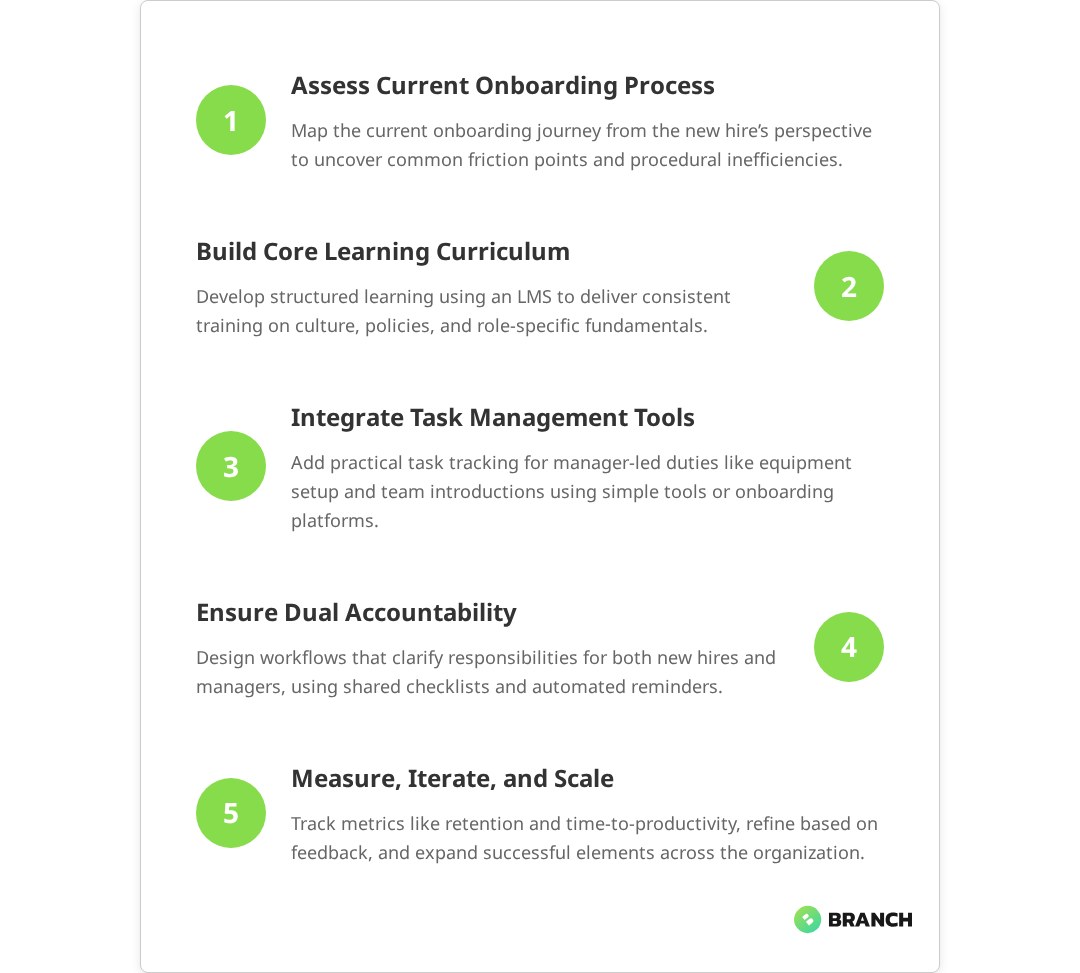
The solution isn’t necessarily more sophisticated technology—it’s better-designed processes that account for how people actually work. This means understanding the constraints and motivations of every stakeholder, from busy hiring managers to overwhelmed new employees trying to absorb an organization’s worth of information in their first few weeks.
What the research says
Multiple studies and industry analyses reveal consistent patterns about what makes onboarding programs successful:
- Structured approaches deliver measurable results: Organizations with formal onboarding processes see significantly higher retention rates and faster time-to-productivity compared to informal approaches.
- Consistency matters more than sophistication: Research indicates that standardized onboarding experiences, even simple ones, outperform inconsistent high-touch approaches in terms of new hire satisfaction and outcomes.
- Manager engagement is critical but often missing: Studies show that nearly 29% of new hires receive inadequate guidance from their managers, highlighting a key gap in most onboarding programs.
- Integration challenges are widespread: The majority of organizations struggle with fragmented onboarding systems, with less than half reporting seamless coordination between different departments and platforms.
- Early evidence suggests technology alone isn’t the solution: While digital platforms can improve efficiency, the research shows that human connection and clear process design remain the strongest predictors of onboarding success.
The Architecture of Effective Onboarding
Successful employee onboarding programs share a common architecture: they combine structured learning pathways with flexible task management, all wrapped in systems that make it easy for both employees and managers to stay on track. Research confirms that effective onboarding programs blend formal learning, informal mentoring, and flexible delivery methods to ensure both engagement and consistency. The key is understanding which elements belong in formal learning platforms versus lightweight collaboration tools.
Learning Management Systems: The Structured Core
Modern Learning Management Systems (LMS) excel at delivering structured, trackable learning experiences. Features like learning pathways or curriculums allow you to sequence courses, documents, and assessments in logical progression, complete with due dates and prerequisites. This structure is particularly valuable for onboarding because it provides consistency while accommodating role-specific variations—a capability that multiple studies confirm improves both retention and employee productivity.
For example, all new hires might complete a foundational curriculum covering company culture, policies, and basic systems training. Role-specific paths then branch off—sales team members get CRM training and pipeline methodology, while engineering hires dive into development workflows and code review processes. The LMS tracks completion across all paths, giving HR teams visibility into progress and bottlenecks.
The most effective onboarding curriculums blend multiple content types:
- Self-paced eLearning modules for foundational knowledge and policies
- Virtual instructor-led training (VILT) for interactive sessions requiring discussion or practice
- Document libraries for reference materials and job aids
- Assessment checkpoints to verify understanding and completion
Task Management: The Practical Layer
While LMS platforms handle structured learning well, they often struggle with the practical, relationship-heavy tasks that make onboarding successful. Equipment setup, facility tours, team introductions, and workspace assignments typically require coordination between the new hire and their manager—and these interactions don’t always fit neatly into course-based workflows.
This is where lightweight task management becomes critical. Research suggests that while simple tools—shared spreadsheets, project management platforms, or even built-in LMS checklists—can track these less formal but equally important elements, purpose-built onboarding platforms with integrated task management significantly outperform generic approaches as organizations scale. The key is keeping manager-facing workflows as simple as possible while maintaining visibility for HR teams.
Read more about integrating training data with HCMS for streamlined HR workflows.
Design Principles for Onboarding That Sticks
Effective employee onboarding programs are built on a few core design principles that prioritize human experience over administrative convenience. These principles help navigate the inevitable trade-offs between comprehensiveness and simplicity, structure and flexibility.
Start with Stakeholder Reality
The best onboarding designs begin with honest assessment of how different stakeholders actually work. New hires are drinking from a fire hose—every additional login, platform, or process adds cognitive load. Hiring managers are typically juggling their regular responsibilities alongside onboarding duties—complex workflows get deprioritized or skipped entirely.
This reality check often reveals that simpler approaches work better than sophisticated ones. A shared spreadsheet that managers actually use trumps an elegant LMS workflow they ignore. A single learning pathway with embedded manager checkpoints often works better than separate systems for learning and task management.
Design for Dual Accountability
Successful onboarding requires coordination between new employees and their managers, but tracking shared accountability can be tricky. Some tasks are purely employee-driven (completing training modules), others require manager action (equipment setup, introductions), and many involve both parties (goal-setting conversations, role-specific training).
The most effective programs make this dual accountability explicit rather than hoping it happens naturally. This might mean:
- Manager-verified completion steps in learning curriculums
- Automated reminders to both parties when collaborative tasks are approaching deadlines
- Separate but linked tracking systems that give each party visibility into their responsibilities
- Clear escalation paths when tasks get stuck between stakeholders
| Onboarding Element | Best Platform Type | Key Stakeholders | Success Metrics |
|---|---|---|---|
| Company culture & policies | LMS curriculum | New hire, HR | Completion rates, assessment scores |
| Role-specific training | LMS with manager verification | New hire, manager, subject experts | Competency demonstrations, manager feedback |
| Equipment & workspace setup | Simple task tracker | Manager, IT, facilities | Setup completion time, new hire satisfaction |
| Team introductions & networking | Calendar integration or task list | Manager, team members | Introduction completion, relationship quality |
| Goal setting & expectations | Collaborative documents or forms | New hire, manager | Goal clarity scores, alignment feedback |
Implementation Strategies: From Planning to Launch
Building an effective employee onboarding program requires careful orchestration of content, technology, and stakeholder needs. The most successful implementations follow a structured approach that prioritizes quick wins while building toward comprehensive solutions.
Phase 1: Foundation and Core Content
Start with the elements that provide immediate value and are least dependent on complex integrations. This typically means focusing on structured learning content that can live in a single platform—company culture, policies, basic systems training, and role-specific fundamentals.
During this phase, invest time in content quality rather than technological sophistication. Well-designed learning modules that new hires can complete independently provide immediate value while you work on more complex coordination elements. This also gives you time to observe how different stakeholders interact with the system and where friction points emerge.
Phase 2: Task Integration and Workflow Optimization
Once your core learning content is solid, layer in the practical elements that require coordination between stakeholders. This is where you’ll need to make critical decisions about platform integration versus separation.
Some organizations find success with all-in-one LMS platforms that include task management features. Others prefer best-of-breed approaches that connect specialized learning platforms with dedicated project management tools. The right choice depends on your stakeholder preferences, existing technology stack, and organizational complexity.
Key considerations for this phase:
- Manager adoption barriers: Will hiring managers consistently use complex workflows, or do you need simpler alternatives?
- Integration complexity: How much technical effort is required to connect different systems, and is that effort justified by the benefits?
- Scalability requirements: Will your approach work as well for high-volume hiring periods as it does for steady-state onboarding?
- Measurement and improvement: What data do you need to continuously optimize the experience, and can your chosen tools provide it?
Phase 3: Measurement, Iteration, and Advanced Features
Once your basic onboarding architecture is stable and adopted, focus on measurement systems that help you understand what’s working and what isn’t. This goes beyond simple completion metrics to include engagement quality, stakeholder satisfaction, and business outcomes like retention and time-to-productivity.
Advanced features—personalized learning paths, AI-powered content recommendations, sophisticated progress analytics—become valuable only after you’ve solved the fundamental design and adoption challenges. These enhancements can provide significant value, but they’re not substitutes for clear processes and stakeholder-friendly workflows.
Read more about Branch Boston's approach to custom employee onboarding program development.
When to Build Custom vs. Extend Existing Platforms
One of the most consequential decisions in onboarding program development is whether to work within existing platforms, extend them with custom features, or build something entirely new. Each approach has distinct advantages and constraints that become more pronounced as your onboarding requirements grow more sophisticated.
Working Within Existing Platforms
Most organizations already have HR systems, learning management platforms, or collaboration tools that can support basic onboarding workflows. This approach offers the fastest path to implementation and lowest ongoing maintenance burden, but may require compromising on ideal user experiences or specific functionality needs.
Existing platforms work best when your onboarding process is relatively straightforward and aligns well with the platform’s intended use cases. For example, if you have an LMS with robust curriculum features and your onboarding is primarily learning-focused, you might achieve 80% of your goals with configuration rather than custom development.
The limitation comes when your process requires coordination across multiple stakeholders, complex conditional logic, or integration with specialized systems. Forcing these requirements into platforms that weren’t designed for them often creates awkward user experiences and maintenance headaches.
Custom Extensions and Integrations
Sometimes the middle path makes most sense: keeping your core platforms while building custom components that address specific gaps or integration needs. This might mean developing custom dashboards that aggregate data from multiple systems, building workflow automation that connects your LMS to task management tools, or creating specialized interfaces for managers who need simplified access to onboarding oversight functions.
This approach requires more technical sophistication but can provide significant advantages in user experience and operational efficiency. The key is identifying the minimum viable extensions that solve your most critical problems while avoiding the complexity trap of over-engineering solutions.
When Custom Development Makes Sense
Fully custom onboarding platforms become appropriate when your organizational needs, compliance requirements, or stakeholder workflows are sufficiently unique that existing solutions create more problems than they solve. This typically happens in highly regulated industries, complex organizational structures, or situations where onboarding is closely integrated with performance management and career development systems.
Custom development also makes sense when onboarding quality is a significant competitive advantage—either for talent attraction or operational efficiency—and the investment in bespoke solutions provides measurable business returns.
| Approach | Best For | Typical Investment | Time to Value | Long-term Flexibility |
|---|---|---|---|---|
| Existing platform configuration | Straightforward processes, standard workflows | Low | Weeks | Limited by platform capabilities |
| Custom extensions & integrations | Good platforms with specific gaps | Medium | Months | High for targeted improvements |
| Fully custom development | Complex requirements, competitive advantage | High | Months to quarters | Complete control over evolution |
Making the Business Case for Better Onboarding
Employee onboarding improvements often get delayed because the benefits feel soft and long-term while the costs are immediate and visible. Building a compelling business case requires connecting onboarding quality to measurable business outcomes and demonstrating that thoughtful design pays for itself through improved retention, faster productivity ramp, and reduced administrative overhead.
Quantifying the Current State
Before proposing solutions, establish baseline metrics that capture both the direct costs of poor onboarding and the opportunity costs of suboptimal experiences. Direct costs include administrative time spent managing fragmented processes, IT support for confused new hires, and manager time devoted to ad-hoc onboarding tasks.
Opportunity costs are often larger but harder to measure: new hires who leave during their first 90 days, extended time-to-productivity periods, and inconsistent experiences that create unfair advantages for some employees while leaving others behind. These costs compound over time and become particularly visible during high-growth periods when onboarding volume increases.
Connecting Experience to Outcomes
The most compelling business cases connect specific onboarding improvements to measurable business outcomes. This might mean demonstrating how structured learning paths reduce time-to-first-sale for sales hires, how streamlined task management improves manager satisfaction scores, or how integrated systems reduce HR administrative burden.
These connections become stronger when you can point to specific friction points in your current process and explain how proposed improvements address them. For example, if new hires frequently report feeling lost during their first week, you can connect improved coordination workflows to engagement scores and early retention rates.
Partnering with Specialized Teams
Organizations often underestimate the specialized expertise required to build truly effective onboarding experiences. Learning design, user experience optimization, systems integration, and stakeholder workflow analysis each require different skill sets that may not exist in-house.
This is where partnerships with teams like Branch Boston become valuable. Rather than trying to build internal expertise in every required discipline, you can leverage specialists who understand both the technical and human elements of effective onboarding design. This approach often provides faster time-to-value and better long-term outcomes than attempting to build everything internally.
The key is finding partners who understand that good onboarding isn’t just about technology—it’s about creating human-centered experiences that work within your organizational constraints and stakeholder realities.
Read more about custom eLearning development for complex organizational workflows.
Getting Started: Your Onboarding Design Roadmap
Building better employee onboarding programs doesn’t require massive upfront investments or months of planning—but it does require systematic thinking about stakeholder needs and realistic assessment of organizational capabilities. Here’s how to approach your onboarding improvements strategically.
Assessment and Discovery
Start by mapping your current onboarding experience from multiple perspectives. What does the process look like for new hires? What tasks and coordination points burden managers? Where do HR teams spend time on manual processes or problem-solving?
This discovery phase often reveals that the biggest problems aren’t technological—they’re process design issues that create unnecessary friction or confusion. Understanding these pain points helps prioritize which improvements will provide the most value.
Pilot and Iterate
Rather than attempting to solve every onboarding challenge at once, focus on one or two high-impact improvements that you can implement and measure quickly. This might mean creating a structured learning curriculum for one department, streamlining task coordination for managers, or building better visibility into onboarding progress for HR teams.
Successful pilots provide both immediate value and learning about how your organization responds to process changes. This learning is critical for designing larger-scale improvements that actually get adopted and sustained.
Scale What Works
Once you’ve identified approaches that work within your organizational culture and constraints, scaling becomes a matter of extending successful patterns rather than rebuilding from scratch. This is where investments in more sophisticated technology, custom development, or specialized partnerships often make sense—after you’ve proven the value and refined the approach.
The organizations that build consistently excellent onboarding experiences are those that treat it as an ongoing design challenge rather than a one-time implementation project. They measure, iterate, and continuously align their processes with both business needs and stakeholder realities.
FAQ
Should we use one platform for all onboarding tasks or separate systems for different elements?
The best approach depends on your stakeholder preferences and process complexity. Integrated platforms work well when your onboarding is primarily learning-focused and managers are comfortable with more sophisticated workflows. Separate systems often work better when you need to keep manager-facing tasks simple while providing rich learning experiences for new hires. The key is ensuring clear coordination between whatever systems you choose.
How do we get managers to actually follow onboarding processes instead of doing things informally?
Manager adoption depends more on workflow design than platform sophistication. Keep manager-facing tasks as simple as possible, integrate with tools they already use, and provide clear value for their time investment. Many successful programs use lightweight task tracking (even spreadsheets) for manager coordination while putting structured learning in dedicated platforms. The goal is supporting their natural workflows, not forcing them into new ones.
What's the best way to track onboarding tasks that involve both employees and managers?
Dual accountability requires explicit design rather than hoping coordination happens naturally. This might mean manager-verified completion steps in learning curriculums, automated reminders to both parties when collaborative tasks approach deadlines, or separate but synchronized tracking systems. The key is making each party's responsibilities clear while providing visibility into overall progress.
How long should employee onboarding programs take, and how do we structure the timeline?
Effective onboarding typically spans 30-90 days, but the structure matters more than the length. Front-load essential information and systems access in the first week, focus on role-specific skills and relationship building in weeks 2-4, then transition to ongoing development and integration. Build in regular check-ins and flexibility for role-specific variations rather than one-size-fits-all timelines.
When does it make sense to build custom onboarding solutions versus using existing platforms?
Start with existing platforms unless they create significant friction or missing capabilities. Custom development becomes worthwhile when your organizational needs, compliance requirements, or stakeholder workflows are unique enough that standard solutions create more problems than they solve. Most organizations can achieve 80% of their goals through thoughtful configuration of existing tools—invest in custom development only where platform limitations create measurable business problems.