

Every B2B leader knows the feeling: your market is getting more crowded by the quarter, differentiation feels increasingly impossible, and your messaging sounds suspiciously like everyone else’s. Whether you’re a SaaS platform competing with dozens of “AI-powered” alternatives or a consulting firm in a sea of “strategic partners,” the challenge of brand positioning in saturated markets has never been more acute.
Here’s the thing though—most organizations approach brand positioning backwards. They start with what they do rather than why it matters to their specific audience. They focus on features rather than the unique value they create. And they treat positioning as a one-time project rather than an ongoing strategic discipline.
This guide cuts through the positioning confusion with a practical framework for B2B leaders who need to stand out without standing on a soapbox. We’ll cover the mechanics of effective positioning, when to rebuild versus refine your current approach, and how to structure positioning work that actually moves the needle in competitive markets.
The Mechanics of Market Positioning: Beyond the Buzzwords
Effective brand positioning isn’t about crafting the perfect tagline or finding an unused corner of your market. Research on brand positioning frameworks confirms it’s about strategic clarity around three core elements: who you serve best, what unique value you create for them, and how that value connects to their real business outcomes.
Let’s break down how positioning actually works in practice:
- Audience precision: Instead of targeting “mid-market companies,” you might focus on “fast-growing professional services firms struggling with client data scattered across multiple systems.”
- Value differentiation: Rather than being “innovative,” you become “the team that turns complex operational challenges into streamlined, measurable processes.”
- Proof mechanisms: Your positioning isn’t just claimed—it’s demonstrated through case studies, specific outcomes, and client testimonials that validate your unique approach.
The key insight here is that positioning works by being more specific, not more general. Multiple studies on positioning strategies show that benefit-based and targeted approaches consistently outperform broader strategies. While your instinct might be to cast a wider net in crowded markets, the opposite approach—narrowing your focus—typically creates more distinct market perception and stronger client attraction.
| Positioning Element | Generic Approach | Strategic Approach | Market Impact |
|---|---|---|---|
| Target Audience | “Enterprise companies” | “Manufacturing leaders implementing digital transformation” | Clear buyer identification |
| Value Proposition | “Best-in-class solutions” | “Reduces operational risk while scaling production capacity” | Measurable business outcomes |
| Proof Points | “Award-winning team” | “Helped 15 manufacturers reduce downtime by 40% in 6 months” | Credible differentiation |
What the research says
- Specific positioning strategies focusing on defined customer segments and unique value propositions consistently outperform generic approaches in creating market differentiation.
- Case studies and client testimonials that validate unique approaches are essential proof mechanisms that strengthen positioning credibility and market perception.
- Internal brand alignment—where teams understand and consistently communicate positioning across all touchpoints—is a critical success factor for effective positioning implementation.
- Early evidence suggests that qualitative feedback from clients and prospects about brand differentiation is among the most reliable indicators of positioning effectiveness, though more research is needed on specific measurement frameworks.
Project Structure: How Positioning Work Actually Gets Done
One common misconception is that brand positioning can be handled as an ongoing monthly retainer. In reality, brand positioning development typically follows a project-based structure with defined phases and deliverables over several months.
Here’s how effective positioning projects usually unfold:
Phase 1: Market and Competitive Analysis (4-6 weeks)
- Audit current market perception through client interviews and competitive analysis
- Identify positioning gaps and opportunities in your specific market
- Map competitor messaging patterns to find white space for differentiation
Phase 2: Strategic Positioning Development (3-4 weeks)
- Define target audience segments with specific business challenges
- Develop value propositions tied to measurable outcomes
- Create messaging architecture that cascades across different touchpoints
Phase 3: Implementation and Testing (6-8 weeks)
- Apply new positioning across key marketing materials and sales conversations
- Test messaging effectiveness through client feedback and engagement metrics
- Refine positioning based on real-world market response
The project-based approach makes sense because positioning requires intensive research, strategic thinking, and iterative refinement that doesn’t fit neatly into monthly retainer chunks. That said, many organizations benefit from ongoing brand guardianship services after the core positioning is established—helping ensure consistent application across campaigns, content, and client communications.
Read more about strategic brand positioning and how it drives market differentiation.
When to Rebuild vs. Refine Your Current Position
Not every positioning challenge requires starting from scratch. The decision to rebuild versus refine your current brand position depends on several key factors:
Signals You Need a Complete Repositioning:
- Your current messaging could apply to any of your direct competitors
- Sales conversations consistently require lengthy explanations of what you actually do
- You’ve expanded into new markets or service areas that don’t align with your original position
- Client feedback suggests confusion about your core value proposition
These indicators are widely recognized signals that suggest a fundamental disconnect between your brand identity and market perception.
When Refinement Makes More Sense:
- Your positioning is directionally correct but needs sharper focus or clearer articulation
- You have strong brand recognition but want to differentiate from new competitors
- Market feedback is positive but suggests opportunities to better highlight specific strengths
- Your core value proposition works but needs updating for evolving client priorities
The refinement approach typically costs 30-50% less than complete repositioning and can often be completed in 6-10 weeks rather than 3-4 months. Research on rebranding costs and timelines confirms that brand refreshes require significantly less investment and time compared to full repositioning projects. However, trying to refine when you actually need rebuilding usually results in marginal improvements that don’t move the competitive needle.
Implementation: Making Your Position Stick in Market
The best positioning strategy means nothing if it doesn’t translate into consistent market presence. Implementation typically involves three interconnected workstreams:
Internal Alignment
Your team needs to understand and consistently communicate the new positioning across all client interactions. Brand alignment research shows that employees who clearly understand and deliver on key brand messages are essential for creating consistent customer experiences. This includes sales conversations, proposal language, conference presentations, and even informal networking discussions.
External Manifestation
Positioning shows up through website messaging, case study narratives, social media content, and marketing materials. Each touchpoint should reinforce your unique value proposition without feeling repetitive or forced.
Proof Development
Strong positioning requires evidence. This means developing case studies that showcase specific outcomes, collecting client testimonials that validate your unique approach, and creating content that demonstrates your expertise in solving the particular challenges you’ve positioned around.
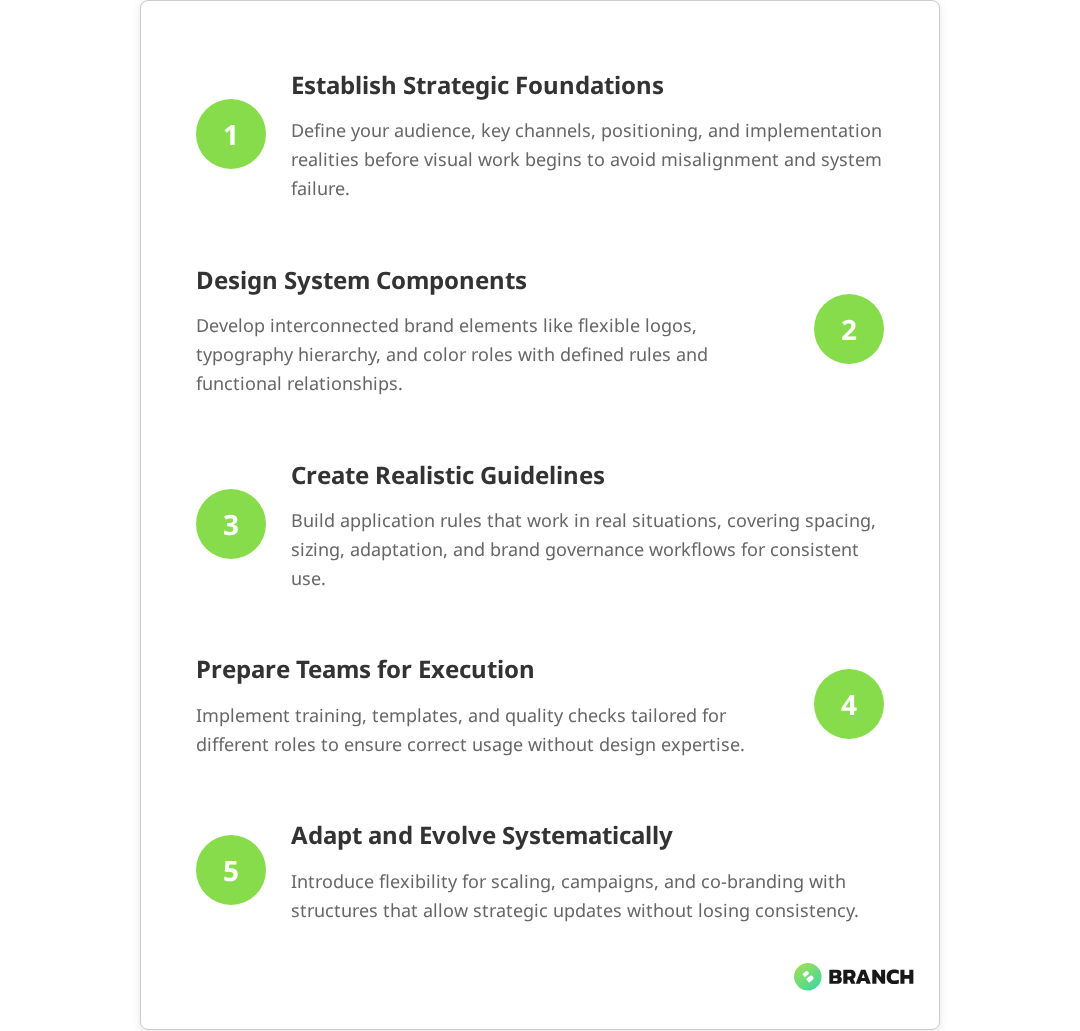
Read more about translating brand strategy into visual identity and design systems.
The implementation phase often benefits from a hybrid project-retainer structure: intensive work to launch the new positioning, followed by ongoing monthly support to ensure consistent application and refinement based on market feedback.
Measuring Positioning Effectiveness in Competitive Markets
Unlike awareness campaigns or lead generation efforts, brand positioning success can be tricky to measure. However, several metrics provide useful signals:
- Sales conversation quality: Are prospects asking more specific, qualified questions about your services?
- Competitive differentiation: Do RFP responses and sales situations feel less commoditized?
- Client referral language: How do existing clients describe you to potential referrals?
- Market recognition: Are you being invited to speak at industry events or contribute to relevant publications?
The most telling measure is often qualitative: when clients and prospects can clearly articulate why they’d choose you over alternatives, your positioning is working. Brand positioning research confirms that customer perception and differentiation clarity are among the strongest indicators of positioning success. When those conversations still feel generic or price-focused, there’s more positioning work to be done.
Read more about this successful brand positioning campaign in the competitive healthcare market.
Working with Positioning Specialists: When to Bring in Outside Help
Many organizations attempt positioning work internally, which can work for refinement but often falls short for complete repositioning. Here’s when external expertise typically makes sense:
You Need Outside Perspective
Internal teams often struggle to see their organization objectively or challenge long-held assumptions about market perception. External strategists bring fresh eyes and can ask uncomfortable questions that lead to breakthrough insights.
You Lack Dedicated Resources
Effective positioning requires focused attention over several months. If your internal team is managing day-to-day marketing responsibilities alongside positioning work, the strategic thinking often gets shortchanged.
You Want Accelerated Timeline
Experienced positioning teams can complete comprehensive work in 3-4 months that might take internal teams 8-12 months of part-time effort.
When evaluating positioning partners, look for teams that combine strategic thinking with implementation capabilities. Research on brand repositioning indicates that external specialists bring strategic conviction and help orchestrate stakeholder engagement more effectively than internal teams managing complete repositioning projects. The best positioning work integrates strategy development with visual identity, messaging architecture, and proof point development—creating a comprehensive foundation for market differentiation.
Read more about developing visual identity systems that support brand positioning strategy.
Getting Started: Next Steps for Better Market Position
If you’re ready to tackle positioning challenges in your crowded market, start with these practical next steps:
- Audit your current position: Can you clearly articulate why clients choose you over alternatives? If not, positioning work is likely needed.
- Gather market intelligence: Interview recent clients about why they selected you and what alternatives they considered.
- Map the competitive landscape: Identify how direct competitors position themselves and where opportunities exist for differentiation.
- Assess internal readiness: Do you have dedicated resources and leadership buy-in for positioning work, or would external support accelerate results?
Remember that effective positioning is an investment in long-term competitive advantage, not a quick marketing fix. The organizations that commit to strategic positioning work—whether internal or with specialist partners—typically see improved sales conversations, stronger client relationships, and clearer market differentiation within 6-9 months.
For B2B organizations ready to move beyond generic messaging and create distinctive market positions, teams like Branch Boston’s creative services group offer the strategic thinking and implementation capabilities to translate positioning strategy into market reality.
FAQ
How long does brand positioning work typically take?
Core brand positioning projects usually take 3-4 months for complete repositioning or 6-10 weeks for refinement work. The timeline depends on market research complexity, internal stakeholder alignment needs, and implementation scope. Most effective positioning follows a project-based structure rather than ongoing monthly work.
What's the difference between branding and positioning?
Positioning is the strategic foundation—how you want to be perceived in the market relative to competitors. Branding includes positioning but extends to visual identity, messaging, and all touchpoint experiences. Think of positioning as the strategy and branding as how that strategy gets expressed across all client interactions.
Should we try positioning work internally or hire specialists?
Refinement work can often be handled internally if you have dedicated strategic resources. Complete repositioning usually benefits from external expertise because it requires objective market perspective, dedicated focus, and specialized methodology. Consider your team's availability and strategic experience when deciding.
How do we know if our current positioning is working?
Effective positioning creates clear differentiation in sales conversations, reduces price-focused discussions, and makes referrals easier for existing clients. If prospects struggle to understand why they'd choose you over alternatives, or if sales cycles feel increasingly commoditized, positioning work is likely needed.
What does brand positioning work typically cost?
Brand positioning projects typically range from $7,000 for focused refinement work to $90,000 for comprehensive repositioning with full implementation. The investment depends on market research scope, strategic complexity, and deliverable depth. Most organizations see ROI through improved sales efficiency and competitive differentiation within 6-9 months.