
Portrait of teenager at home using his laptop for watching videos or playing games - one man working at the office with his computer

What to Look for When Hiring an eLearning Development Company

Choosing the right eLearning development company can make or break your training initiative. With corporate learning and development spending reaching new heights, organizations are increasingly recognizing that effective digital training isn’t just about converting PowerPoint slides into online modules. Research shows that the best eLearning experiences blend instructional design expertise, technical proficiency, and a deep understanding of how adults learn in digital environments.

Whether you’re a learning and development leader looking to modernize your training programs, a product manager tasked with building customer education platforms, or a CTO evaluating partners for a complex learning management system implementation, the stakes are high. While comprehensive data on project failure rates varies, industry sources consistently identify that poorly executed eLearning projects can lead to low completion rates, reduced engagement, and failure to achieve intended learning outcomes.

This guide walks through the essential criteria for evaluating eLearning development companies, from technical capabilities and instructional design approaches to project management methodologies and long-term partnership potential. We’ll explore the questions you should ask, the red flags to watch for, and how to structure an evaluation process that leads to successful outcomes.

Understanding the eLearning Development Landscape

The eLearning development industry encompasses a broad spectrum of providers, from one-person consultancies to global training corporations. Some focus exclusively on content creation, while others offer full-service solutions including technology implementation, learning strategy, and ongoing support.

Content-focused providers typically excel at transforming subject matter expertise into engaging digital experiences. They bring strong instructional design capabilities and often have specialized knowledge in specific industries or learning methodologies. However, they may partner with or rely on clients for technical implementation and platform management.

Technology-first companies often have deep expertise in learning management systems, authoring tools, and educational technology platforms. Industry examples demonstrate they can handle complex integrations and custom platform development, though research suggests that prioritizing technology over pedagogical design may not always lead to optimal learning outcomes.

Full-service agencies attempt to bridge both worlds, offering end-to-end capabilities from learning strategy through technical implementation. Multiple providers offer comprehensive services, though finding those who truly excel across all these disciplines rather than being mediocre generalists can be challenging.

💡 Tip: Before starting your search, clearly define whether you need primarily content development, technology implementation, or strategic learning design. This will help you focus on providers whose core strengths align with your primary needs.

Core Technical Capabilities to Evaluate

Modern eLearning development requires more than basic multimedia production skills. The technical landscape has evolved significantly, with new standards, platforms, and integration requirements that can impact both immediate project success and long-term scalability.

Standards Compliance and Interoperability

Your eLearning content needs to work across different platforms and systems, both now and in the future. Understanding how potential partners handle technical standards is crucial for avoiding vendor lock-in and ensuring content portability.

SCORM remains widely supported, though its dominance faces growing competition from newer standards. SCORM 1.2/2004 continues to provide universal compatibility with traditional LMS environments, but newer specifications like xAPI (also called Tin Can API) and cmi5 offer more sophisticated tracking and analytics capabilities. The right choice depends on your specific requirements for data collection, reporting, and integration with existing systems.

StandardBest ForKey BenefitsLimitations
SCORM 1.2/2004Traditional LMS environmentsUniversal compatibility, established workflowsLimited tracking, basic analytics
xAPI (Tin Can)Complex learning ecosystemsRich data capture, offline learning supportRequires Learning Record Store (LRS)
cmi5Modern LMS with advanced trackingCombines SCORM simplicity with xAPI powerLimited adoption, newer standard
Read more: Understanding eLearning Standards and Their Impact on Your Training Strategy

Platform Integration and Custom Development

Many organizations need eLearning content that integrates with existing systems—HR platforms, customer relationship management tools, or specialized industry applications. Industry best practices emphasize evaluating potential partners on their experience with:

  • API integrations for single sign-on, user provisioning, and data synchronization
  • Custom learning management system development when off-the-shelf solutions don’t meet requirements
  • Mobile-responsive design that works across devices and connection speeds
  • Accessibility compliance meeting WCAG guidelines and organizational policies
  • Multi-language support for global organizations or diverse audiences

What the research says

  • Multiple studies confirm that adults learn differently from children, requiring self-directed, experience-based, and problem-centered approaches rather than traditional instructional methods.
  • Research on eLearning standards shows xAPI provides significantly more sophisticated tracking capabilities than SCORM, including granular data capture and support for diverse learning experiences beyond traditional course completion.
  • WCAG guidelines are the established standard for accessibility compliance, often legally required and should align with organizational procurement policies.
  • Evidence on microlearning effectiveness is mixed – while it works well for knowledge reinforcement and just-in-time skills, studies don’t show clear superiority over traditional methods for complex procedural training.
  • Research on technology-first versus pedagogy-first approaches in eLearning suggests that prioritizing educational expertise and learning science typically yields better outcomes than leading with technology solutions.

Instructional Design Philosophy and Process

Technical execution means nothing without sound instructional design. The most engaging multimedia experiences fail if they don’t actually help learners develop new skills or change behaviors. When evaluating eLearning development companies, dig deep into their approach to learning design.

Adult Learning Principles

Effective eLearning acknowledges how adults learn differently than children. Research consistently shows that adults are self-directed, experience-based learners who need different approaches than traditional educational methods. Look for providers who can articulate how they apply principles like:

  • Problem-centered learning: Content tied to real workplace challenges rather than abstract concepts
  • Experience integration: Building on learners’ existing knowledge and skills
  • Immediate applicability: Skills and knowledge learners can use immediately
  • Self-directed progression: Allowing learners control over pace and sequence when appropriate

Evidence-Based Design Decisions

Ask potential partners how they make design decisions. Do they rely on personal preferences and trends, or do they ground choices in learning research and user feedback? Strong eLearning developers can explain why they choose specific interaction types, content structures, and assessment methods based on learning objectives and audience characteristics.

For example, microlearning approaches work well for just-in-time skill development and knowledge reinforcement, though early evidence suggests they may not be appropriate for complex procedural training that requires sustained focus and practice.

Project Management and Collaboration Approach

eLearning development projects involve multiple stakeholders with different expertise, priorities, and communication styles. Subject matter experts, technical teams, compliance officers, and end users all need to contribute effectively to project success.

Stakeholder Management

Look for development companies that have established processes for:

  • Subject matter expert interviews that efficiently extract knowledge without overwhelming busy professionals
  • Regular review cycles with clear deliverables and approval processes
  • Change management when requirements evolve during development
  • User testing integration with representative learners throughout the process

The best partners act as translators between technical and non-technical stakeholders, ensuring everyone understands project progress, decisions, and implications.

Development Methodology

eLearning projects benefit from iterative development approaches that allow for feedback and refinement. However, pure agile methodologies don’t always map cleanly to instructional design workflows. Look for companies that have adapted project management approaches specifically for learning content development.

💡 Tip: Ask to see examples of project communication artifacts—status reports, review templates, and stakeholder feedback processes. These documents reveal how organized and professional the company's project management actually is.

Quality Assurance and Testing Processes

eLearning content needs to work flawlessly across different browsers, devices, and learning management systems. A single broken interaction or compatibility issue can derail an entire training initiative.

Comprehensive quality assurance goes beyond basic functionality testing. It includes:

  • Cross-platform compatibility testing on multiple browsers, operating systems, and mobile devices
  • LMS integration testing to ensure content launches, tracks, and reports correctly
  • Accessibility testing with screen readers and other assistive technologies
  • Performance optimization for different connection speeds and device capabilities
  • Content accuracy reviews by subject matter experts at multiple stages

Ask potential partners about their testing protocols and who performs different types of reviews. Companies with robust QA processes will have detailed checklists and testing environments that mirror your production systems.

Ongoing Support and Maintenance Considerations

eLearning content isn’t a “set it and forget it” deliverable. Technology platforms evolve, content becomes outdated, and user needs change over time. Understanding how potential partners handle ongoing relationships is crucial for long-term success.

Content Updates and Revisions

Most organizations need to update training content regularly—whether due to regulatory changes, product updates, or evolving best practices. Clarify how potential partners handle:

  • Minor content updates like text corrections or image replacements
  • Structural changes that affect navigation or learning paths
  • Technology updates required for new LMS versions or platform migrations
  • Analytics and reporting modifications based on changing business requirements

Knowledge Transfer and Documentation

Even with ongoing support relationships, your organization should understand how content is structured and maintained. Look for partners who provide comprehensive documentation and, when appropriate, training for internal teams.

Read more: Understanding Professional eLearning Development Processes and Best Practices

Evaluating Past Work and Client References

Portfolio reviews and client references provide crucial insights into a company’s capabilities and working style. However, evaluating eLearning work requires different criteria than reviewing websites or marketing materials.

Portfolio Assessment Criteria

When reviewing sample projects, focus on:

  • Learning objective alignment: Can you identify clear learning goals, and does the content structure support them?
  • Engagement without gimmicks: Are interactive elements purposeful or just flashy distractions?
  • Content organization: Is information presented in logical, digestible chunks?
  • Assessment quality: Do evaluation methods actually test the intended skills or knowledge?
  • Accessibility considerations: Is the content usable by learners with different abilities and technical access?

Reference Conversation Topics

When speaking with past clients, go beyond general satisfaction questions. Ask about specific aspects of the working relationship:

  • How well did the company handle unexpected challenges or scope changes?
  • What was the quality of subject matter expert interviews and content extraction?
  • How responsive was the team to feedback and revision requests?
  • Did the final deliverable actually improve learning outcomes or business metrics?
  • Would they choose the same partner for their next eLearning project?

Budget and Pricing Models

eLearning development costs vary dramatically based on complexity, customization requirements, and the level of service provided. Understanding different pricing approaches helps you evaluate proposals and make informed decisions.

Pricing ModelBest ForAdvantagesPotential Risks
Fixed Project PriceWell-defined scope, tight budgetsPredictable costs, clear deliverablesLimited flexibility, change order costs
Time and MaterialsEvolving requirements, complex projectsFlexible scope, transparent billingBudget uncertainty, requires oversight
Retainer/OngoingMultiple projects, long-term partnershipConsistent availability, relationship buildingCommitment risk, utilization challenges
Per-Seat/UsagePlatform licensing, ongoing servicesScales with adoption, predictable unit costsUsage forecasting, long-term cost growth

Be wary of prices that seem too good to be true—quality eLearning development requires significant expertise and time investment. However, the most expensive option isn’t necessarily the best fit for your specific requirements.

Making the Final Decision

After evaluating multiple potential partners, you’ll likely have several viable options. The final decision should balance technical capabilities, cultural fit, and practical considerations like timeline and budget.

Cultural and Communication Fit

eLearning development is inherently collaborative. The best technical capabilities won’t compensate for poor communication or misaligned working styles. Consider:

  • How well do they listen and ask clarifying questions during initial conversations?
  • Do their communication preferences match your organization’s style?
  • Are they comfortable working with your internal stakeholders and processes?
  • Do they proactively suggest improvements or just execute what’s requested?

Risk Assessment and Mitigation

Every eLearning project involves some risk—technology changes, stakeholder availability, or evolving requirements. Strong development partners acknowledge these risks and have strategies for managing them.

Consider factors like company stability, team continuity, and backup plans for key personnel. A great individual developer working alone may deliver excellent results but poses higher risk than a team-based organization.

💡 Tip: Start with a smaller pilot project when possible. This allows you to evaluate the working relationship and deliverable quality before committing to larger initiatives.

Working with Specialized eLearning Development Partners

The most successful eLearning initiatives often result from partnerships with companies that combine deep technical expertise with genuine understanding of how adults learn in digital environments. Look for partners who can bridge the gap between educational theory and practical implementation.

Organizations like Branch Boston exemplify this approach, bringing together instructional designers, developers, and user experience specialists who understand both the technical requirements and the human factors that make eLearning effective. They focus on creating learning experiences that work for real people in real workplace contexts, not just impressive demonstrations.

When evaluating any potential partner, remember that the best eLearning development companies are ultimately in the business of helping people learn more effectively. Technical skills and project management capabilities are necessary but not sufficient—the best partners genuinely care about learning outcomes and user experiences.

The right custom eLearning development partnership can transform how your organization approaches training and development, creating scalable solutions that adapt to evolving needs while consistently delivering measurable results.

FAQ

How long does typical eLearning development take?

Timeline varies significantly based on project complexity, but most custom eLearning projects take 6-16 weeks from initial concept to final delivery. Simple content conversions might be completed in 4-6 weeks, while complex interactive simulations or multi-module programs can take 3-6 months. The key factors affecting timeline include content complexity, stakeholder availability for reviews, technical integration requirements, and revision cycles.

What's the difference between custom development and template-based solutions?

Custom development creates unique learning experiences tailored to your specific content, brand, and learner needs, while template-based solutions adapt existing frameworks to your content. Custom development offers unlimited design flexibility and can integrate with existing systems, but requires higher investment and longer timelines. Template solutions are faster and more cost-effective but may have limitations in customization and functionality.

How do I know if an eLearning company understands my industry?

Look for specific examples of work in your sector, understanding of industry-specific compliance requirements, and familiarity with your audience's typical challenges and workflows. Ask about their process for learning new domains quickly—experienced developers can adapt to unfamiliar industries if they have strong subject matter expert interview skills and research capabilities. Sometimes a company with excellent instructional design skills and no industry experience is better than one with industry knowledge but poor learning design capabilities.

What ongoing support should I expect after project completion?

Professional eLearning developers typically offer different levels of ongoing support, from basic technical maintenance to comprehensive content updating services. Standard support often includes bug fixes, minor content updates, and platform compatibility updates for 30-90 days. Extended support might cover regular content reviews, analytics reporting, and strategic recommendations for improving learning outcomes. Clarify what's included in initial pricing versus ongoing service agreements.

How can I measure the success of an eLearning development project?

Success metrics should align with your original learning objectives and business goals. Common measures include completion rates, assessment scores, learner satisfaction surveys, and behavioral changes in the workplace. More sophisticated measurement might track knowledge retention over time, correlation with job performance metrics, or business outcomes like reduced errors or increased productivity. The best eLearning partners help you define appropriate success metrics during project planning and build in measurement capabilities from the beginning.

Social media concept. Technological abstract background.

What Makes Scenario-Based Learning Effective?

Picture this: instead of clicking through another slide deck about customer service best practices, your team is navigating a realistic simulation where an angry customer is demanding a refund for a product they clearly misused. They have to think on their feet, choose their words carefully, and deal with the consequences of their decisions. That’s scenario-based learning in action and when it’s done right, it’s transformative.

For B2B leaders evaluating training solutions, scenario-based learning represents a shift from passive consumption to active problem-solving. Research consistently shows that scenario-based learning immerses learners in realistic situations that require analysis, decision-making, and adaptation, promoting critical thinking and practical application rather than passive recall. Rather than hoping employees will remember bullet points from a presentation, you’re giving them a safe space to practice skills, make mistakes, and build confidence before they face real-world challenges. But like any learning methodology, effectiveness depends entirely on execution.

This approach is particularly valuable for organizations that need their teams to handle complex, nuanced situations whether that’s customer de-escalation, technical troubleshooting, compliance decisions, or leadership challenges. Multiple studies demonstrate that scenario-based learning effectively develops the skills needed for complex, real-world situations by providing a safe environment for practicing judgment and handling uncertainty. The question isn’t whether scenario-based learning works (research consistently shows it does), but how to design it so your specific audience actually engages with it and retains what they learn.

Why Our Brains Love Stories and Simulations

Scenario-based learning taps into something fundamental about how humans process and remember information. When we encounter abstract concepts in isolation, our brains file them away as disconnected facts. But when those same concepts are embedded in a story or simulation, they become part of a richer mental model that’s much easier to recall and apply.

This happens because scenarios activate multiple cognitive systems simultaneously. You’re not just reading about conflict resolution you’re experiencing the emotional weight of an upset customer, considering the business implications of different responses, and practicing the social skills needed to navigate the conversation. Brain science research shows that this multi-layered engagement creates stronger neural pathways and more durable learning outcomes by simultaneously recruiting brain regions involved in attention, memory, behavior, and emotional processing.

The storytelling element is particularly powerful. When learners encounter a well-crafted narrative, they naturally start making predictions, empathizing with characters, and drawing connections to their own experiences. This isn’t just engagement for engagement’s sake it’s cognitive architecture that makes learning stick.

Read more: How to structure effective eLearning development from concept to completion.

What the research says

  • Active engagement drives results: Studies consistently show that scenario-based learning enhances learner engagement, critical thinking, and decision-making skills by immersing people in realistic, practical situations rather than passive content consumption.
  • Skills transfer to real work: Research indicates that learners who practice in well-designed scenarios demonstrate improved confidence and competence when applying those same skills in actual work situations.
  • Multiple brain systems work together: Scientific evidence reveals that scenarios simultaneously activate cognitive, behavioral, and emotional brain systems, creating stronger neural pathways that support better retention and recall.
  • Context matters for engagement: Studies show that when scenarios reflect learners’ actual work challenges and use realistic dialogue and processes, engagement and practical application improve significantly compared to generic training content.
  • Measurement needs to be built in: Early research suggests that effective programs design assessment strategies from the beginning, tracking decision patterns and correlating scenario performance with real-world outcomes, though more research is needed on optimal measurement approaches.

The Anatomy of Effective Scenarios

Not all scenarios are created equal. The difference between a compelling learning experience and a forgettable one often comes down to a few key design principles that many organizations overlook in their enthusiasm to “gamify” their training.

Authenticity Over Complexity

The most effective scenarios feel real to learners, even if they’re simplified. This means grounding your situations in actual challenges your team faces, using realistic dialogue and constraints, and avoiding the temptation to create overly complex branching narratives that confuse rather than educate.

A customer service scenario works better when it reflects the specific types of complaints your team actually handles, uses your company’s real policies as constraints, and incorporates the communication tools and processes your staff use daily. Generic scenarios about “difficult customers” miss the mark because they don’t prepare learners for their specific reality.

Meaningful Consequences and Feedback

Good scenarios let learners experience the results of their decisions, but great ones help them understand why those results occurred. Educational research shows that high-quality scenarios provide not only consequences but also explanations for outcomes, which enhances reflection and skill development through immediate feedback and learning opportunities.

For example, in a compliance training scenario, showing that a seemingly minor documentation shortcut leads to audit findings six months later helps learners understand the long-term impact of their decisions. The key is making consequences feel connected to real business outcomes rather than arbitrary point deductions.

💡 Tip: Start with real situations your team has actually encountered, then simplify them for learning purposes. Authenticity beats complexity every time when it comes to engagement and retention.

Design Approaches That Drive Engagement

The most engaging scenario-based learning programs share certain structural characteristics that keep learners invested in the outcome. Understanding these patterns can help you evaluate potential approaches or brief a development team effectively.

Design ElementWhat It DoesImplementation ExamplesCommon Pitfalls
Character DevelopmentCreates emotional investment in outcomesPersonas with backstories, realistic motivations, consistent personality traitsOver-complicated character arcs that distract from learning objectives
Progressive ComplexityBuilds confidence while increasing challengeStarting with straightforward decisions, adding variables and time pressureJumping to complex scenarios too quickly, overwhelming learners
Multiple Valid PathsReflects real-world ambiguity and choiceDifferent approaches that achieve the same goal through different trade-offsCreating false choices where only one path is truly “correct”
Contextual ResourcesMirrors on-the-job reference materialsPolicy documents, calculation tools, decision frameworks available during scenariosMaking learners memorize information they’d look up in real situations

The Power of Personal Relevance

One insight that consistently emerges from learning communities is the importance of personal connection to the scenario content. Research on personalized scenario-based learning shows that when learners find the subject matter genuinely relevant to their work experiences, engagement improves markedly, though the impact on retention may depend on additional instructional factors.

This doesn’t mean every training program needs to be about topics your learners love as hobbies. Instead, it means finding the aspects of their work that they’re most curious about or motivated to improve, then building scenarios around those areas. A sales training program might focus on the types of prospects that your team finds most challenging to convert, rather than generic objection-handling scripts.

Measuring What Actually Matters

Traditional eLearning metrics completion rates, quiz scores, time spent in modules tell you very little about whether scenario-based learning is actually working. The real measures of effectiveness are behavioral: are learners applying what they practiced when they encounter similar situations in their actual work?

This requires designing measurement into your scenarios from the beginning, not bolting it on afterward. Assessment research indicates that effective programs track decision patterns, identify common failure points, and correlate scenario performance with real-world outcomes over time.

  • Decision Quality Metrics: Track not just whether learners choose the “right” answer, but how consistently they apply decision-making frameworks across different scenarios
  • Transfer Indicators: Look for evidence that learners are using scenario-based strategies in their actual work through manager feedback, customer interactions, or peer observations
  • Confidence and Competence: Measure both self-reported confidence and demonstrated competence to identify gaps between what learners think they know and what they can actually do
  • Retention Over Time: Test scenario-based skills weeks or months after initial training to ensure learning durability

When to Build Custom vs. Adapt Existing Solutions

The scenario-based learning market offers everything from off-the-shelf simulations to completely custom-built experiences. The right choice depends on how closely your learning needs align with standard approaches and how much specificity your industry or organization requires.

Off-the-Shelf Solutions Work When:

  • Your training needs are common across industries (basic customer service, general leadership skills, universal compliance topics)
  • You have limited budget or timeline constraints
  • Your team size makes custom development cost-prohibitive per learner
  • You’re testing scenario-based approaches before committing to larger investments

Custom Development Makes Sense When:

  • Your industry has specific regulations, processes, or terminology that generic scenarios can’t capture
  • You need scenarios that incorporate your actual tools, systems, and workflows
  • Your learning objectives are complex or unique enough that existing solutions don’t address them
  • You want to integrate scenarios into larger learning ecosystems or performance support tools
💡 Tip: Before committing to custom development, test your assumptions with a small pilot program. Even simple branching scenarios can reveal whether your audience responds well to this learning format.

Implementation Strategy and Change Management

Even the most brilliantly designed scenarios will fail if your organization isn’t prepared to support them. Successful scenario-based learning programs require more than just good content they need organizational alignment, manager buy-in, and integration with existing workflows.

The most common implementation failure isn’t technical it’s cultural. Organizations introduce scenario-based learning as a one-time training event rather than an ongoing development approach. Learners complete the modules, maybe enjoy them, then return to their regular work without any reinforcement or application opportunities.

Building Organizational Support

Effective programs start with stakeholder alignment around learning objectives and success metrics. This means getting managers to understand not just what their teams will learn, but how they can recognize and reinforce those skills in day-to-day work situations.

Consider creating “scenario debriefs” where teams discuss how training situations relate to real challenges they’re facing. This bridges the gap between simulation and application while giving managers concrete ways to support their teams’ development.

Working with Development Teams

Whether you’re building scenarios in-house or working with external developers, successful projects require clear communication about learning objectives, audience characteristics, and technical constraints. The best scenario-based learning comes from teams that understand both instructional design principles and the realities of your business context.

When evaluating potential partners, look for teams that ask detailed questions about your learners’ actual work situations, existing knowledge levels, and the specific behaviors you want to change. Generic questions about “learning objectives” often lead to generic solutions.

A specialized eLearning development team can help you navigate the trade-offs between engagement and effectiveness, design measurement strategies that actually inform improvement, and integrate scenarios into broader learning ecosystems. The key is finding partners who see scenario-based learning as a means to an end better job performance rather than an end in itself.

For organizations ready to explore custom scenario development, working with experienced teams can accelerate both the design process and the likelihood of successful outcomes. The investment in custom eLearning development often pays dividends in engagement, retention, and real-world application.

Looking Forward: Integration and Evolution

The future of scenario-based learning isn’t just about better simulations it’s about smarter integration with the tools and processes your teams use every day. This might mean scenarios that pull real data from your systems, software simulation training that mirrors your actual applications, or adaptive scenarios that adjust based on individual learner performance.

Organizations are also discovering the value of treating scenarios as living resources rather than static training content. The same scenario framework that works for onboarding new employees might be adapted for refresher training, policy updates, or even team problem-solving sessions.

The key is building scenario-based learning programs that can evolve with your organization’s needs rather than becoming outdated as soon as they launch. This requires thoughtful eLearning course development that considers not just immediate learning objectives, but long-term organizational development goals.

For organizations exploring advanced approaches, AI training solutions can offer new possibilities for personalizing scenarios, generating realistic dialogue variations, and providing more sophisticated feedback mechanisms. However, the fundamentals remain the same: effective scenario-based learning starts with understanding your learners and designing authentic, meaningful experiences that prepare them for real-world success.

FAQ

How long should scenario-based learning modules be to maintain engagement?

Most effective scenarios run 15-45 minutes, depending on complexity. The key is designing natural break points where learners can pause and resume without losing context. Longer scenarios work better when broken into distinct phases or decision points rather than presented as single marathon sessions.

Can scenario-based learning work for technical training, or is it mainly for soft skills?

Scenario-based approaches work exceptionally well for technical training, especially when you need people to apply knowledge under realistic constraints. Software troubleshooting, system configuration, and diagnostic procedures all benefit from scenario-based practice. The key is incorporating the actual tools and time pressures your team faces.

How do we measure ROI on scenario-based learning investments?

Focus on behavioral indicators rather than just completion metrics. Track changes in job performance, error rates, customer satisfaction scores, or other business outcomes that matter to your organization. Compare pre- and post-training performance, and survey managers about observable skill improvements in real work situations.

What's the difference between branching scenarios and simulations?

Branching scenarios are story-based with decision points that lead to different outcomes, while simulations replicate actual work environments or tools. Both are forms of scenario-based learning, but simulations typically require more technical development and are better for procedural skills, while branching scenarios excel for decision-making and interpersonal skills.

How do we ensure scenarios stay relevant as our business processes change?

Build update processes into your initial development plan. Create scenarios using modular content that can be easily modified, establish regular review cycles with subject matter experts, and track learner feedback about scenario realism. Consider working with development partners who offer ongoing maintenance and updates as part of their service model.

Woman watching online video course, training conference inside office at workplace. Office worker in headphones using laptop for remote meeting, writing data in notebook.

How to Test SCORM Compliance in eLearning

Testing SCORM compliance isn’t just about checking boxes it’s about ensuring your eLearning content actually works when real learners need it most. Whether you’re a learning and development leader evaluating a new course or a product owner launching an enterprise training platform, SCORM compliance testing can make the difference between seamless learning experiences and frustrated users stuck with modules that won’t load, track, or report properly.

The challenge? SCORM testing often gets treated as an afterthought, squeezed into tight project timelines with makeshift processes that miss critical issues. Many teams rely on rigid Excel checklists that don’t capture the nuanced ways eLearning content can fail across different learning management systems, devices, and user scenarios.

This guide walks through a practical approach to SCORM compliance testing covering what to test, when to test it, and how to structure your QA process for reliable results without endless back-and-forth.

Understanding SCORM Compliance Beyond the Basics

SCORM (Sharable Content Object Reference Model) compliance means your eLearning content can communicate effectively with any SCORM-conformant LMS. Research confirms that SCORM compliance enables seamless interoperability between eLearning content and SCORM-compatible platforms, allowing consistent delivery and tracking without custom coding. But “compliance” isn’t binary there are degrees of compatibility, and real-world performance depends on how well your content handles the specific quirks of different learning platforms.

At its core, SCORM defines three key areas of interaction:

  • Launch and initialization: Can the LMS successfully start your content and establish communication?
  • Runtime communication: Does your content properly send completion status, time spent, scores, and other tracking data?
  • Content packaging: Are all files correctly bundled and referenced so the LMS can import and deploy your content?

Industry analysis shows that these three components work together to enable content packaging, runtime environment communication via JavaScript API, and proper sequencing. Most compliance failures happen not because teams ignore SCORM requirements, but because they test in controlled environments that don’t reflect real deployment scenarios. A course that works perfectly in your authoring tool’s preview might struggle with specific LMS configurations, network conditions, or user behaviors.

💡 Tip Test SCORM compliance early in development, not just at the end. Catching packaging or communication issues during content creation saves significant rework compared to discovering them during final QA or after deployment.

What the research says

Multiple studies and industry analyses reveal key insights about effective SCORM compliance testing:

  • Early testing significantly reduces development costs: Industry best practices show that testing during content creation rather than at project end prevents delays and ensures smoother LMS integration.
  • Both technical and experiential validation are necessary: Effective testing must cover technical aspects like API communication and user experience elements such as navigation and responsiveness across devices.
  • Package integrity issues are the most common failure points: Studies of SCORM troubleshooting reveal that missing file references, case sensitivity mismatches, and incomplete resource declarations account for the majority of deployment problems.
  • Cross-platform compatibility varies significantly: Research indicates that content working in one LMS may behave differently in another due to browser compatibility, security policies, and platform-specific implementations.
  • Mobile testing is increasingly critical: With growing mobile learning adoption, testing across devices is essential but often overlooked in traditional compliance processes.

Building a Systematic Testing Workflow

Effective SCORM testing requires both technical validation and user experience verification. Research shows that comprehensive testing must cover functional aspects like data verification alongside learner-facing elements such as navigation usability and cross-platform compatibility. Many teams focus heavily on the technical side checking that API calls work and data transfers correctly while overlooking how real users will interact with the content across different contexts.

Here’s a structured approach that addresses both dimensions:

Testing PhaseFocus AreaKey CheckpointsTools & Methods
Pre-deploymentPackage integrityManifest validation, file structure, metadata accuracySCORM validators, manual package inspection
Initial integrationLMS communicationLaunch success, API initialization, basic data flowLMS test environments, browser dev tools
Functional testingLearning experienceNavigation, content display, interaction responsivenessCross-device testing, user scenario walkthroughs
Data validationTracking accuracyCompletion tracking, score reporting, time calculationsLMS reporting tools, data export verification
Edge case testingError handlingNetwork interruptions, browser crashes, incomplete sessionsControlled disruption testing, recovery scenarios

The key insight from teams who do this well: collaborative testing tools significantly outperform rigid spreadsheet checklists. Rather than passing around Excel files with static checkboxes, successful teams use visual feedback platforms and project management tools that allow testers to attach screenshots, tag specific issues, and track resolution progress in real-time.

Read more about structuring professional eLearning development workflows for better quality outcomes.

Common Compliance Issues and How to Catch Them

Most SCORM compliance problems fall into predictable categories. Understanding these patterns helps you design more targeted testing that catches issues before they reach learners.

Package and Manifest Problems

These are often the easiest to fix but can completely break content deployment. Troubleshooting guides consistently identify these common manifest issues:

  • Missing or incorrect file references in the manifest (imsmanifest.xml)
  • Case sensitivity issues where file names don’t match exactly between manifest and actual files
  • Incomplete resource declarations that leave out CSS, JavaScript, or media files
  • Incorrect SCORM version declarations that don’t match your content’s actual implementation

Runtime Communication Failures

These issues typically surface during actual learning sessions. Technical analysis reveals that proper initialization timing and data formatting are critical for successful SCORM communication:

  • Initialization timing problems where content tries to communicate with the LMS before the API is ready
  • Data format mismatches in how scores, completion status, or learner responses are structured
  • Session management issues when learners pause, resume, or navigate away from content
  • Character encoding problems that corrupt text or break data transmission

Cross-Platform Inconsistencies

Content that works in one LMS might behave differently in another:

  • Browser compatibility variations in how different LMS platforms render content
  • Security policy differences that block certain JavaScript functions or external resources
  • Mobile responsiveness gaps where content doesn’t adapt properly to smaller screens
  • Network handling differences in how various LMS handle slow connections or timeouts
💡 Tip Create a testing checklist specific to your organization's LMS landscape. If you primarily use Moodle and Canvas, focus your compliance testing on those platforms' specific behaviors rather than trying to test against every possible LMS configuration.

Choosing the Right Testing Tools and Processes

The testing tools you choose significantly impact both the thoroughness of your QA process and how efficiently your team can collaborate on fixes. Based on how successful eLearning teams actually work, here are the most effective approaches:

Technical Validation Tools

Collaborative QA Platforms

Instead of managing testing through static spreadsheets, teams are increasingly adopting visual feedback tools that integrate with their existing project management workflows:

  • Visual feedback platforms allow testers to capture screenshots with annotations directly on the content being tested
  • Task export capabilities let you push identified issues directly into tools like Trello, Asana, or Jira for developer assignment and tracking
  • Progress tracking features give stakeholders real-time visibility into testing status without constant status meetings

The shift toward more dynamic, visual testing approaches reflects a broader recognition that eLearning QA involves both technical validation and user experience evaluation areas where static checklists often fall short.

When to Test In-House vs. When to Engage Specialists

SCORM compliance testing sits at the intersection of technical implementation and learning experience design. For many organizations, the question isn’t whether to test, but how much testing expertise to develop internally versus when to bring in specialized help.

Good Candidates for In-House Testing

  • Organizations with consistent LMS platforms and predictable content types
  • Teams that regularly produce eLearning content and can develop institutional testing knowledge
  • Projects with straightforward SCORM requirements and minimal custom interactions
  • Situations where internal learning and development teams have bandwidth for systematic QA processes

When Specialist Support Makes Sense

  • Multi-LMS deployments: Testing across multiple learning platforms requires deep knowledge of platform-specific quirks
  • Custom interactions and assessments: Complex content with unique tracking requirements needs specialized SCORM implementation expertise
  • High-stakes deployments: Mission-critical training programs where compliance failures have significant business impact
  • Tight timelines: When internal teams lack the capacity to develop robust testing processes quickly
Read more about SCORM, xAPI, and cMI5 standards implementation and how they impact your eLearning strategy.

The key insight: SCORM compliance testing is most effective when it’s integrated into your broader eLearning development process, not treated as a separate, final-stage activity. Whether you handle testing internally or work with specialists, the goal is creating systematic feedback loops that catch issues early and ensure consistent quality across all your learning content.

Getting Started: Your First SCORM Testing Implementation

If your organization is moving from ad hoc testing to a more systematic approach, start with these practical steps:

  1. Audit your current process: Document how SCORM testing currently happens (or doesn’t happen) in your content development workflow
  2. Identify your critical test scenarios: Based on your actual LMS environment and learner contexts, define the most important compatibility and functionality tests
  3. Choose appropriate tools: Select testing and collaboration tools that integrate well with your existing development and project management systems
  4. Pilot with a single project: Test your new process on one eLearning project to identify gaps and refine your approach before rolling it out broadly
  5. Build institutional knowledge: Document lessons learned and create resources that help your team consistently apply effective testing practices

For organizations building significant eLearning capabilities, consider how SCORM compliance testing fits into your broader technology and content strategy. Testing isn’t just about avoiding immediate problems it’s about building reliable, scalable processes that support your organization’s learning goals over time.

💡 Tip Start measuring your testing process effectiveness by tracking metrics like time-to-fix for discovered issues, number of post-deployment problems, and user satisfaction scores. These metrics help you refine your approach and demonstrate the value of systematic compliance testing.

Working with eLearning Development Partners

When working with external eLearning development teams, SCORM compliance testing becomes a shared responsibility that requires clear coordination. The most successful partnerships establish testing protocols early and maintain ongoing communication throughout the development process.

Effective collaboration typically involves:

  • Shared testing environments: Both teams need access to realistic test scenarios that mirror your actual deployment conditions
  • Clear responsibility mapping: Who handles initial technical validation versus user experience testing versus final deployment verification
  • Iterative feedback loops: Regular testing checkpoints that catch issues while they’re still easy to fix
  • Documentation standards: Consistent approaches to documenting testing results, issues, and resolutions

Teams experienced in eLearning standards implementation bring valuable expertise in anticipating platform-specific issues and designing content that works reliably across different LMS environments. This expertise becomes particularly valuable for organizations managing complex learning ecosystems or deploying content across multiple platforms.

The key is finding development partners who treat SCORM compliance as an integral part of the learning experience design process, not just a technical checkbox to complete at project end.

FAQ

How long should SCORM compliance testing typically take?

Testing duration depends on content complexity and deployment scope, but plan for 15-25% of your total development timeline. Simple, single-LMS deployments might need just a few days, while complex, multi-platform content can require 2-3 weeks of thorough testing. Starting testing early in development, rather than saving it for the end, significantly reduces overall timeline impact.

Can we test SCORM compliance without access to our production LMS?

Yes, but with limitations. Tools like SCORM Cloud provide excellent initial validation and cross-LMS compatibility testing capabilities. However, you'll still need to test in an environment that closely matches your production LMS configuration, including user roles, security settings, and integration specifics. Many organizations use LMS staging environments or sandbox instances for realistic testing.

What's the difference between SCORM 1.2 and SCORM 2004 for testing purposes?

SCORM 2004 offers more sophisticated tracking capabilities and better error handling, but also introduces more complexity in testing. SCORM 1.2 is simpler and more widely supported, making it easier to test and troubleshoot. Your choice should align with your specific tracking requirements and LMS capabilities. Most testing processes can handle both, but SCORM 2004 may require additional validation steps for advanced features.

How do we handle SCORM testing when content includes custom JavaScript or external integrations?

Custom code requires additional testing layers, including security policy validation, cross-browser compatibility checks, and API integration verification. Test these elements separately before full SCORM package testing, and pay special attention to how different LMS platforms handle external resources and JavaScript execution. Document any platform-specific requirements or limitations for future reference.

Should we test SCORM compliance on mobile devices?

Absolutely, especially if your learners access content on tablets or smartphones. Mobile testing should cover touch interactions, responsive layout behavior, and offline capability (if supported). Many SCORM compliance issues only surface on mobile devices due to different browser behaviors, network conditions, and user interaction patterns. Include representative mobile devices in your standard testing process.

Students watching online training video with teacher and chart on tablet. Online teaching, share your knowledge, english teacher online concept. Bright vibrant violet vector isolated illustration

How to Make Compliance Training More Engaging

If you’ve ever watched employees’ eyes glaze over during mandatory compliance training, you’re not alone. Most organizations struggle to balance regulatory requirements with actual learning outcomes—and let’s be honest, traditional compliance training often feels like digital broccoli: necessary but far from appetizing.

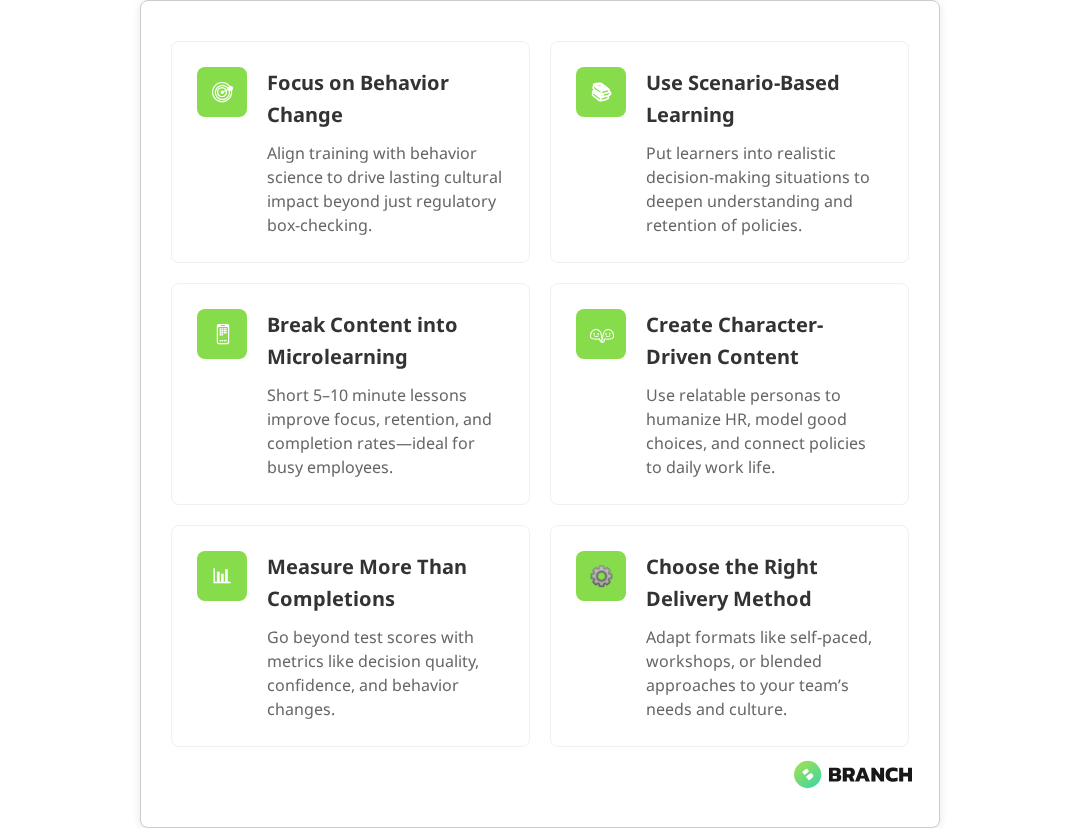
The challenge isn’t just about checking boxes. Effective compliance training needs to change behaviors, not just satisfy auditors. Research shows that sustainable compliance programs must incorporate behavior change science and real-world relevance to achieve measurable cultural transformation. When employees genuinely understand policies and feel equipped to make good decisions, organizations see fewer violations, better workplace culture, and reduced legal risk. The key is transforming compliance from a necessary evil into engaging, practical learning that people actually retain and apply.

This guide walks through proven strategies for making compliance training more engaging, based on real-world implementation insights and practical design approaches that work for busy teams and skeptical learners alike.

Why Traditional Compliance Training Falls Flat

Most compliance training fails because it treats learners like passive recipients of information rather than active decision-makers. The typical approach—lengthy modules crammed with policy text, followed by obvious multiple-choice questions—creates what learning professionals call “click-through compliance.” Studies indicate that a substantial proportion of employees either click through mandatory training without properly engaging or only skim-read content, showing they haven’t internalized the actual decision-making skills they need when facing real workplace dilemmas.

The problem compounds when organizations prioritize completion rates over comprehension. Multiple sources confirm that focusing solely on compliance training completion rates rather than comprehension leads to disengagement and negative perceptions. When training feels like a time-wasting obstacle rather than useful preparation, employees develop negative associations with both the content and the HR teams behind it. This skepticism makes future training efforts even harder to execute effectively.

The good news? Research shows that small but targeted changes in design and delivery—such as using microlearning, realistic scenarios, and more contextual learning—can significantly increase engagement, retention, and application of compliance knowledge.

Read more about the professional eLearning development process that creates effective training experiences.

Scenario-Based Learning: Moving Beyond Policy Recitation

The most effective compliance training puts learners in realistic workplace situations where they must apply policy knowledge to make decisions. Multiple studies show 30-50% improvement in exam scores and 70% improvement in knowledge retention when using scenario-based learning compared to traditional lecture-based training. Instead of asking “What does the harassment policy say about reporting timelines?” scenario-based training presents a situation: “Your colleague mentions feeling uncomfortable about jokes made during team meetings. What’s your next step?”

Effective scenarios share several characteristics:

  • Realistic context: Situations that learners might actually encounter, not extreme edge cases
  • Non-binary choices: Multiple options that aren’t obviously right or wrong, forcing critical thinking
  • Consequences shown: Clear demonstration of how different choices play out over time
  • Policy integration: Natural connection between scenario decisions and underlying policies

The key is creating branching scenarios where learners can explore “less correct” paths without being immediately shut down. Evidence shows this approach helps people understand the nuances of policy application rather than just memorizing rules. When learners can see why certain choices lead to better outcomes, they’re more likely to make similar decisions in real workplace situations.

💡 Tip: Design scenarios with characters who represent different roles within your organization. This helps learners see how policies apply across departments and hierarchies, making the training feel more relevant to everyone.

Microlearning and Modular Design

Breaking compliance training into shorter, focused modules serves both learning science and practical constraints. Research demonstrates that microlearning (5–10 minute modules) significantly improves attention span and knowledge retention compared to traditional hour-long sessions, with studies showing up to 80% better retention rates and 83% completion rates versus 20–30% for conventional courses.

Effective microlearning modules focus on specific decision points or skills rather than trying to cover entire policy areas. For example, instead of a comprehensive “Code of Conduct” module, you might create separate focused pieces on:

  1. Recognizing conflicts of interest
  2. Appropriate use of company resources
  3. Social media and confidentiality guidelines
  4. Reporting concerns and escalation paths

This modular approach allows for more targeted delivery—new employees get the full sequence, while experienced staff might only need refreshers on updated policies. It also makes maintenance easier when policies change, since you can update individual modules rather than rebuilding entire courses.

Read more about using video and animation to create engaging microlearning experiences.

What the research says

  • Scenario-based learning consistently outperforms traditional training methods, with organizations adopting this approach reporting higher policy adherence and fewer compliance incidents over time.
  • Microlearning approaches can improve knowledge retention by up to 80% compared to traditional methods, while reducing cognitive overload and fitting better into busy work schedules.
  • Training programs that focus on behavior change science—rather than just regulatory box-ticking—achieve measurable improvements in workplace culture and decision-making quality.
  • Early evidence suggests that branching scenarios allowing exploration of multiple decision paths help learners grasp policy nuances more effectively than linear training modules.
  • While completion rates remain important for compliance documentation, research shows that measuring decision quality and real-world application provides better indicators of training effectiveness.

Humanizing HR Through Character-Driven Content

One overlooked aspect of compliance training is how it shapes employees’ perceptions of HR and company leadership. When training feels punitive or disconnected from reality, it reinforces negative stereotypes about HR being the “policy police” rather than a supportive business function.

Character-driven training can help address this perception. Instead of faceless policy statements, use consistent characters or personas who guide learners through scenarios and explain the reasoning behind policies. These characters can model good decision-making while acknowledging the real constraints and pressures employees face.

Effective character development includes:

  • Relatable backgrounds: Characters from different departments and experience levels
  • Realistic motivations: Showing why people might struggle with policy decisions
  • Growth over time: Characters learning from mistakes and improving their judgment
  • Positive HR interactions: Demonstrating how HR can be a resource rather than an obstacle

This approach works particularly well when combined with light humor or storytelling elements that make the content more memorable without undermining the seriousness of compliance issues.

Implementation Strategies and Delivery Options

Even the most engaging content will fail if the implementation doesn’t match your organization’s culture and constraints. The table below outlines different delivery approaches and their trade-offs:

Delivery MethodBest ForTime InvestmentEngagement PotentialScalability
Self-paced online modulesGeographically distributed teamsLow ongoingMediumHigh
Facilitated workshopsComplex policy changesHighHighLow
Microlearning sequencesBusy schedules, mobile workforceMediumMedium-HighHigh
Blended approachCritical compliance areasHighHighMedium

Most successful implementations combine multiple approaches rather than relying on a single delivery method. For example, you might use self-paced modules for foundational knowledge, followed by facilitated discussions for complex scenarios, with microlearning reinforcements delivered over time.

💡 Tip: Offer a 'test-out' option for experienced employees who can demonstrate competency upfront. This respects their existing knowledge while ensuring compliance, and it often improves overall reception of the training program.

Measuring Success Beyond Completion Rates

Traditional compliance training metrics focus on completion rates and test scores, but these don’t tell you whether the training is actually changing behaviors or reducing risk. More meaningful metrics include:

  • Time to competency: How quickly employees can apply policy knowledge in realistic scenarios
  • Decision quality: Performance on complex, branching scenarios rather than simple recall questions
  • Self-reported confidence: Employees’ comfort level with handling policy-related situations
  • Behavior indicators: Changes in reporting rates, policy violations, or help-seeking behavior
  • Feedback quality: Depth and specificity of learner comments about the training experience

The most valuable metric might be reduction in repeat violations or policy-related incidents over time. This indicates that training is actually preventing problems rather than just documenting that education occurred.

Read more about eLearning standards that enable sophisticated tracking and measurement of learning outcomes.

When to Build In-House vs. Partner with Specialists

The decision between developing compliance training internally or working with specialists depends on several factors: your team’s capacity, the complexity of your compliance requirements, and how critical these training programs are to your organization’s risk management.

Consider building in-house when:

  • You have dedicated learning and development resources
  • Your compliance requirements are straightforward and stable
  • You need frequent updates and iterations
  • Your organization has unique cultural considerations that outsiders might miss

Consider partnering with specialists when:

  • You need sophisticated interactivity or multimedia production
  • Compliance requirements are complex or changing rapidly
  • You want to leverage proven instructional design methodologies
  • Internal teams lack bandwidth for a major training overhaul

Many organizations find success with a hybrid approach: partnering with specialists to design the foundational architecture and most complex modules, while handling simpler updates and customizations internally. This approach provides professional design quality while maintaining ongoing flexibility.

Getting Buy-In and Managing Change

Even excellent compliance training can fail if employees approach it with negative expectations. Successful rollouts require intentional change management that addresses both practical and emotional barriers to engagement.

Pre-training communication from leadership helps set appropriate expectations and context. When managers can explain how compliance training connects to organizational values and business success, rather than just regulatory requirements, employees are more likely to engage meaningfully with the content.

Consider gathering anonymous feedback from employees about their current perceptions of HR and compliance processes. This intelligence can inform both content design and communication strategy, helping you address specific concerns or misconceptions that might otherwise undermine the training’s effectiveness.

Read more about our specialized approach to developing compliance training that balances engagement with regulatory requirements.

Working with Digital Learning Partners

Organizations that choose to work with external partners for compliance training development benefit most when they approach the relationship as a collaboration rather than a simple vendor transaction. The most effective partnerships involve:

Clear stakeholder alignment from the start, including legal, HR, and operational teams who understand both the compliance requirements and the practical realities of your workplace culture.

Iterative design processes that allow for testing and refinement based on real user feedback, rather than trying to perfect everything before any employees see the content.

Knowledge transfer that leaves your internal team equipped to make updates and modifications as policies evolve, rather than creating dependency on external resources for every small change.

Teams like Branch Boston specialize in translating complex compliance requirements into engaging, human-centered learning experiences. We work with organizations to design training that satisfies auditors while actually improving workplace decision-making—because the best compliance training is the kind people want to complete and remember how to apply.

FAQ

How long should compliance training modules be to maintain engagement?

Most effective compliance training modules run 5-10 minutes each, focusing on specific decisions or skills rather than trying to cover entire policy areas. This length respects learners' attention spans while allowing sufficient depth for meaningful scenarios. Breaking content into shorter modules also enables better scheduling flexibility and makes updates easier when policies change.

What's the best way to handle employees who rush through compliance training just to get it done?

Design scenarios with branching paths and realistic consequences that require genuine consideration rather than obvious answers. Implement 'test-out' options for experienced employees to demonstrate competency upfront, which respects their knowledge while ensuring compliance. Focus on measuring decision quality in complex scenarios rather than just completion speed or simple recall questions.

How can we make compliance training feel less punitive and more supportive?

Use character-driven content that shows HR as a helpful resource rather than policy enforcers. Include scenarios where characters learn from mistakes and grow over time, demonstrating that compliance is about making good decisions rather than avoiding punishment. Pre-training communication from leadership should frame compliance as part of company values and ethical culture, not just regulatory obligations.

Should we customize compliance training for different departments or keep it standardized?

A hybrid approach works best: standardized core content ensures consistent policy understanding across the organization, while department-specific scenarios help employees see how policies apply to their actual work situations. This maintains compliance consistency while improving relevance and engagement for different roles and responsibilities within your organization.

How do we measure whether compliance training is actually changing behavior, not just completion rates?

Track metrics like decision quality in complex scenarios, self-reported confidence levels, reduction in policy violations over time, and changes in help-seeking behavior when employees face policy questions. Anonymous feedback about training relevance and applicability can also indicate whether employees feel prepared to handle real workplace situations covered by your compliance policies.

3D illustration of colorful human figures representing diversity and inclusion, with different skin tones and patterns symbolizing equality, respect and unity in a multicultural environment.

How to Create Effective Diversity and Inclusion Training

Diversity and inclusion training has become a workplace staple, but let’s be honest: most of it falls flat. You’ve probably sat through those mandatory sessions where everyone checks their phones while someone clicks through slides about unconscious bias. The real challenge isn’t understanding why D&I matters—it’s creating programs that actually change hearts, minds, and behaviors.

The difference between effective and ineffective diversity and inclusion training often comes down to design. When training feels like a checkbox exercise, it becomes one. But when it’s built around engaging experiences that connect with people’s real-world challenges, it can spark genuine understanding and lasting change.

This guide will walk you through the essential elements of creating D&I training that works—from understanding what makes people actually pay attention to designing experiences that stick long after the session ends.

Why Most Diversity Training Misses the Mark

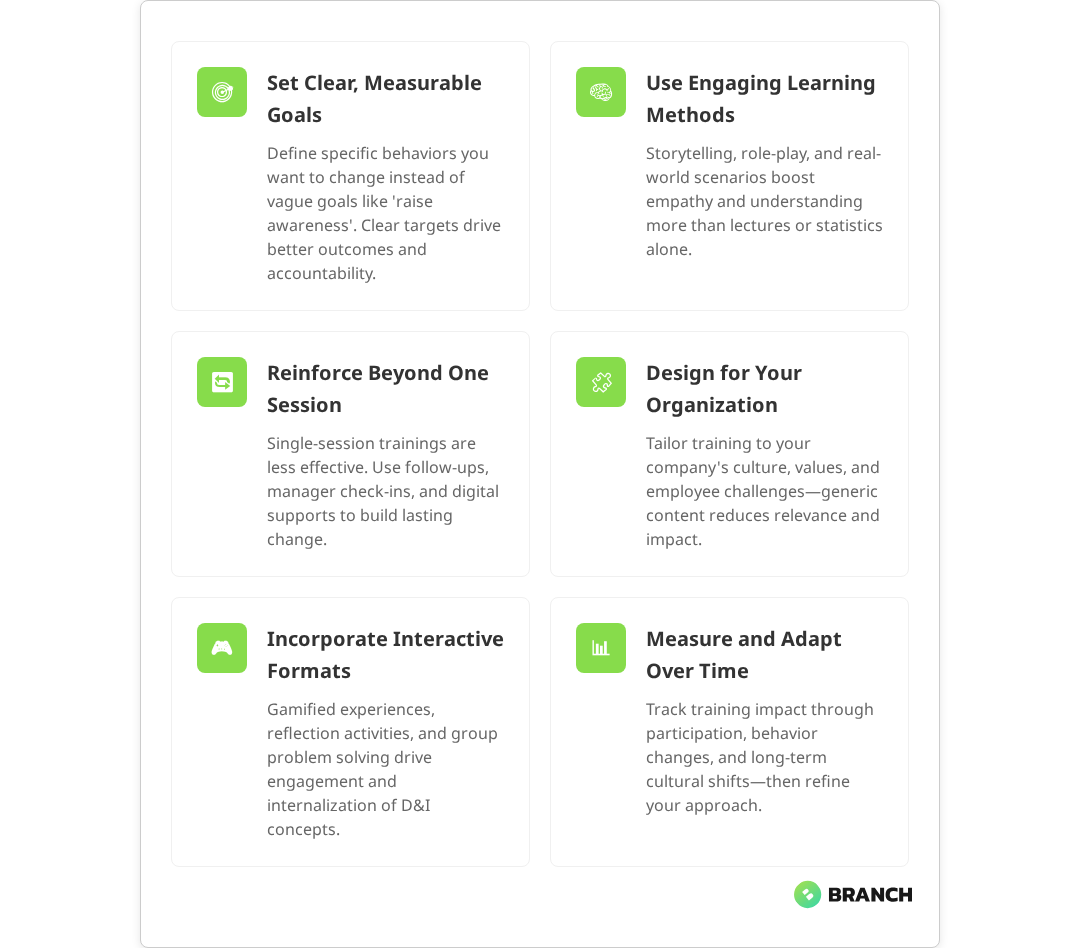
Traditional diversity training often fails because it treats complex social dynamics like technical procedures. You can’t PowerPoint your way to empathy, and you definitely can’t lecture people into being more inclusive. Research consistently shows that many traditional diversity training programs are ineffective because they oversimplify complex social issues, often using generic, lecture-based formats that do not produce lasting behavioral changes. The most common mistakes include:

  • Passive consumption: Sitting through presentations about bias without opportunities for reflection or practice
  • One-size-fits-all content: Generic scenarios that don’t reflect your organization’s actual challenges
  • Defensive positioning: Framing D&I as compliance rather than competitive advantage
  • Lack of follow-through: Single sessions with no ongoing reinforcement or skill-building

The result? Participants walk away feeling either lectured at or confused about how to apply what they’ve learned. Some may even become more resistant to D&I initiatives, viewing them as performative rather than meaningful. Studies show that mandatory or compliance-focused trainings can trigger resistance or backlash, and tend not to increase diversity in management roles over time.

💡 Tip: Start your D&I program design by asking participants what inclusion looks like in their day-to-day work. Their answers will tell you where to focus your training efforts.

The Science of Engagement in D&I Training

Effective diversity and inclusion training leverages how adults actually learn. Research consistently shows that interactive, story-driven experiences create stronger retention and behavior change than traditional lecture formats.

The key is moving from telling people about diversity to helping them experience different perspectives. This might sound touchy-feely, but it’s grounded in solid learning science. Multiple studies demonstrate that when people actively engage with content—whether through problem-solving activities, personal reflection, or group discussions—they’re more likely to internalize and apply the concepts.

Traditional ApproachEngagement-Focused ApproachWhy It Works Better
Statistics about workplace biasInteractive scenarios based on real situationsParticipants practice applying concepts in context
Definitions of microaggressionsRole-playing exercises with guided reflectionBuilds empathy through perspective-taking
Company policies on inclusionCase studies from your actual organizationShows relevance to participants’ daily experience
Generic best practicesTeam-specific action planningCreates concrete next steps for behavior change
Read more about how professional eLearning programs are designed for maximum engagement and retention.

What the research says

Evidence from systematic reviews and organizational studies reveals key insights about what makes diversity and inclusion training effective:

  • Multi-session programs work better: Research shows that 85.7% of multi-session DEI trainings reported significant improvements in measured outcomes, compared to just 46.7% of single-session programs.
  • Active engagement drives results: Interactive training that includes problem-solving, reflection, and group discussion significantly outperforms passive lecture formats in changing attitudes and behaviors.
  • Timing and context matter: Training delivered when people are making actual decisions—like hiring or promotions—produces more behavioral change than standalone awareness sessions.
  • Personal narratives create connection: Stories and real experiences help participants relate to abstract concepts and develop empathy more effectively than hypothetical scenarios.
  • Evidence on mandatory training is mixed: While ensuring consistent messaging, required training can sometimes trigger resistance, especially when framed as compliance rather than skill development.

Interactive Formats That Actually Work

The most impactful D&I training sessions share one thing: participants are actively engaged, not just passively listening. Here are formats that consistently drive results:

Story-Driven Learning

Personal narratives make abstract concepts concrete. When team members share their own experiences—both positive and challenging—it creates authentic learning moments that resonate far more than hypothetical scenarios. Research shows that personal narratives increase relatability and emotional connection, enhancing empathy and perspective-taking. The key is creating safe spaces where people feel comfortable being vulnerable.

Problem-Solving Activities

Present real workplace challenges and have teams work through solutions together. This might involve analyzing communication breakdowns, designing more inclusive meeting practices, or troubleshooting bias in hiring processes. Evidence demonstrates that collaborative problem-solving builds both skills and buy-in while increasing motivation and ownership of outcomes through active participation.

Gamified Learning Experiences

Games and simulations can make difficult topics more approachable. Custom trivia about your company’s diversity initiatives, inequality-focused board games, or digital simulations that let people experience different perspectives can all be powerful learning tools when thoughtfully designed.

Activity-Based Sessions

Short, focused activities often outperform lengthy presentations. A well-designed 30-minute exercise that highlights communication differences can create more “aha” moments than an hour of slides. The key is choosing activities that connect directly to your learning objectives.

💡 Tip: Build your D&I activities around actual workplace scenarios your teams face. Generic examples feel academic; specific situations feel relevant and actionable.

Designing for Your Context

Effective diversity and inclusion training starts long before you create the first slide or activity. The foundation is understanding your specific organizational context, audience, and goals.

Know Your Audience

Demographics matter, but culture matters more. A startup with 30 employees needs different approaches than a Fortune 500 company with global teams. Consider:

  • Current diversity representation and inclusion challenges
  • Existing company values and how D&I connects to them
  • Previous training experiences (what worked, what didn’t)
  • Leadership support and messaging around D&I initiatives
  • Time constraints and competing priorities

Set Clear, Measurable Goals

Vague objectives lead to vague outcomes. Instead of aiming to “increase awareness,” define specific behaviors you want to see change. Research emphasizes that measurable, specific goals are essential for tracking progress and determining program effectiveness. Examples might include:

  • Improved participation from underrepresented team members in meetings
  • Reduced bias in hiring and promotion decisions
  • Increased psychological safety scores in team surveys
  • Better conflict resolution around cultural differences
Read more about how D&I training integrates with broader compliance and organizational development frameworks.

Building Content That Sticks

The best diversity and inclusion training doesn’t just inform—it transforms. This requires thoughtful content design that balances education with application.

Start With Self-Reflection

Before diving into group activities, give participants time to examine their own experiences and assumptions. Self-awareness is the foundation of inclusive behavior, and rushing past it undermines everything that follows. Studies show that DEI training incorporating self-reflection promotes lasting change more effectively than programs that skip this critical step.

Use Real Examples

Draw from your organization’s actual challenges and successes. If your company struggled with inclusive leadership during rapid growth, build scenarios around that experience. If certain teams have found innovative ways to collaborate across differences, showcase those practices. Research demonstrates that training grounded in practical, real-world scenarios leads to more meaningful behavior change and improved outcomes.

Make It Actionable

Every session should end with specific next steps. This might be individual commitments, team agreements, or organizational process changes. Without clear action items, even the most engaging training becomes just an interesting conversation.

Build in Reinforcement

One-and-done training rarely creates lasting change. Plan for follow-up sessions, peer coaching, manager check-ins, or digital reinforcement tools that keep D&I concepts front of mind.

Delivery Options and Trade-offs

How you deliver your diversity and inclusion training affects both engagement and outcomes. Each format has strengths and limitations:

Delivery MethodBest ForConsiderations
In-person workshopsDeep discussion, team building, sensitive topicsHigher cost, scheduling complexity, geographic limitations
Virtual sessionsDistributed teams, consistent messaging, cost efficiencyEngagement challenges, technical barriers, screen fatigue
Self-paced eLearningIndividual reflection, flexible scheduling, scalabilityLower engagement, reduced discussion, isolation
Blended approachCombining individual prep with group applicationDesign complexity, multiple platforms, coordination needs

The most effective programs often combine multiple delivery methods, using each format’s strengths to reinforce key messages and skills.

Read more about integrating D&I concepts into structured employee onboarding workflows.

Measuring Impact and Iteration

Creating effective diversity and inclusion training is an iterative process. What works for one organization—or even one team—may need adjustment for another context.

Leading Indicators

Track engagement metrics during training: participation rates, question frequency, activity completion, and immediate feedback scores. These tell you whether your content is connecting.

Behavioral Changes

The real test is whether behavior changes after training. This might include manager observations, peer feedback, inclusion survey results, or analysis of meeting participation patterns.

Long-term Outcomes

Ultimate success shows up in retention rates, promotion patterns, employee engagement scores, and the overall health of your workplace culture. These metrics take time but provide the clearest picture of training effectiveness.

When to Partner With Specialists

Many organizations start diversity and inclusion training with internal resources—HR teams, learning and development staff, or external consultants. This can work well, especially for foundational concepts and company-specific content.

However, creating truly engaging, behavior-changing D&I programs requires specialized expertise in instructional design, adult learning principles, and inclusive content creation. Consider partnering with specialists when:

  • Your internal team lacks eLearning development experience
  • You need interactive, multimedia content that goes beyond slides
  • Previous training attempts haven’t driven desired behavior changes
  • You’re scaling programs across multiple locations or business units
  • Leadership wants measurable ROI from D&I investments

The right development partner brings both technical expertise and fresh perspective, helping you avoid common pitfalls while creating programs tailored to your organization’s unique needs. Look for teams that combine instructional design skills with deep understanding of diversity, equity, and inclusion principles.

A thoughtful approach to diversity and inclusion training can transform workplace culture, but only if it’s built on solid learning foundations and genuine commitment to change. The investment in getting it right—whether through internal development or external partnership—pays dividends in employee engagement, innovation, and organizational resilience.

FAQ

How long should diversity and inclusion training sessions be?

Effective D&I training often works better in shorter, focused sessions rather than day-long workshops. Consider 30-60 minute activities that allow for deep engagement without overwhelming participants. Multiple shorter sessions with time for reflection and practice between them typically drive better behavior change than single marathon sessions.

Should diversity training be mandatory or voluntary?

This depends on your organizational culture and goals. Mandatory training ensures everyone receives consistent messaging but can create resistance. Voluntary programs often see higher engagement but may miss people who most need the content. Many successful programs start voluntary and become part of standard professional development as they prove their value.

How do we handle resistance or pushback during D&I training?

Resistance often signals that people feel defensive or don't see personal relevance. Address this by focusing on business outcomes, using data to ground discussions, and creating safe spaces for questions and concerns. Frame D&I as skills development rather than correction, and acknowledge that these conversations can feel uncomfortable while remaining important.

What's the difference between diversity training and inclusion training?

Diversity training typically focuses on understanding differences and reducing bias, while inclusion training emphasizes behaviors that make everyone feel valued and able to contribute. The most effective programs address both, helping people recognize differences AND develop skills to create environments where everyone can thrive.

How much should we budget for effective D&I training?

Costs vary widely based on scope, delivery method, and customization level. Basic online modules might cost a few thousand dollars, while comprehensive custom programs can require tens of thousands. Consider the cost of not addressing D&I issues—turnover, reduced innovation, legal risks—when evaluating your investment. Most organizations find that thoughtful D&I training pays for itself through improved retention and engagement.

Woman following online courses on her laptop at home.

What Are the Best Methods for Soft Skills Training?

Your team needs better communication. Collaboration feels stilted. Managers struggle to give feedback effectively. Sound familiar? You’re not alone—soft skills gaps consistently rank among the top workforce challenges, yet recent research shows that only one-fifth of employees feel they receive effective soft skills training from their organizations.

The problem isn’t a lack of content. There’s no shortage of leadership modules, communication courses, or teamwork workshops out there. The real challenge is choosing methods that drive genuine behavioral change rather than just ticking compliance boxes. Whether you’re a learning and development leader, HR director, or operations manager tasked with upskilling your team, you need approaches that work in the real world—not just in theory.

Let’s explore the most effective methods for soft skills training, the trade-offs you’ll face, and how to design programs that actually change how people work together.

Why Most Soft Skills Training Falls Flat

Before diving into what works, let’s acknowledge what doesn’t. Generic soft skills content—the kind that gets rolled out enterprise-wide with minimal customization—typically sees adoption rates of just 5-10%. That’s not because employees don’t value communication or leadership skills. It’s because the training doesn’t connect to their daily reality.

Research has identified three common failure modes that plague soft skills training:

  • Solution without a problem: Content that isn’t tied to specific business challenges your organization faces
  • Digital-only delivery: Relying purely on eLearning modules without human reinforcement or coaching
  • One-size-fits-all approach: Generic content that doesn’t reflect your team’s roles, industry, or organizational culture

The most effective soft skills training flips these problems on their head. Instead of starting with content, start with the specific performance gaps you need to address.

💡 Tip Before investing in any soft skills training, identify 2-3 specific business problems it should solve. 'Better communication' is too vague—'reducing project delays caused by unclear stakeholder feedback' gives you something measurable.

The Four Most Effective Training Methods

Based on what actually works in practice, here are the four methods that consistently deliver behavioral change:

1. Blended Learning with Human Support

Pure digital content rarely drives culture change on its own. Research consistently shows that the most successful soft skills programs combine digital resources with human-led elements like facilitated discussions, peer learning sessions, or one-on-one coaching.

This hybrid approach works because soft skills are inherently interpersonal. You can’t truly practice active listening or conflict resolution through a screen—you need real interactions with feedback and guidance.

2. Problem-Centered Workshops

Instead of abstract training on “leadership principles,” focus workshops on specific challenges your team faces. For example, if project handoffs consistently create confusion, design a session around stakeholder communication and documentation practices.

These workshops work best when they:

  • Address real scenarios from your organization
  • Include role-playing with actual team dynamics
  • Produce actionable tools or templates participants can use immediately
Read more about designing effective learning experiences that stick.

3. Peer Learning and Mentoring Programs

Some of the most powerful soft skills development happens through structured peer interactions. This might include cross-functional project teams, mentoring relationships, or regular feedback partnerships.

The key is making these interactions intentional rather than hoping they happen organically. Provide frameworks for giving and receiving feedback, templates for difficult conversations, and regular check-ins to ensure the relationships are productive.

4. Microlearning with Practical Application

Rather than lengthy courses, break soft skills training into bite-sized lessons tied to immediate application. Recent studies show that a 10-minute module on giving constructive feedback, followed by a template and an assignment to practice with a real team member, often proves more effective than a two-hour workshop.

This approach works because it reduces cognitive load and creates multiple opportunities for practice and reinforcement.

What the research says

  • Blended approaches outperform single methods: Multiple studies confirm that combining digital content with human-led elements like coaching and facilitated discussions leads to better skill retention and application than purely digital training.
  • Microlearning boosts engagement and outcomes: Research shows that bite-sized training modules can reduce training time by up to 80% while improving engagement by 50% and enhancing real-world skill application.
  • Business alignment is crucial: Training programs that address specific organizational challenges rather than generic skills see significantly higher adoption rates and measurable business impact.
  • Manager involvement is critical: Studies indicate that manager buy-in and active participation can influence up to 70% of training effectiveness, making leadership support essential for success.
  • Measurement needs time: Early research suggests that while initial enthusiasm may appear within weeks, genuine behavior change typically requires 3-6 months to become visible and measurable.

Choosing the Right Approach for Your Organization

The best training method depends on your specific context. Here’s a framework for making that decision:

Your SituationRecommended ApproachKey Success Factors
Small team (under 50), specific skill gapsProblem-centered workshopsAddress real scenarios; include all stakeholders
Large organization, broad skill developmentBlended learning programStrong managerial support; clear success metrics
Remote or distributed teamsMicrolearning + peer partnershipsStructured interaction frameworks; regular check-ins
Leadership development focusMentoring + targeted workshopsExecutive sponsorship; real project assignments
Limited budget or pilot programCurated content + facilitated discussionsStrong curation; consistent facilitation quality

Building vs. Buying: Your Content Options

Once you’ve selected your delivery method, you need to decide on content. You have three main options, each with distinct trade-offs:

Off-the-Shelf Solutions

Best for: Common skill areas with broad applicability (basic communication, time management)

Pros: Quick deployment, lower upfront cost, professionally produced

Cons: Generic scenarios, limited customization, may not reflect your culture

Curated and Customized Content

Best for: Organizations with specific industry context or unique challenges

Pros: Relevant scenarios, aligned with company values, can incorporate real examples

Cons: Higher upfront investment, longer development timeline

Fully Custom Development

Best for: Complex skill development tied to specific business processes or unique organizational dynamics

Pros: Perfectly aligned with business needs, can integrate with existing workflows

Cons: Significant time and budget investment, requires ongoing maintenance

💡 Tip Start with pilot testing before committing to any approach. Test different content types with small groups and measure both engagement and behavior change before scaling up.

Measuring Success Beyond Completion Rates

The metrics that matter for soft skills training go beyond traditional learning analytics. While completion rates and quiz scores provide basic data, they don’t tell you if behavior actually changed.

Expert frameworks recommend more meaningful metrics including:

  • Performance indicators: Project success rates, stakeholder satisfaction scores, conflict resolution times
  • 360-degree feedback: Pre- and post-training assessments from peers, direct reports, and managers
  • Application tracking: Evidence that participants are using tools or frameworks from training in real work situations
  • Business impact: Improvements in collaboration, communication effectiveness, or team performance tied to training initiatives

The key is establishing baseline measurements before training begins and tracking changes over 3-6 month periods, not just immediate post-training surveys. Multiple training specialists emphasize that this extended timeframe allows you to measure sustained behavioral change rather than just initial enthusiasm.

Read more about how Branch Boston designs measurable soft skills training programs.

When to Partner with Specialists

While some organizations successfully develop soft skills training internally, others benefit from working with experienced learning design partners. Consider external help when:

  • You need custom content that reflects complex business processes or unique organizational challenges
  • Your internal team lacks instructional design expertise or bandwidth
  • You want to integrate multiple delivery methods (digital + facilitated + coaching) into a cohesive program
  • You need to scale training across multiple locations or business units while maintaining consistency

The right partner will start by understanding your specific business problems, not pushing a predetermined solution. They should be able to demonstrate experience with both content development and program implementation, including change management support.

At Branch Boston, we’ve found that the most successful soft skills training programs combine thoughtful instructional design with deep understanding of how teams actually work. Rather than generic modules, we create learning experiences tied to real business outcomes—whether that’s leadership development for emerging managers or communication training for cross-functional project teams.

Getting Started: A Practical Framework

Ready to design soft skills training that actually works? Here’s a step-by-step approach:

  1. Identify specific problems: What business challenges could better soft skills address? Be concrete.
  2. Choose your pilot group: Start small with 10-20 participants who are motivated to participate and represent your broader audience.
  3. Select delivery method: Use the decision framework above to choose an approach that fits your constraints and culture.
  4. Design measurement strategy: Establish baseline metrics and plan for tracking both learning and behavior change.
  5. Test and iterate: Run your pilot, gather feedback, and refine before scaling.

Remember, effective soft skills training is less about finding the perfect content and more about creating consistent opportunities for practice, feedback, and reflection. The organizations that see real results treat skill development as an ongoing process, not a one-time event.

Whether you build internally or work with a partner like Branch Boston for custom eLearning development, focus on creating learning experiences that connect directly to how your team works—and the business problems you’re trying to solve.

FAQ

How long does it take to see results from soft skills training?

Genuine behavior change typically takes 3-6 months to become visible and measurable. You might see initial engagement and enthusiasm within weeks, but sustainable changes in communication patterns, leadership behaviors, or collaboration effectiveness require consistent practice and reinforcement over several months.

What's the biggest mistake organizations make with soft skills training?

Rolling out generic content without tying it to specific business problems. When training feels disconnected from daily work challenges, adoption rates plummet. Start by identifying 2-3 concrete performance gaps, then design training to address those specific issues rather than general 'communication skills.'

Can soft skills training work for remote teams?

Absolutely, but it requires different approaches than in-person training. Focus on microlearning modules paired with structured peer partnerships or mentoring relationships. Virtual role-playing sessions and regular practice opportunities through video calls can be highly effective when well-facilitated.

How much should we budget for effective soft skills training?

Budget varies widely based on approach and scale. Simple curated content with internal facilitation might cost $500-1,500 per participant, while fully custom blended programs with coaching support can range from $2,000-5,000 per participant. The key is aligning investment with expected business impact and measuring ROI through performance improvements.

Do managers need special training to support soft skills development?

Yes, manager buy-in and participation dramatically increases training effectiveness. Managers need frameworks for reinforcing learning, giving feedback on skill application, and modeling the behaviors you're trying to develop. Consider training managers first or running parallel manager development alongside employee programs.

Mid adult businessman typing an e-mail on a computer in the office. His colleagues are in the background.

ADDIE vs SAM vs Agile Instructional Design Models

If you’ve spent any time in the eLearning world, you’ve probably encountered the acronym soup: ADDIE, SAM, Agile. These instructional design models promise to bring structure and predictability to learning development projects. But here’s the thing that most practitioners won’t tell you upfront the gap between theory and practice is often wider than the Grand Canyon.

Whether you’re a learning and development leader evaluating your team’s approach or a digital decision-maker considering custom eLearning development, understanding when and how these models actually work (versus when they don’t) can save you from costly missteps and scope creep nightmares.

Let’s cut through the LinkedIn thought leadership fluff and examine what ADDIE, SAM, and Agile instructional design really look like when they hit the messy reality of stakeholder politics, changing requirements, and tight deadlines.

The Reality Check: How Models Actually Get Used

Before diving into the specifics of each model, let’s acknowledge an uncomfortable truth that experienced instructional designers know well: most teams claim to follow formal models but adapt them heavily in practice. This isn’t necessarily a failure it’s often smart pragmatism.

Research shows that the most effective learning development teams blend methodologies based on project constraints, stakeholder needs, and organizational culture. They might use ADDIE’s structure to communicate with unfamiliar clients, SAM’s iterative approach for rapid prototyping, and Agile principles for stakeholder collaboration sometimes all within the same project. This hybrid approach allows teams to match their process to project realities rather than forcing projects to fit rigid methodological frameworks.

💡 Tip: When evaluating eLearning partners, ask for specific examples of how they've adapted their process to different project constraints. Rigid adherence to any single model is often a red flag.

ADDIE: The Structured Workhorse

ADDIE (Analysis, Design, Development, Implementation, Evaluation) remains the most widely recognized instructional design model, and for good reason. Multiple sources confirm that it provides a clear, linear framework that’s particularly valuable when working with complex stakeholder groups or clients new to learning development.

When ADDIE Works Best

  • Complex compliance training where documentation and approval processes are critical
  • Large enterprise projects with multiple subject matter experts and approval layers
  • Clients unfamiliar with instructional design who need transparent, step-by-step guidance
  • High-stakes learning programs where thorough upfront analysis prevents costly mistakes

ADDIE’s Real-World Challenges

The linear nature of ADDIE can feel rigid when requirements change mid-project (and they always do). Research indicates that once ADDIE development has begun, it does not adapt well to mid-project changes, and shifting project goals can throw the entire process back to the analysis phase. The model works well when you have stable requirements and cooperative subject matter experts, but it can become a bureaucratic burden when stakeholders want to see something tangible quickly.

Additionally, ADDIE’s emphasis on comprehensive upfront analysis can slow initial momentum, leading to pushback from stakeholders who confuse activity with progress. Studies show this front-loaded approach can result in lengthy development cycles, with some courses taking up to two years from approval to delivery.

SAM: ADDIE’s Agile Cousin

The Successive Approximation Model (SAM) emerged as a response to ADDIE’s perceived rigidity. Research confirms that SAM emphasizes iterative development through rapid prototyping and frequent stakeholder feedback cycles, making it more adaptable to changing requirements.

SAM’s Two-Tier Approach

SAM1 works well for smaller, less complex projects with minimal stakeholders. SAM2 adds more formal project management and evaluation phases for larger initiatives.

When SAM Makes Sense

  • Innovative learning experiences where the final product isn’t clearly defined upfront
  • Projects with engaged stakeholders who can provide timely, meaningful feedback
  • Learning programs where user experience and engagement are primary concerns
  • Teams comfortable with ambiguity and iterative refinement

SAM’s Hidden Pitfalls

While SAM promises faster delivery through iteration, it requires disciplined scope management. Without clear boundaries, the “successive approximation” can become successive scope creep. Studies highlight that the frequent changes and overlapping phases in SAM can extend timelines and increase costs if scope is not managed carefully. The model also assumes stakeholders understand their role in providing timely, actionable feedback an assumption that often proves optimistic.

Read more: How professional eLearning development processes actually work in practice.

Agile Instructional Design: Promise vs. Practice

Agile principles have migrated from software development into instructional design, bringing concepts like user stories, sprints, and retrospectives to learning development. However, the implementation often falls short of the ideals.

True Agile Characteristics in Learning Design

  • Cross-functional collaboration between designers, developers, and stakeholders
  • Working prototypes delivered in short iterations
  • Adaptive planning based on user feedback and changing requirements
  • Continuous improvement through regular retrospectives

Where “Agile” Goes Wrong

Many organizations slap the “Agile” label on chaotic processes that lack clear ownership, defined scope, or meaningful user feedback loops. True Agile requires organizational maturity and stakeholder buy-in that many teams simply don’t possess.

The result? Projects that ping-pong between unclear requirements, with “Agile” becoming an excuse for poor planning rather than a framework for adaptive excellence.

What the research says

  • Blended approaches outperform single models: Multiple studies show that teams combining elements from different models achieve better outcomes than those rigidly following one approach
  • ADDIE remains valuable for complex projects: Research consistently supports ADDIE’s effectiveness for compliance training and large enterprise initiatives requiring extensive documentation
  • SAM requires stakeholder maturity: Evidence indicates SAM’s success depends heavily on engaged stakeholders who can provide meaningful, timely feedback throughout iterative cycles
  • Agile principles work across models: Cross-functional collaboration and continuous improvement practices enhance outcomes regardless of the primary methodology chosen
  • Context matters more than methodology: Early research suggests that project constraints and organizational readiness are stronger predictors of success than model selection, though more studies are needed to establish definitive best practices

Choosing Your Approach: A Practical Framework

Rather than asking “Which model should we use?” the more useful question is “What constraints and goals shape our project?” Here’s a practical decision framework:

Project CharacteristicsRecommended Primary ApproachKey Adaptations
Complex compliance with multiple approversADDIE-basedAdd SAM-style prototyping for stakeholder alignment
Innovative UX with engaged stakeholdersSAM-basedInclude Agile retrospectives and user story mapping
Ongoing learning platform developmentAgile-basedUse ADDIE analysis phase for foundational research
Tight timeline with clear requirementsModified SAM1Front-load analysis, compress iteration cycles
Uncertain scope with exploratory goalsDesign thinking + AgileExtended discovery phase before development sprints

Making Models Work in the Real World

Successful instructional design projects share certain characteristics regardless of the underlying model:

Clear Stakeholder Roles and Expectations

Define who provides input, who makes decisions, and who has final approval authority. Ambiguous ownership kills more projects than methodology choices.

Realistic Timeline and Scope Boundaries

Whether you’re using ADDIE’s phases, SAM’s iterations, or Agile sprints, scope creep is the enemy of every model. Build change management processes into your approach from day one.

Meaningful User Feedback Loops

All three models depend on stakeholder input, but they differ in when and how that feedback gets incorporated. Match your feedback approach to your stakeholders’ availability and expertise.

Flexible Documentation

ADDIE traditionally emphasizes comprehensive documentation, while Agile favors working software over documentation. The sweet spot is usually somewhere in between enough documentation to maintain quality and enable handoffs, but not so much that it becomes bureaucratic overhead.

When to Partner with Specialists

Custom eLearning development requires more than choosing the right model it demands expertise in learning science, user experience design, and technical implementation. Consider partnering with specialists when:

  • Your internal team lacks experience with iterative development approaches
  • The project involves complex technical integrations or custom functionality
  • Stakeholder alignment and change management are proving challenging
  • You need to balance multiple competing priorities across different organizational levels

A thoughtful digital partner can help you adapt instructional design models to your specific constraints while maintaining focus on learning outcomes rather than process orthodoxy. They bring experience with what actually works across different organizational contexts, not just what sounds good in theory.

💡 Tip: Look for partners who can articulate how they've successfully modified standard models for different client needs. The best teams blend approaches based on evidence, not ideology.

Beyond the Model Wars: What Really Matters

Here’s what experienced practitioners know: the model matters less than execution quality and stakeholder alignment. A well-executed ADDIE project will outperform a poorly managed Agile effort every time.

Focus on these fundamentals regardless of your chosen approach:

  • Learning objectives that connect to business outcomes
  • User research that informs design decisions
  • Stakeholder communication that prevents surprises
  • Quality assurance that catches problems before launch
  • Success metrics that measure actual learning transfer

The teams that succeed understand that instructional design models are tools, not religions. They adapt their approach based on project realities while maintaining unwavering focus on creating learning experiences that actually work for end users.

Whether you’re building custom eLearning development projects, implementing LMS platforms, or developing structured learning courses, success comes from matching your process to your context, not from following any particular model perfectly.

FAQ

Do most instructional design teams actually follow ADDIE, SAM, or Agile strictly?

No, most experienced teams blend elements from different models based on project needs. They might use ADDIE's structure for stakeholder communication, SAM's rapid prototyping for user testing, and Agile principles for team collaboration often within the same project. Pure adherence to any single model is less common than adaptive, hybrid approaches.

How do I know if my team is ready for Agile instructional design?

Successful Agile requires organizational maturity: stakeholders who can provide timely feedback, teams comfortable with ambiguity, and leadership that supports iterative refinement over upfront perfection. If your organization struggles with scope creep or has unclear decision-making authority, address those issues before adopting Agile approaches.

Is SAM just a repackaged version of ADDIE?

While SAM and ADDIE share similar phases, SAM emphasizes iterative development and rapid prototyping where ADDIE follows a more linear progression. SAM's key difference is building working prototypes early and often, while ADDIE typically develops the full solution after comprehensive upfront analysis. However, many practitioners blend both approaches in practice.

What's the biggest mistake teams make when choosing an instructional design model?

The biggest mistake is choosing a model based on what sounds innovative rather than what fits the project constraints. Teams often underestimate the organizational change required for newer approaches like Agile, or they dismiss ADDIE as outdated when its structure would actually help manage complex stakeholder environments.

How should I evaluate an eLearning partner's approach to instructional design models?

Ask for specific examples of how they've adapted their process to different client needs and constraints. Look for partners who can explain the trade-offs between different approaches rather than promoting one model as universally superior. The best partners match their methodology to your project reality, not the other way around.

Young adult Black woman having job interview online using laptop in modern coworking

How to Design Employee Onboarding Programs That Work

Employee onboarding isn’t just about filling out forms and watching compliance videos—though plenty of programs still feel that way. Done right, research shows that effective onboarding programs can improve retention by over 80% and increase productivity by more than 70%, transforming nervous first-day energy into confident, productive team members who stick around. Done wrong, it’s a bureaucratic slog that leaves new hires questioning their decision to join your organization.

The challenge? Most onboarding programs are built around internal convenience rather than human experience—a problem supported by recent data showing that only about 12% of employees rate their onboarding as satisfactory. They scatter tasks across disconnected systems, burden managers with complex workflows they’ll inevitably skip, and treat learning like a checklist instead of a journey. The result is predictable: inconsistent experiences, frustrated stakeholders, and new employees who feel more lost after onboarding than before.

This guide breaks down how to build employee onboarding programs that actually work—combining structured learning pathways, practical task management, and the kind of thoughtful design that makes complex processes feel surprisingly simple.

Why Most Onboarding Programs Miss the Mark

The fundamental problem with most employee onboarding programs isn’t a lack of good intentions—it’s a mismatch between ambitious goals and practical execution. Organizations want comprehensive, engaging experiences that cover everything from culture to compliance. What they often get are fragmented systems that create more confusion than clarity.

Consider the typical onboarding experience: new hires log into one platform for HR paperwork, another for training modules, receive a separate checklist from their manager (if they’re lucky), and somehow need to track their progress across all three. Meanwhile, managers juggle their own set of tasks—facility tours, equipment setup, introductions—often with no systematic way to ensure nothing falls through the cracks.

This fragmentation creates several cascading problems that research confirms are widespread across organizations:

  • Accountability gaps: When tasks span multiple systems and stakeholders, research shows that only 36% of HR leaders describe the handoff between recruiting, HR, and hiring managers as seamless, making it easy for critical steps to get lost or delayed.
  • Inconsistent experiences: Different departments or managers deliver wildly different onboarding quality, creating unfair advantages for some new hires. Studies indicate that nearly one in three HR leaders report new hires receive no guidance at all.
  • Manager resistance: Complex workflows that don’t fit into managers’ existing routines often get abandoned in favor of informal, ad-hoc approaches—a pattern consistently observed when onboarding systems are too complex or time-consuming for busy managers.
  • Poor visibility: HR teams struggle to understand where onboarding breaks down or which elements actually drive retention and performance, with many organizations lacking the data needed to continuously improve their processes.
💡 Tip: Before building any onboarding solution, map out your current process from the new hire's perspective. Include every login, handoff, and waiting period—the friction points become obvious quickly.

The solution isn’t necessarily more sophisticated technology—it’s better-designed processes that account for how people actually work. This means understanding the constraints and motivations of every stakeholder, from busy hiring managers to overwhelmed new employees trying to absorb an organization’s worth of information in their first few weeks.

Read more about structured eLearning development processes that support complex organizational workflows.

What the research says

Multiple studies and industry analyses reveal consistent patterns about what makes onboarding programs successful:

  • Structured approaches deliver measurable results: Organizations with formal onboarding processes see significantly higher retention rates and faster time-to-productivity compared to informal approaches.
  • Consistency matters more than sophistication: Research indicates that standardized onboarding experiences, even simple ones, outperform inconsistent high-touch approaches in terms of new hire satisfaction and outcomes.
  • Manager engagement is critical but often missing: Studies show that nearly 29% of new hires receive inadequate guidance from their managers, highlighting a key gap in most onboarding programs.
  • Integration challenges are widespread: The majority of organizations struggle with fragmented onboarding systems, with less than half reporting seamless coordination between different departments and platforms.
  • Early evidence suggests technology alone isn’t the solution: While digital platforms can improve efficiency, the research shows that human connection and clear process design remain the strongest predictors of onboarding success.

The Architecture of Effective Onboarding

Successful employee onboarding programs share a common architecture: they combine structured learning pathways with flexible task management, all wrapped in systems that make it easy for both employees and managers to stay on track. Research confirms that effective onboarding programs blend formal learning, informal mentoring, and flexible delivery methods to ensure both engagement and consistency. The key is understanding which elements belong in formal learning platforms versus lightweight collaboration tools.

Learning Management Systems: The Structured Core

Modern Learning Management Systems (LMS) excel at delivering structured, trackable learning experiences. Features like learning pathways or curriculums allow you to sequence courses, documents, and assessments in logical progression, complete with due dates and prerequisites. This structure is particularly valuable for onboarding because it provides consistency while accommodating role-specific variations—a capability that multiple studies confirm improves both retention and employee productivity.

For example, all new hires might complete a foundational curriculum covering company culture, policies, and basic systems training. Role-specific paths then branch off—sales team members get CRM training and pipeline methodology, while engineering hires dive into development workflows and code review processes. The LMS tracks completion across all paths, giving HR teams visibility into progress and bottlenecks.

The most effective onboarding curriculums blend multiple content types:

  • Self-paced eLearning modules for foundational knowledge and policies
  • Virtual instructor-led training (VILT) for interactive sessions requiring discussion or practice
  • Document libraries for reference materials and job aids
  • Assessment checkpoints to verify understanding and completion

Task Management: The Practical Layer

While LMS platforms handle structured learning well, they often struggle with the practical, relationship-heavy tasks that make onboarding successful. Equipment setup, facility tours, team introductions, and workspace assignments typically require coordination between the new hire and their manager—and these interactions don’t always fit neatly into course-based workflows.

This is where lightweight task management becomes critical. Research suggests that while simple tools—shared spreadsheets, project management platforms, or even built-in LMS checklists—can track these less formal but equally important elements, purpose-built onboarding platforms with integrated task management significantly outperform generic approaches as organizations scale. The key is keeping manager-facing workflows as simple as possible while maintaining visibility for HR teams.

Read more about integrating training data with HCMS for streamlined HR workflows.

Design Principles for Onboarding That Sticks

Effective employee onboarding programs are built on a few core design principles that prioritize human experience over administrative convenience. These principles help navigate the inevitable trade-offs between comprehensiveness and simplicity, structure and flexibility.

Start with Stakeholder Reality

The best onboarding designs begin with honest assessment of how different stakeholders actually work. New hires are drinking from a fire hose—every additional login, platform, or process adds cognitive load. Hiring managers are typically juggling their regular responsibilities alongside onboarding duties—complex workflows get deprioritized or skipped entirely.

This reality check often reveals that simpler approaches work better than sophisticated ones. A shared spreadsheet that managers actually use trumps an elegant LMS workflow they ignore. A single learning pathway with embedded manager checkpoints often works better than separate systems for learning and task management.

Design for Dual Accountability

Successful onboarding requires coordination between new employees and their managers, but tracking shared accountability can be tricky. Some tasks are purely employee-driven (completing training modules), others require manager action (equipment setup, introductions), and many involve both parties (goal-setting conversations, role-specific training).

The most effective programs make this dual accountability explicit rather than hoping it happens naturally. This might mean:

  • Manager-verified completion steps in learning curriculums
  • Automated reminders to both parties when collaborative tasks are approaching deadlines
  • Separate but linked tracking systems that give each party visibility into their responsibilities
  • Clear escalation paths when tasks get stuck between stakeholders
Onboarding ElementBest Platform TypeKey StakeholdersSuccess Metrics
Company culture & policiesLMS curriculumNew hire, HRCompletion rates, assessment scores
Role-specific trainingLMS with manager verificationNew hire, manager, subject expertsCompetency demonstrations, manager feedback
Equipment & workspace setupSimple task trackerManager, IT, facilitiesSetup completion time, new hire satisfaction
Team introductions & networkingCalendar integration or task listManager, team membersIntroduction completion, relationship quality
Goal setting & expectationsCollaborative documents or formsNew hire, managerGoal clarity scores, alignment feedback
💡 Tip: Create manager onboarding checklists that are separate but synchronized with employee-facing materials. This prevents overwhelming new hires with manager-specific tasks while keeping everyone aligned.

Implementation Strategies: From Planning to Launch

Building an effective employee onboarding program requires careful orchestration of content, technology, and stakeholder needs. The most successful implementations follow a structured approach that prioritizes quick wins while building toward comprehensive solutions.

Phase 1: Foundation and Core Content

Start with the elements that provide immediate value and are least dependent on complex integrations. This typically means focusing on structured learning content that can live in a single platform—company culture, policies, basic systems training, and role-specific fundamentals.

During this phase, invest time in content quality rather than technological sophistication. Well-designed learning modules that new hires can complete independently provide immediate value while you work on more complex coordination elements. This also gives you time to observe how different stakeholders interact with the system and where friction points emerge.

Phase 2: Task Integration and Workflow Optimization

Once your core learning content is solid, layer in the practical elements that require coordination between stakeholders. This is where you’ll need to make critical decisions about platform integration versus separation.

Some organizations find success with all-in-one LMS platforms that include task management features. Others prefer best-of-breed approaches that connect specialized learning platforms with dedicated project management tools. The right choice depends on your stakeholder preferences, existing technology stack, and organizational complexity.

Key considerations for this phase:

  • Manager adoption barriers: Will hiring managers consistently use complex workflows, or do you need simpler alternatives?
  • Integration complexity: How much technical effort is required to connect different systems, and is that effort justified by the benefits?
  • Scalability requirements: Will your approach work as well for high-volume hiring periods as it does for steady-state onboarding?
  • Measurement and improvement: What data do you need to continuously optimize the experience, and can your chosen tools provide it?

Phase 3: Measurement, Iteration, and Advanced Features

Once your basic onboarding architecture is stable and adopted, focus on measurement systems that help you understand what’s working and what isn’t. This goes beyond simple completion metrics to include engagement quality, stakeholder satisfaction, and business outcomes like retention and time-to-productivity.

Advanced features—personalized learning paths, AI-powered content recommendations, sophisticated progress analytics—become valuable only after you’ve solved the fundamental design and adoption challenges. These enhancements can provide significant value, but they’re not substitutes for clear processes and stakeholder-friendly workflows.

Read more about Branch Boston's approach to custom employee onboarding program development.

When to Build Custom vs. Extend Existing Platforms

One of the most consequential decisions in onboarding program development is whether to work within existing platforms, extend them with custom features, or build something entirely new. Each approach has distinct advantages and constraints that become more pronounced as your onboarding requirements grow more sophisticated.

Working Within Existing Platforms

Most organizations already have HR systems, learning management platforms, or collaboration tools that can support basic onboarding workflows. This approach offers the fastest path to implementation and lowest ongoing maintenance burden, but may require compromising on ideal user experiences or specific functionality needs.

Existing platforms work best when your onboarding process is relatively straightforward and aligns well with the platform’s intended use cases. For example, if you have an LMS with robust curriculum features and your onboarding is primarily learning-focused, you might achieve 80% of your goals with configuration rather than custom development.

The limitation comes when your process requires coordination across multiple stakeholders, complex conditional logic, or integration with specialized systems. Forcing these requirements into platforms that weren’t designed for them often creates awkward user experiences and maintenance headaches.

Custom Extensions and Integrations

Sometimes the middle path makes most sense: keeping your core platforms while building custom components that address specific gaps or integration needs. This might mean developing custom dashboards that aggregate data from multiple systems, building workflow automation that connects your LMS to task management tools, or creating specialized interfaces for managers who need simplified access to onboarding oversight functions.

This approach requires more technical sophistication but can provide significant advantages in user experience and operational efficiency. The key is identifying the minimum viable extensions that solve your most critical problems while avoiding the complexity trap of over-engineering solutions.

When Custom Development Makes Sense

Fully custom onboarding platforms become appropriate when your organizational needs, compliance requirements, or stakeholder workflows are sufficiently unique that existing solutions create more problems than they solve. This typically happens in highly regulated industries, complex organizational structures, or situations where onboarding is closely integrated with performance management and career development systems.

Custom development also makes sense when onboarding quality is a significant competitive advantage—either for talent attraction or operational efficiency—and the investment in bespoke solutions provides measurable business returns.

ApproachBest ForTypical InvestmentTime to ValueLong-term Flexibility
Existing platform configurationStraightforward processes, standard workflowsLowWeeksLimited by platform capabilities
Custom extensions & integrationsGood platforms with specific gapsMediumMonthsHigh for targeted improvements
Fully custom developmentComplex requirements, competitive advantageHighMonths to quartersComplete control over evolution
💡 Tip: Start with the simplest viable approach, then invest in custom development only where platform limitations create measurable business problems. Most organizations underestimate how much value they can extract from thoughtful configuration of existing tools.

Making the Business Case for Better Onboarding

Employee onboarding improvements often get delayed because the benefits feel soft and long-term while the costs are immediate and visible. Building a compelling business case requires connecting onboarding quality to measurable business outcomes and demonstrating that thoughtful design pays for itself through improved retention, faster productivity ramp, and reduced administrative overhead.

Quantifying the Current State

Before proposing solutions, establish baseline metrics that capture both the direct costs of poor onboarding and the opportunity costs of suboptimal experiences. Direct costs include administrative time spent managing fragmented processes, IT support for confused new hires, and manager time devoted to ad-hoc onboarding tasks.

Opportunity costs are often larger but harder to measure: new hires who leave during their first 90 days, extended time-to-productivity periods, and inconsistent experiences that create unfair advantages for some employees while leaving others behind. These costs compound over time and become particularly visible during high-growth periods when onboarding volume increases.

Connecting Experience to Outcomes

The most compelling business cases connect specific onboarding improvements to measurable business outcomes. This might mean demonstrating how structured learning paths reduce time-to-first-sale for sales hires, how streamlined task management improves manager satisfaction scores, or how integrated systems reduce HR administrative burden.

These connections become stronger when you can point to specific friction points in your current process and explain how proposed improvements address them. For example, if new hires frequently report feeling lost during their first week, you can connect improved coordination workflows to engagement scores and early retention rates.

Partnering with Specialized Teams

Organizations often underestimate the specialized expertise required to build truly effective onboarding experiences. Learning design, user experience optimization, systems integration, and stakeholder workflow analysis each require different skill sets that may not exist in-house.

This is where partnerships with teams like Branch Boston become valuable. Rather than trying to build internal expertise in every required discipline, you can leverage specialists who understand both the technical and human elements of effective onboarding design. This approach often provides faster time-to-value and better long-term outcomes than attempting to build everything internally.

The key is finding partners who understand that good onboarding isn’t just about technology—it’s about creating human-centered experiences that work within your organizational constraints and stakeholder realities.

Read more about custom eLearning development for complex organizational workflows.

Getting Started: Your Onboarding Design Roadmap

Building better employee onboarding programs doesn’t require massive upfront investments or months of planning—but it does require systematic thinking about stakeholder needs and realistic assessment of organizational capabilities. Here’s how to approach your onboarding improvements strategically.

Assessment and Discovery

Start by mapping your current onboarding experience from multiple perspectives. What does the process look like for new hires? What tasks and coordination points burden managers? Where do HR teams spend time on manual processes or problem-solving?

This discovery phase often reveals that the biggest problems aren’t technological—they’re process design issues that create unnecessary friction or confusion. Understanding these pain points helps prioritize which improvements will provide the most value.

Pilot and Iterate

Rather than attempting to solve every onboarding challenge at once, focus on one or two high-impact improvements that you can implement and measure quickly. This might mean creating a structured learning curriculum for one department, streamlining task coordination for managers, or building better visibility into onboarding progress for HR teams.

Successful pilots provide both immediate value and learning about how your organization responds to process changes. This learning is critical for designing larger-scale improvements that actually get adopted and sustained.

Scale What Works

Once you’ve identified approaches that work within your organizational culture and constraints, scaling becomes a matter of extending successful patterns rather than rebuilding from scratch. This is where investments in more sophisticated technology, custom development, or specialized partnerships often make sense—after you’ve proven the value and refined the approach.

The organizations that build consistently excellent onboarding experiences are those that treat it as an ongoing design challenge rather than a one-time implementation project. They measure, iterate, and continuously align their processes with both business needs and stakeholder realities.

FAQ

Should we use one platform for all onboarding tasks or separate systems for different elements?

The best approach depends on your stakeholder preferences and process complexity. Integrated platforms work well when your onboarding is primarily learning-focused and managers are comfortable with more sophisticated workflows. Separate systems often work better when you need to keep manager-facing tasks simple while providing rich learning experiences for new hires. The key is ensuring clear coordination between whatever systems you choose.

How do we get managers to actually follow onboarding processes instead of doing things informally?

Manager adoption depends more on workflow design than platform sophistication. Keep manager-facing tasks as simple as possible, integrate with tools they already use, and provide clear value for their time investment. Many successful programs use lightweight task tracking (even spreadsheets) for manager coordination while putting structured learning in dedicated platforms. The goal is supporting their natural workflows, not forcing them into new ones.

What's the best way to track onboarding tasks that involve both employees and managers?

Dual accountability requires explicit design rather than hoping coordination happens naturally. This might mean manager-verified completion steps in learning curriculums, automated reminders to both parties when collaborative tasks approach deadlines, or separate but synchronized tracking systems. The key is making each party's responsibilities clear while providing visibility into overall progress.

How long should employee onboarding programs take, and how do we structure the timeline?

Effective onboarding typically spans 30-90 days, but the structure matters more than the length. Front-load essential information and systems access in the first week, focus on role-specific skills and relationship building in weeks 2-4, then transition to ongoing development and integration. Build in regular check-ins and flexibility for role-specific variations rather than one-size-fits-all timelines.

When does it make sense to build custom onboarding solutions versus using existing platforms?

Start with existing platforms unless they create significant friction or missing capabilities. Custom development becomes worthwhile when your organizational needs, compliance requirements, or stakeholder workflows are unique enough that standard solutions create more problems than they solve. Most organizations can achieve 80% of their goals through thoughtful configuration of existing tools—invest in custom development only where platform limitations create measurable business problems.

Close-up of hands typing on a laptop with glowing programming code and binary graphics, symbolizing cybersecurity technology coding or software development.

How to Integrate LMS with HRIS Systems

If you’ve ever watched an HR manager manually upload employee training records from an LMS into their HRIS—or worse, maintain two separate spreadsheets—you know the pain of disconnected systems. Learning Management Systems and Human Resources Information Systems should talk to each other seamlessly, but the reality is often messier.

For L&D leaders, CTOs, and operations teams at B2B organizations, integrating your LMS with HRIS isn’t just about eliminating double data entry. Research confirms that this integration creates a unified view of employee development that supports compliance, career progression, and strategic workforce planning. When done right, this integration transforms scattered training data into actionable insights that drive both individual growth and business outcomes.

This guide walks through the practical realities of LMS-HRIS integration—from understanding the technical architecture to making smart decisions about custom builds versus off-the-shelf connectors. We’ll cover what works, what doesn’t, and how to avoid the common pitfalls that turn promising integration projects into expensive headaches.

Why LMS-HRIS Integration Matters (Beyond the Obvious)

The surface-level benefits are clear: no more manual data transfers, fewer errors, and happier HR teams. But the real value of LMS-HRIS integration runs deeper, touching everything from compliance reporting to talent development strategy.

Compliance and audit readiness become dramatically easier when training completion data flows directly into employee records. Industry guidance shows that this automated transfer reduces manual data entry, minimizes errors, and centralizes training records. Instead of scrambling to pull reports from multiple systems during an audit, compliance teams can generate comprehensive training histories with a few clicks. This is particularly crucial for industries with strict regulatory requirements around ongoing education and certification maintenance.

Career development visibility improves when managers can see both performance data and learning progress in a single interface. Studies indicate that these integrated views help managers better identify development needs, track goal progress, and recognize high-potential employees. An employee’s training completion rates, skill development trajectory, and performance reviews paint a more complete picture than either dataset alone. This integrated view helps identify high-potential employees and surface development opportunities that might otherwise be missed.

Workforce analytics become more sophisticated when learning data enriches HR metrics. Questions like “Do employees who complete certain training programs have better retention rates?” or “Which departments have skill gaps based on training completion patterns?” become answerable with integrated data.

💡 Tip Start with your reporting requirements first, not your technical architecture. Map out what insights you actually need from integrated data—this will guide your integration design and help you avoid over-engineering solutions for data you'll never use.

Understanding Integration Architecture Options

LMS-HRIS integration isn’t a one-size-fits-all problem. The right approach depends on your existing systems, data complexity, and organizational constraints. Here are the main architectural patterns and when each makes sense:

Integration TypeBest ForComplexityOngoing MaintenanceTypical Cost
Pre-built API ConnectorsStandard systems with common pairingsLowVendor-managed$500-5,000/month
Custom API IntegrationComplex data requirements or unique workflowsMedium-HighInternal or partner-managed$15,000-100,000+ initial
Middleware PlatformMultiple system integrations neededMediumPlatform-managed$2,000-15,000/month
File-based SyncLegacy systems or simple data transfersLow-MediumHigh (manual oversight)$5,000-25,000 initial

Pre-built connectors work well when you’re using popular LMS and HRIS combinations like Cornerstone OnDemand with Workday, or Canvas with BambooHR. Industry analysis confirms these solutions handle the most common data flows with low complexity and vendor-managed maintenance. However, they may not support custom fields or complex business logic unique to your organization.

Custom API integrations give you complete control over data mapping, transformation rules, and error handling. This approach makes sense when your data requirements are sophisticated—for example, if you need to sync custom competency frameworks or handle complex organizational hierarchies that don’t map cleanly to standard connector assumptions.

Read more about strategic approaches to training data integration.

Data Flow Design: What Syncs When

Successful LMS-HRIS integration requires thoughtful consideration of data direction, timing, and business rules. Not all data should flow both ways, and not everything needs to sync in real-time.

Typical Data Flow Patterns

Research confirms that most integrations follow established patterns for data synchronization:

  • Employee profile data (HRIS → LMS): Names, employee IDs, department assignments, job titles, manager relationships, and start dates typically flow from HRIS to LMS to ensure accurate user provisioning and appropriate training assignment.
  • Training completions (LMS → HRIS): Course completions, certification statuses, skill assessments, and continuing education credits flow back to create comprehensive employee development records.
  • Organizational changes (HRIS → LMS): Department transfers, role changes, and manager reassignments need to trigger updates in LMS access permissions and training requirements.
  • Compliance tracking (Bidirectional): Required training assignments may originate in HRIS based on role or location, while completion status returns to HRIS for audit and reporting purposes.

The trickiest decisions often involve data timing and conflict resolution. Should training completions sync immediately or in daily batches? What happens when an employee’s name is updated in HRIS while they’re mid-course in the LMS? These edge cases seem minor but can create significant user experience problems if not handled properly.

Handling Data Conflicts and Edge Cases

Real-world integration projects often stumble on scenarios that seem simple but reveal system complexities:

  • Employee departures: Should departed employees lose LMS access immediately, or should their training records remain accessible for knowledge transfer? How long do you maintain their certification history?
  • Rehires: When someone returns to the company, do you restore their old training records or start fresh? Different compliance requirements may have different answers.
  • Bulk organizational changes: During restructures or acquisitions, thousands of employee records might change simultaneously. Your integration needs to handle these volume spikes without breaking.

What the research says

  • Multiple studies confirm that integrating LMS with HRIS eliminates double data entry, reduces errors, and streamlines processes like onboarding and record-keeping for HR and IT teams.
  • Evidence shows that integrated systems enable managers to maintain a unified view of employee performance and learning progress, improving their ability to identify high-potential employees and development opportunities.
  • Research indicates that automated training completion tracking significantly improves compliance and audit readiness, allowing comprehensive training histories to be generated efficiently rather than manually compiled from multiple systems.
  • Early studies suggest that pre-built connectors work well for standard system pairings, though organizations with unique compliance requirements or complex workflows may need custom solutions.
  • Industry guidance recommends designing integrations for eventual consistency with retry logic rather than real-time synchronization, as this approach proves more reliable and cost-effective for training data.

Technical Implementation Considerations

Moving beyond the conceptual design, successful LMS-HRIS integration requires attention to several technical details that can make or break your project.

API Capabilities and Limitations

Not all LMS and HRIS platforms are created equal when it comes to integration capabilities. Before committing to an integration approach, audit what each system actually supports:

  • API comprehensiveness: Can you access all the data fields you need? Some systems have robust APIs for reading data but limited capabilities for creating or updating records.
  • Rate limiting and throttling: How many API calls can you make per hour or day? Large organizations with thousands of employees may hit limits during bulk sync operations.
  • Authentication and security: What authentication methods are supported? How do you handle API key rotation and secure credential storage?
  • Webhook support: Can the system notify your integration when data changes, or do you need to poll continuously for updates?

Some legacy HRIS platforms still rely primarily on SFTP file transfers rather than modern APIs. While this seems outdated, file-based integration can actually be more reliable for bulk data transfers and simpler to debug when things go wrong.

Read more about integration patterns with enterprise backend systems.

Security and Compliance Requirements

Employee data integration touches on multiple compliance frameworks—GDPR, CCPA, industry-specific regulations, and internal security policies. Your integration architecture needs to address:

  • Data encryption in transit and at rest, with proper key management
  • Access logging for audit trails showing who accessed what employee data when
  • Data retention policies that align across both systems
  • Geographic data residency requirements if you operate internationally

Security isn’t just about the integration code—it’s about operational procedures for monitoring, incident response, and regular access reviews.

Implementation Strategies: Build, Buy, or Partner

The classic build-versus-buy decision becomes more nuanced with LMS-HRIS integration because your options range from fully managed solutions to custom development, with several middle-ground approaches.

When to Use Pre-built Solutions

Off-the-shelf integration platforms like Zapier, MuleSoft, or specialized HR-tech connectors work well when:

  • Your LMS and HRIS are both mainstream platforms with existing connector support
  • Your data requirements fit standard templates (employee profiles, basic training completions)
  • You can adapt your business processes to match the connector’s assumptions
  • You prefer predictable monthly costs over upfront development investment

The downside is limited customization. If your organization has unique compliance requirements or complex approval workflows, pre-built solutions may not fit.

When Custom Development Makes Sense

Custom integration development is justified when:

  • Your data model includes custom fields or complex relationships not supported by standard connectors
  • You need sophisticated business logic for data transformation or validation
  • Integration is part of a larger system modernization where you’re building custom middleware anyway
  • Long-term total cost of ownership favors upfront development over ongoing subscription fees

Custom solutions require ongoing maintenance and expertise, but they give you complete control over functionality and data handling.

The Partner Approach

Working with an integration specialist combines the flexibility of custom development with the expertise of teams who’ve solved similar problems before. This approach works particularly well for organizations that need customization but lack internal integration expertise.

A good integration partner brings architectural experience, knowledge of common pitfalls, and ongoing support capabilities. They can help you design solutions that balance current needs with future flexibility—avoiding over-engineering while ensuring your integration won’t become a bottleneck as your organization grows.

Planning Your Integration Project

Successful LMS-HRIS integration projects share common characteristics: clear scope, realistic timelines, and strong stakeholder alignment. Here’s how to set your project up for success.

Stakeholder Alignment and Requirements Gathering

Integration projects often fail not because of technical challenges, but because different stakeholders have different expectations. Your project team should include:

  • HR operations who understand current data workflows and pain points
  • L&D teams who know training requirements and reporting needs
  • IT/Security who can assess technical feasibility and compliance requirements
  • End users (managers and employees) who will interact with the integrated systems

Spend time mapping current manual processes before designing automated ones. Often, manual workarounds exist because of legitimate business requirements that automated integration needs to preserve.

Project PhaseDurationKey ActivitiesSuccess Criteria
Discovery & Planning2-4 weeksRequirements gathering, system audit, architecture designDocumented data flows and technical specification
Development & Configuration4-12 weeksIntegration build, testing, security reviewWorking integration in staging environment
Pilot & Testing2-4 weeksLimited production testing, user feedback, refinementSuccessful data sync for pilot group
Full Deployment1-2 weeksProduction rollout, monitoring, documentationAll users successfully integrated
💡 Tip Start with a limited pilot group—perhaps one department or business unit—rather than attempting organization-wide integration immediately. This lets you identify and fix edge cases before they affect everyone.

Testing and Validation Strategy

Integration testing goes beyond verifying that data transfers correctly. You need to validate business logic, error handling, and user experience across both systems:

  • Data accuracy testing: Verify that employee profiles, training records, and organizational hierarchies sync correctly
  • Performance testing: Ensure the integration handles your actual data volumes without timing out
  • Error scenario testing: What happens when one system is unavailable? How do you handle malformed data or network interruptions?
  • User experience testing: Do employees see consistent information across systems? Are there confusing delays or discrepancies?

Ongoing Management and Optimization

Launch day is just the beginning. Successful LMS-HRIS integration requires ongoing monitoring, maintenance, and optimization to deliver sustained value.

Monitoring and Alerting

Set up monitoring that goes beyond basic “is it working” checks:

  • Data quality metrics: Track sync success rates, data validation failures, and processing times
  • Business impact metrics: Monitor training completion rates, compliance status, and user adoption
  • System health indicators: API response times, error rates, and resource utilization

Alert fatigue is real—configure notifications for genuinely critical issues while logging everything else for periodic review.

Evolution and Scaling

Your integration needs will change as your organization grows and your systems evolve. Plan for:

  • New data requirements as L&D programs become more sophisticated
  • Additional system connections as you add performance management tools or other HR technologies
  • Increased data volumes as headcount grows or training programs expand
  • Changing compliance requirements that affect data handling or retention policies

Regular architecture reviews help ensure your integration continues to serve your evolving needs rather than constraining them.

When to Bring in Integration Specialists

Some organizations have the internal expertise to handle LMS-HRIS integration in-house, while others benefit from working with specialized partners. Consider external support when:

  • Your internal team lacks experience with enterprise system integration
  • You’re working with complex or legacy systems that require specialized knowledge
  • Timeline pressure makes it impractical to build internal expertise
  • Integration is part of a larger digital transformation initiative

The right integration partner brings architectural expertise, knowledge of common pitfalls, and ongoing support capabilities. They can help you avoid expensive mistakes while ensuring your solution scales with your organization’s growth.

At Branch Boston, we’ve helped B2B organizations design and implement integration solutions that bridge learning management systems with broader enterprise infrastructure. Our approach focuses on understanding your unique business requirements and building solutions that work reliably in the real world—not just in perfect test conditions.

Whether you need enterprise systems integration expertise, LMS implementation support, or custom software development to fill integration gaps, we can help you create connected systems that actually serve your people and processes.

FAQ

How long does LMS-HRIS integration typically take?

Timeline varies significantly based on complexity, but most projects take 2-4 months from planning to full deployment. Simple connector-based integrations might complete in 4-6 weeks, while custom integrations with complex business logic can take 4-6 months. The discovery phase is crucial—rushing through requirements gathering often extends overall timeline.

What's the biggest mistake organizations make with LMS-HRIS integration?

Trying to sync everything in real-time without considering whether it's necessary. Most training data doesn't need instantaneous consistency across systems, and over-engineering for real-time sync creates complexity and failure points. Focus on business requirements first, then design the simplest technical solution that meets those needs.

Should we integrate our existing systems or replace them with an all-in-one platform?

It depends on your satisfaction with current functionality and budget for change management. If your LMS and HRIS serve your needs well, integration is usually more cost-effective than platform replacement. However, if you're already planning system upgrades, consider whether modern platforms with built-in integration might serve you better long-term.

How do we handle employee data privacy during integration?

Start with a data audit to understand what personal information you're syncing and why. Implement encryption for data in transit and at rest, maintain detailed access logs, and ensure your integration complies with relevant privacy regulations like GDPR or CCPA. Consider data minimization—only sync the employee information you actually need for business purposes.

What happens if the integration breaks—do we have a backup plan?

Build fallback procedures before you need them. This might include automated daily data exports, manual sync procedures for critical data, and clear escalation paths for integration issues. Most importantly, ensure your systems can operate independently if the integration fails—avoid creating single points of failure that could disrupt core HR or training operations.

Mobile App Gamification, Interactive Content For Audience Engaging, Encouraging Customers to Earn Rewards. 3D Isometric Flat Vector Conceptual Illustration.

How Does Gamification Boost eLearning Engagement?

Let’s be honest: most corporate training feels like watching paint dry while filling out tax forms. Employees click through slides, check completion boxes, and promptly forget everything they just “learned.” But here’s where gamification in eLearning gets interesting research shows that when done right, it transforms passive content consumption into active skill-building that actually sticks.

For B2B leaders evaluating eLearning solutions, gamification isn’t just about adding points and badges to make training “fun.” Multiple studies confirm it’s about creating learning experiences that drive measurable behavior change and business outcomes. The key is understanding which game mechanics work, why they work, and how to avoid the common pitfalls that turn engagement tactics into expensive distractions.

The Engagement Problem in Traditional eLearning

Traditional eLearning has a retention problem. Employees complete modules with completion rates that look good on paper, but knowledge retention and real-world application remain frustratingly low. This happens because most eLearning treats learners as passive recipients of information rather than active participants in skill development.

The human brain is wired to learn through practice, feedback, and progression exactly the elements that effective gamification provides. Research demonstrates that gamification incorporates these three core learning mechanisms: interactive practice through challenges and quizzes, instant feedback via progress indicators, and clear progression through levels and achievements. When learners can see their progress, retry challenging scenarios, and receive immediate feedback on their decisions, they engage with content on a deeper level than simple read-and-quiz formats allow.

The difference matters for business outcomes. Organizations that implement thoughtfully designed gamified learning see improvements in:

  • Knowledge retention rates (often 75-90% higher than traditional methods)
  • Course completion rates and voluntary re-engagement
  • Time-to-competency for new skills
  • Employee confidence in applying learned concepts
  • Measurable performance improvements in real-world scenarios

How Gamification Mechanics Drive Learning

Effective gamification in eLearning works by tapping into psychological drivers that make learning feel natural rather than forced. Understanding these mechanisms helps you evaluate whether a gamified solution will deliver real value or just superficial engagement.

Simulation and Safe Practice

The most powerful gamified learning experiences create realistic simulations where learners can practice skills without real-world consequences. Instead of reading about how to handle difficult customer interactions, employees can work through branching scenarios that respond to their choices. When they make mistakes, they can retry immediately with new knowledge rather than carrying uncertainty into actual customer conversations.

This approach works because it moves beyond recognition and recall (remembering facts) to application and analysis (using knowledge to solve problems). Real mastery happens when learners can confidently navigate complex, realistic situations something traditional content delivery rarely achieves.

Read more: How professional eLearning development creates effective skill-building experiences.

Progress Visualization and Mastery Paths

Well-designed gamification makes learning progress visible and meaningful. Rather than a simple progress bar, effective systems show learners how their growing competencies connect to larger goals. This might include skill trees that unlock new capabilities, proficiency levels that reflect real expertise, or achievement systems tied to measurable performance outcomes.

The key is ensuring that progress indicators reflect actual learning rather than just time spent clicking through content. Studies show that learners are more motivated and engaged when progress systems are tied to genuine learning achievements, as this fosters a sense of accomplishment and intrinsic motivation. When progress visualization aligns with genuine skill development, it motivates continued engagement and helps learners understand their own growth trajectory.

💡 Tip: Before implementing gamified elements, define what successful learning outcomes look like in measurable, job-relevant terms. Then design game mechanics that directly support those outcomes rather than generic engagement metrics.

What the research says

  • Large-scale studies demonstrate that gamification can boost engagement by 60-150%, with one challenge-based program showing 89.45% performance improvement compared to lecture-based education.
  • Randomised trials consistently find that gamified learning experiences with immediate feedback and retry mechanisms lead to significantly higher knowledge retention up to 90% higher than traditional methods.
  • Evidence from corporate implementations shows gamification drives measurable business outcomes: course completion rates increase by up to 47%, and employees demonstrate improved real-world performance in job-relevant tasks.
  • However, research also reveals that effectiveness varies significantly based on design quality not all gamification creates effective learning, and success depends heavily on alignment between game mechanics and learning objectives.
  • Studies consistently show that while external rewards boost initial participation, over-reliance on points and badges can shift learner focus away from skill development toward reward optimization, making intrinsic motivation more sustainable long-term.

Strategic Implementation: What Works vs. What Backfires

Not all gamification creates effective learning. The difference between successful and counterproductive implementation often comes down to alignment between game mechanics and learning objectives.

Effective ApproachProblematic ApproachWhy It Matters
Skill-based challenges with real scenariosGeneric point systems for content consumptionBuilds applicable competence vs. gaming the system
Immediate feedback on decision outcomesDelayed or irrelevant rewardsReinforces learning in context vs. disconnected motivation
Retry mechanisms that encourage experimentationOne-shot assessments with pass/fail outcomesSupports mastery learning vs. anxiety-inducing evaluation
Progress tied to demonstrable skillsCompletion badges without competency validationReflects real capability vs. checkbox completion

The Extrinsic Motivation Trap

Many organizations fall into the trap of focusing on external rewards discounts, prizes, or public recognition without considering how these incentives interact with learning goals. While external motivators can boost initial participation, research from cognitive psychology demonstrates they can also shift focus away from skill development toward reward optimization.

The most sustainable gamified learning systems emphasize intrinsic motivators: the satisfaction of mastering new skills, the confidence that comes from successful problem-solving, and the recognition that follows demonstrated competence. External rewards work best when they celebrate meaningful achievements rather than driving the learning process itself.

Accessibility and Inclusive Design

Gamified eLearning must work for learners with diverse needs and abilities. This goes beyond basic accessibility compliance to consider how interactive elements, multimedia feedback, and navigation patterns affect different users. Current accessibility standards confirm that visual progress indicators need audio alternatives, timed challenges need accommodation options, and complex interfaces need simplified navigation paths.

Designing for accessibility from the start creates better experiences for all learners, not just those with specific needs. It also ensures that gamification enhances rather than creates barriers to learning.

Implementation Considerations for B2B Organizations

Successfully implementing gamification in eLearning requires careful planning around your organization’s specific context, constraints, and goals.

Technology and Integration Requirements

Gamified eLearning often requires more sophisticated tracking and interaction capabilities than traditional content delivery. Industry analysis shows that effective gamification requires expertise in instructional design, game mechanics, and sophisticated development capabilities. You’ll need to consider:

  • Learning analytics: Systems that can track detailed interaction patterns, not just completion status
  • Standards compliance: Integration with existing LMS infrastructure through SCORM, xAPI, or cmi5 standards
  • Performance optimization: Interactive content that loads reliably across different devices and network conditions
  • Data privacy: Secure handling of detailed learning behavior data

Content Development and Maintenance

Gamified content typically requires more upfront development investment than traditional eLearning, but this investment pays dividends in engagement and effectiveness. Key considerations include:

  • Scenario development based on real workplace situations
  • Iterative testing and refinement based on learner feedback
  • Regular content updates to maintain relevance and challenge
  • Cross-functional collaboration between instructional designers, UX professionals, and subject matter experts
Read more: Understanding eLearning standards for gamified content integration.

Making the Build vs. Buy Decision

Organizations considering gamified eLearning face several implementation options, each with distinct trade-offs in cost, customization, and time-to-deployment.

Off-the-Shelf Gamification Platforms

Best for: Organizations with standard training needs and limited customization requirements.

These platforms offer pre-built game mechanics that can be applied to existing content. They’re typically faster to deploy and less expensive upfront, but may not align perfectly with your specific learning objectives or organizational context. The gamification elements may feel generic rather than integrated into your content and culture.

Custom Gamified Learning Solutions

Best for: Organizations with unique training requirements, complex skill development needs, or specific brand/culture considerations.

Custom development allows for deeper integration between game mechanics and learning objectives. This approach can create more engaging, effective experiences but requires significant upfront investment and longer development timelines. The payoff comes in better alignment with business goals and more sustainable learner engagement.

Hybrid Approaches

Best for: Organizations that want some customization without full custom development costs.

Many successful implementations combine customizable platforms with targeted custom development for specific high-impact areas. This might mean using a flexible framework for general training needs while investing in custom simulation development for critical skills training.

💡 Tip: Start with a pilot program focused on one specific skill area where you can measure clear business outcomes. Use pilot results to inform broader gamification strategy rather than trying to gamify all training at once.

Measuring Success Beyond Engagement Metrics

The true value of gamification in eLearning shows up in business outcomes, not just engagement statistics. Effective measurement requires tracking both learning indicators and performance results.

Leading Indicators (Learning Metrics)

  • Scenario completion rates and retry patterns
  • Time spent on challenging content vs. simple content
  • Help-seeking behavior and resource utilization
  • Peer collaboration and knowledge sharing activities

Lagging Indicators (Business Outcomes)

  • Performance improvements in actual job tasks
  • Reduced error rates or faster problem resolution
  • Employee confidence and competence assessments
  • Customer satisfaction scores for trained employees
  • Time-to-productivity for new hires or role transitions

The most convincing ROI data comes from connecting learning engagement patterns to measurable business improvements. When you can show that employees who engaged deeply with gamified simulations perform better in real scenarios, you have a compelling case for continued investment.

Working with eLearning Development Partners

Many organizations find that effective gamified eLearning requires expertise they don’t have in-house combining instructional design, user experience design, technical development, and performance measurement in ways that few internal teams can manage alone.

The right development partner brings together specialists who understand how game mechanics support learning objectives rather than just engagement metrics. They can help you avoid common pitfalls like superficial point systems or accessibility barriers while creating experiences that align with your specific organizational context and constraints.

Look for partners who start with learning outcomes and business goals rather than technology features. The best collaborations focus on understanding your learners’ real challenges and designing solutions that address those challenges through thoughtfully applied game design principles.

A team like Branch Boston can help organizations navigate the strategic decisions around gamification from initial feasibility assessment through custom development and performance measurement. The goal is creating eLearning experiences that employees actually want to engage with because they’re genuinely helpful for doing their jobs better.

For organizations ready to move beyond checkbox compliance training toward skill-building experiences that drive business results, custom eLearning development offers the flexibility to implement gamification strategies that align with your specific needs and constraints.

FAQ

What's the difference between gamification and game-based learning?

Gamification applies game design elements (points, levels, challenges) to traditional learning content, while game-based learning uses actual games as the primary learning vehicle. Gamification enhances existing content; game-based learning replaces it with interactive simulations or serious games. Both can be effective, but gamification is often easier to implement gradually.

How do you prevent gamification from becoming a distraction from actual learning?

The key is aligning game mechanics directly with learning objectives rather than adding them as superficial elements. Focus on mechanics that reinforce skill practice like scenario-based challenges or mastery progression rather than generic point systems. Always test whether gamified elements help learners demonstrate competence, not just engagement.

What types of training content work best with gamification?

Gamification works exceptionally well for procedural training, decision-making skills, customer interaction scenarios, and complex problem-solving tasks. It's less effective for purely informational content or compliance training that doesn't require skill application. The best candidates are training areas where practice and feedback improve real-world performance.

How much more expensive is gamified eLearning compared to traditional approaches?

Custom gamified eLearning typically costs 2-4x more than traditional content initially, but often delivers better ROI through improved retention and performance outcomes. Off-the-shelf gamification tools can reduce upfront costs but may sacrifice effectiveness. Consider starting with high-impact pilot programs to demonstrate value before scaling investment.

Can gamification work for compliance training or mandatory courses?

Yes, but it requires careful design to avoid trivializing serious content. Focus on scenario-based practice rather than entertainment elements. Use gamification to help employees practice applying compliance knowledge in realistic situations rather than just memorizing rules. The goal is building confident, competent behavior, not making compliance 'fun.'